If you’ve ever had a Tesla or other EV shut down on the Broken Arrow Expressway with a dead battery and no idea what to do next, you’re not alone. Tesla towing is one of the fastest-growing calls we get, and it’s also one of the most misunderstood parts of the towing business here in Tulsa.
Electric vehicles aren’t just gas cars with a different fuel source. They’ve got low ground clearance, exposed battery packs, and drivetrains that can get damaged if you tow them the wrong way. Knowing how Tesla towing actually works matters, whether you’re stuck on I-44 right now or just planning ahead in case it ever happens.
Why Tesla towing is different from a regular tow
Most gas-powered cars can be towed with the drive wheels on the ground for short distances without much risk. Teslas and most EVs are a different story. Tesla’s own guidance says its vehicles shouldn’t be towed with the wheels on the ground. The electric motors and regenerative braking system can generate damaging heat and voltage when the wheels spin without the car powered on.
That means dolly towing, once common for front-wheel-drive cars, is off the table for Teslas. There’s also the low-slung battery pack running along the bottom of the car. Drag it over a curb or a steep driveway approach, and you’re looking at a repair bill that makes a tow truck fee look cheap.
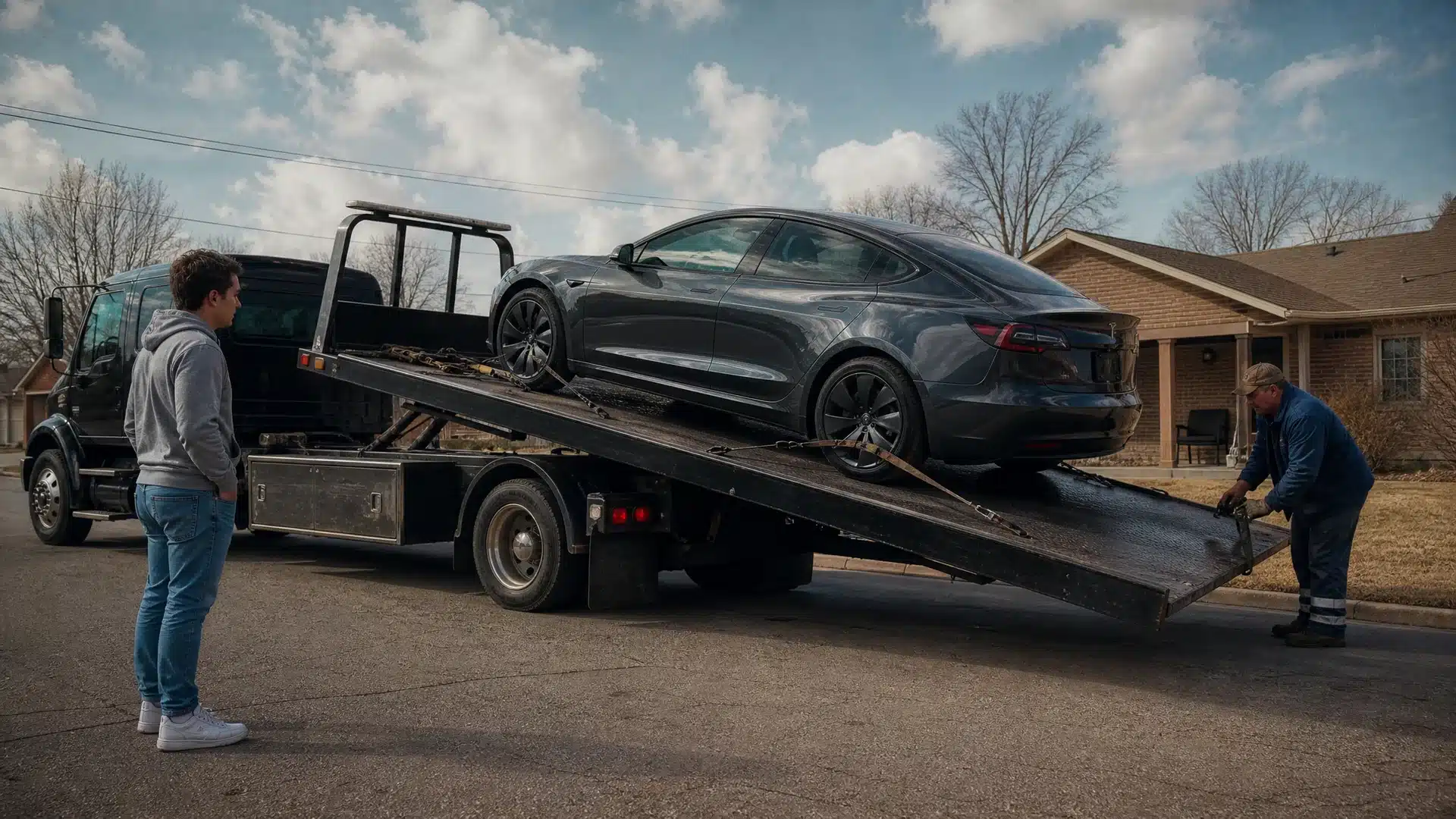
This is really the whole reason flatbed towing exists as a specialty. A flatbed lifts the entire vehicle off the ground, so none of the wheels touch pavement and the underbody stays clear of ramps, curbs, or angled driveways. For a Tesla, a flatbed isn’t a nice-to-have. It’s the only way to move the car without risking damage to the drivetrain or the battery housing.
What makes flatbed towing the right call for EVs
We’ve been doing flatbed towing around Tulsa since 2019, and Teslas have become a regular part of that work. A few things we always keep in mind on an EV call:
- Low clearance points. Tesla models sit lower than a lot of trucks and SUVs, so loading angles matter. We adjust the ramp angle and use extra care around the front fascia and rear diffuser.
- Weight distribution. The battery pack adds a good bit of weight low in the vehicle, which changes how the car needs to be secured on the deck. Straps and wheel nets have to sit correctly so the car doesn’t shift during transport.
- Neutral or tow mode. Depending on the model, getting the car into the right mode before loading matters for the parking brake and rolling the vehicle safely onto the bed.
- No ground contact. Once it’s on the flatbed, none of the four wheels touch the road again until we set it down at the destination.
None of this is complicated once you’ve done it a hundred times. But it’s exactly the kind of detail that gets missed by an outfit that mostly does regular wheel-lift towing and only occasionally handles an EV.
Common Tesla towing situations around Tulsa
Tulsa’s a spread-out city, and EV owners run into trouble in a handful of predictable spots. A few situations we see fairly often:
Dead 12-volt battery. This trips up a lot of Tesla owners because they assume the big battery pack is the problem. Often it’s actually the small 12-volt battery that runs the car’s electronics, similar to a traditional car battery. When that dies, the car can act like it’s completely dead even though the main battery still has charge.
Running out of range. Tulsa’s charging network is still filling in across the metro, so it’s not unheard of for a driver to misjudge range on a longer trip out toward Bixby or Owasso and end up needing a tow to the nearest charger.
Flat tires on low-profile wheels. Teslas often run tires that don’t leave much room for error on Tulsa’s rougher stretches of road, including some of the patchier sections downtown and near the older parts of Route 66.
Collision or accident recovery. After a wreck, an EV needs extra care just getting it loaded. Impact damage can affect the battery casing, and the vehicle may not be safe to move under its own power at all.
In every one of these cases, the fix is the same: get a flatbed out, load it properly, and get the car somewhere safe without adding a second problem on top of the first.
What to do if your Tesla needs a tow
If you’re sitting in a parking lot near Utica Square or pulled over on the shoulder of the Gilcrease Expressway wondering what to do, here’s the short version:
- Get the car somewhere safe first, off the traffic lane if at all possible.
- Call for a tow and mention specifically that it’s a Tesla or EV, so a flatbed gets dispatched instead of a standard tow truck.
- Don’t try to push, drag, or roll the car yourself, even a short distance, if the wheels won’t turn freely.
- Have your destination ready, whether that’s a charging station, a service center, or your home.
That second step matters more than people realize. Not every towing call ends up with the right equipment showing up if the dispatcher doesn’t know it’s an EV. Saying “Tesla” or “electric vehicle” up front saves everyone time.
A local, owner operator approach to EV towing
We’re a Tulsa towing company, powered by Neptune Towing, and we’ve built our business around doing this job right rather than doing it fast and sloppy. Being an owner operator means the person answering your call and the person showing up with the flatbed are working for the same reputation. There’s no corporate call center between you and the truck.
That matters a lot with Tesla towing specifically. A damaged battery pack or a scraped underbody isn’t something you can just buff out, and it’s not something we’re willing to risk on someone’s car to save a few minutes. Damage free towing isn’t a slogan for us. It’s the actual standard we hold every flatbed job to, gas or electric.
Tulsa’s roads, weather, and traffic patterns are part of daily life for us, not something we’re learning on the fly. Whether it’s a Tesla stalled near the BOK Center after a downtown event or an EV that ran low on charge out past Jenks, having a crew that already knows the area and already knows how to handle an electric vehicle means less time waiting and less risk to the car.
Final thoughts on Tesla towing in Tulsa
Electric vehicles aren’t going anywhere, and Tulsa’s roads are seeing more of them every year. Tesla towing isn’t harder than regular towing, but it does require doing things a specific way: flatbed only, no wheels on the ground, and careful loading around a low, heavy battery pack.
If your Tesla or any other EV ever needs a lift around Tulsa, the safest move is a flatbed and a crew that’s handled electric vehicles before. That’s the kind of experience that keeps a bad afternoon from turning into an expensive one.