
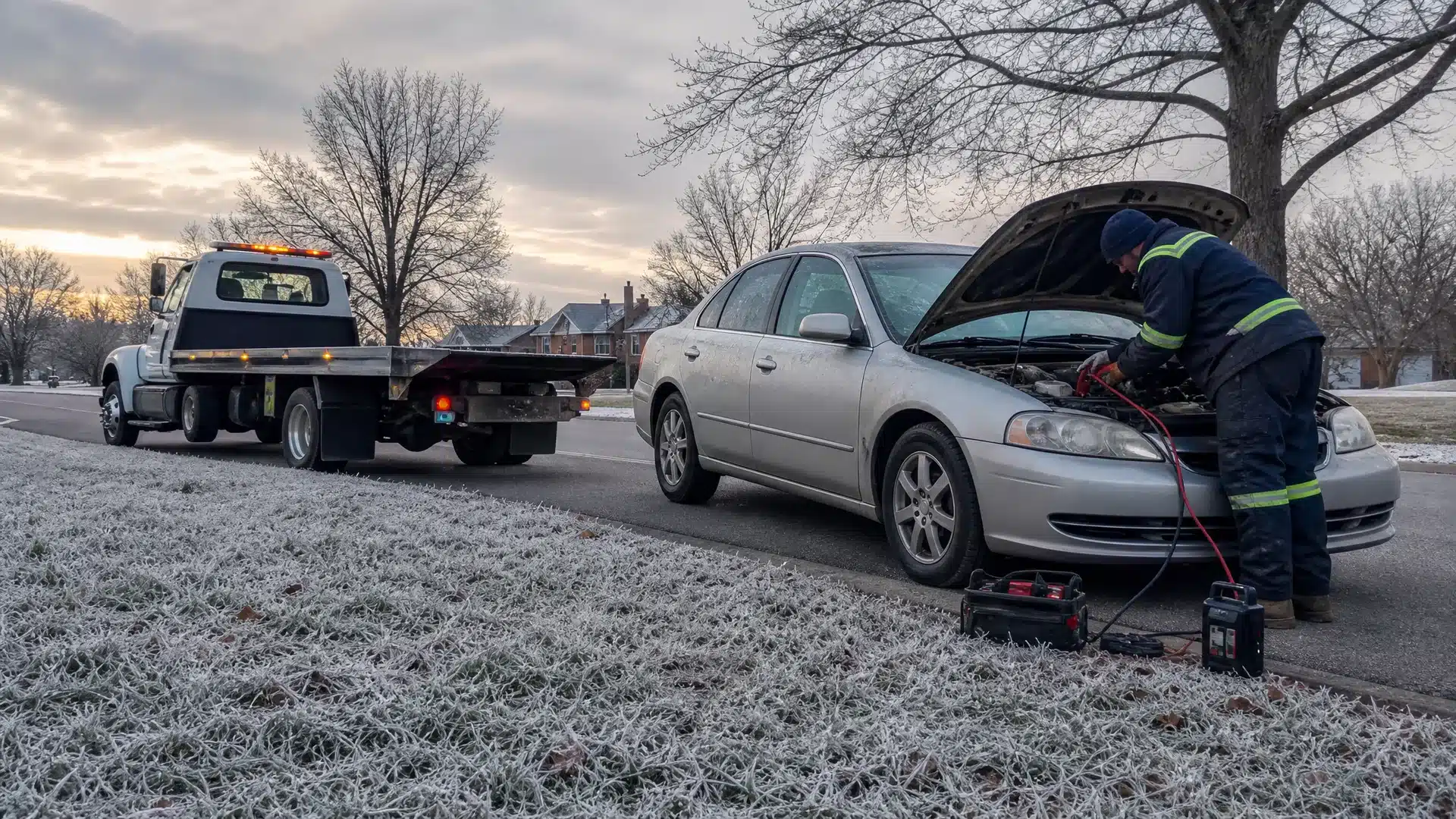
If your vehicle won’t start in cold weather in Tulsa, you’re not alone, and you’re not dealing with bad luck. Oklahoma winters have a way of exposing every weakness a car has been hiding all summer. One night of hard freeze is often all it takes to go from “runs fine” to “won’t turn over.” Here’s what’s actually happening, what you can try yourself, and when to call for help.
Why Cold Weather Hits Tulsa Vehicles Harder Than You’d Expect
Oklahoma’s Freeze-Thaw Cycle Is Rough on Cars
Tulsa isn’t Minneapolis. Drivers here don’t usually spend months bracing for deep winter, and that’s exactly why a cold snap hits so hard. Oklahoma winters swing unpredictably. You might see 62°F on a Tuesday and wake up to 18°F by Thursday morning. That temperature rollercoaster, not a sustained deep freeze, is what does the most damage.
Drivers in northern states keep their vehicles winter-prepped because they have to. Tulsa drivers often don’t bother, because most of the year, they don’t need to. So when a hard freeze rolls down from the Panhandle and settles over I-44 and the BA Expressway, a lot of vehicles simply aren’t ready.
The Most Common Cold-Weather Breakdown Causes in Tulsa
The usual suspects when a vehicle won’t start in cold weather in Tulsa:
- Dead or weak battery, by far the most common cause
- Thickened engine oil, cold oil moves slowly, putting extra load on the starter
- Fuel system issues, especially in older vehicles or diesels
- Corroded or loose battery terminals, the freeze-thaw cycle loosens connections over time
- Failing alternator, sometimes cold weather just reveals what was already going wrong
Most of these aren’t problems the cold created. The cold just made them impossible to ignore.
Cold Weather Car Battery Failure in Tulsa: What’s Actually Happening
How Cold Temperatures Kill a Weak Battery
A battery works through a chemical reaction. Cold weather slows that reaction down, meaning the battery can’t deliver cranking amps as efficiently when temperatures drop. At the same time, cold oil is thicker and harder to push through the engine, so your starter motor demands more power just when the battery can deliver less.
A fully charged, healthy battery loses a meaningful portion of its cranking power as temperatures drop below freezing. By the time temps hit the single digits, which does happen in Tulsa, even if rarely, an aging battery may not have enough reserve to turn the engine over at all.
That’s the physics. The problem for Tulsa drivers is the freeze-thaw swing that makes it worse.
Why Your Battery Seemed Fine Yesterday
A classic Tulsa winter scenario: temperatures sit in the upper 50s for two weeks, then a cold front drops overnight lows into the mid-teens. A battery that was borderline all autumn finally can’t deliver enough cranking amps on that first hard-freeze morning, and the driver is stranded in a parking lot off Memorial Drive or on the BA Expressway.
Cold weather doesn’t kill a healthy battery, it kills a weak one that was already on borrowed time. If your battery is three or more years old and you haven’t had it load-tested, an Oklahoma cold snap is often all it takes to finish it off. The warm weeks beforehand give no warning. That’s why so many Tulsa drivers are caught off guard.
This is the reality behind most cold weather car battery calls we handle in Tulsa every winter.
DIY Fixes That Work, and When They Don’t
Jump-Starting Your Car in Cold Weather
A jump start is worth trying if you have good cables and a cooperative neighbor or passerby with a healthy vehicle. Do it right:
- Connect red (positive) to the dead battery’s positive terminal first
- Connect the other red to the good battery’s positive terminal
- Connect black (negative) to the good battery’s negative terminal
- Connect the last black clamp to an unpainted metal surface on the dead vehicle, not the dead battery itself
- Start the good vehicle and let it run for 2–3 minutes before attempting to start yours
- Once your car starts, keep it running for at least 20 minutes to let the alternator recharge the battery
Check that your terminal connections are clean and tight. Corroded terminals are a common reason jump starts fail even with good cables.
When a Jump Start Isn’t Enough
There’s a point where jumping a car stops being helpful and starts being risky. Watch for these signals:
- The engine cranks weakly or not at all, even with a solid jump
- The car starts but dies again within minutes
- Warning lights come on after the jump, battery or alternator symbols especially
- You’ve already tried twice with no result
At that point, the battery may be beyond holding a charge, or the alternator isn’t doing its job. Continuing to force jumps can stress an already-failing alternator further.
Diesel truck owners face a different situation entirely. Diesel engines require significantly more cranking power than gas engines to start in cold weather, and diesel fuel can begin to gel at low temperatures, which no jump start will fix. A standard set of passenger car jumper cables won’t deliver what a diesel needs. If you’re driving a diesel and it won’t start cold, calling a professional with heavy-duty equipment is the right first move, not the last resort.
If your jump start isn’t working in Tulsa, that’s the moment to call, not after you’ve drained two batteries trying.
When to Call a Tow Truck Instead of Waiting It Out
There’s no shame in calling early. Some situations just aren’t safe or practical to DIY, and waiting makes them worse.
Call for emergency towing in Tulsa winter conditions if:
- You’ve attempted multiple jump starts and nothing is holding. The battery or alternator needs professional diagnosis, not another jump.
- Your vehicle is in a dangerous location. Stranded on the Creek Turnpike or on the I-44 corridor in icy conditions is a real safety risk. Get off the road.
- Temperatures are still dropping. If it’s getting colder and your car isn’t starting, time is not on your side.
- You’re seeing warning lights. A battery or check engine light after a no-start means something needs to be looked at before the vehicle moves.
- It’s a diesel with potential fuel gelling. This isn’t something a jump or a longer wait fixes.
- You’re not comfortable with the situation. That instinct is usually right.
When to call a tow truck in cold weather is ultimately a judgment call, but if you’ve been sitting in a cold parking lot for 30 minutes with no progress, stop waiting and make the call. Tulsa Wrecker dispatches fast, and getting your vehicle somewhere safe is almost always better than a second hour in the cold.
What Happens When Tulsa Wrecker Responds to a Cold-Weather Breakdown
Here’s how a typical call goes. A driver in South Tulsa or Broken Arrow calls in, engine won’t turn over, battery is clearly dead, or the car started once and died. The call comes in, dispatch is quick, and a truck is rolling.
When there’s an electrical fault, a drained battery that may have damaged something, or any reason we can’t safely drive the vehicle, we use a flatbed. Flatbed towing protects the drivetrain and electronics, no dragging, no stress on a vehicle that’s already having a bad day. That matters especially for newer vehicles with complex electrical systems and for EVs, which should never be towed with their wheels on the ground.
Tulsa Wrecker, powered by Neptune Towing and operating since 2019, handles cold-weather breakdown calls across Tulsa, South Tulsa, Broken Arrow, Jenks, Bixby, and Glenpool, with flatbed equipment ready for vehicles that can’t be safely hooked and towed. Diesel trucks and EVs both get appropriate handling, not a one-size-fits-all hookup.
The goal every time is damage-free towing and a driver who gets home safe. That’s it.
Staying Ahead of Cold-Weather Breakdowns in Tulsa
A little prep before freeze season goes a long way. Here’s what’s actually worth doing:
- Get your battery load-tested. Not just a voltage check, a load test tells you what the battery can actually deliver under demand. If it’s three or more years old, test it before the first cold snap.
- Check your oil viscosity. Some older vehicles still run heavier oils that thicken significantly in cold weather. Your owner’s manual will tell you what’s recommended for cold temps.
- Keep your fuel tank above half. This helps prevent moisture from accumulating in the fuel system and keeps you from running low if you’re stuck in traffic during an ice event on Peoria Ave or the BA Expressway.
- Inspect terminal connections. If there’s white or greenish corrosion on your battery terminals, clean them before winter. Corroded connections are a silent cause of cold-weather no-starts.
- Know who to call before you need them. Save a towing number in your phone now, not while you’re sitting in a freezing parking lot trying to Google it.
Oklahoma winter car breakdowns are often preventable, but when one happens anyway, fast and professional help makes all the difference. If you’re dealing with a vehicle that won’t start in cold weather in Tulsa, give Tulsa Wrecker a call. We’ll get there, we’ll handle it right, and we’ll get you moving again.