A flat tire on 71st Street or out on Highway 75 forces a quick decision, and it’s not just about finding the nearest truck. You need to know who to call for a flat tire in Tulsa, and that depends on whether your car needs a simple roadside fix or a full trip to a shop. A lot of drivers assume every disabled car needs a wrecker. Dispatching heavy equipment for a minor flat wastes time and money when a lighter service vehicle could’ve had you rolling already. Get that distinction right before you dial, and you get the right help without paying for capacity you don’t need.
Tulsa Wrecker has handled damage-free roadside assistance and towing across Tulsa, Jenks, Bixby, and Broken Arrow since 2019 under local owner-operator Remi Carrillo. We see this decision point daily. Getting it right is the difference between a twenty-minute stop and a multi-hour ordeal.
Flat Tire Roadside Help in Tulsa vs. Full Tow Truck Service
Knowing the difference between a service call and a tow saves you time when you’re already stressed and running late. A flatbed tow truck moves non-drivable vehicles over long distances. Roadside tire assistance makes your existing vehicle mobile again right where it sits. Send the wrong truck and you’ll often wait longer, because heavy wreckers are frequently tied up on accidents or recovery jobs that take hours to clear.
When a Spare Tire Change Solves the Problem
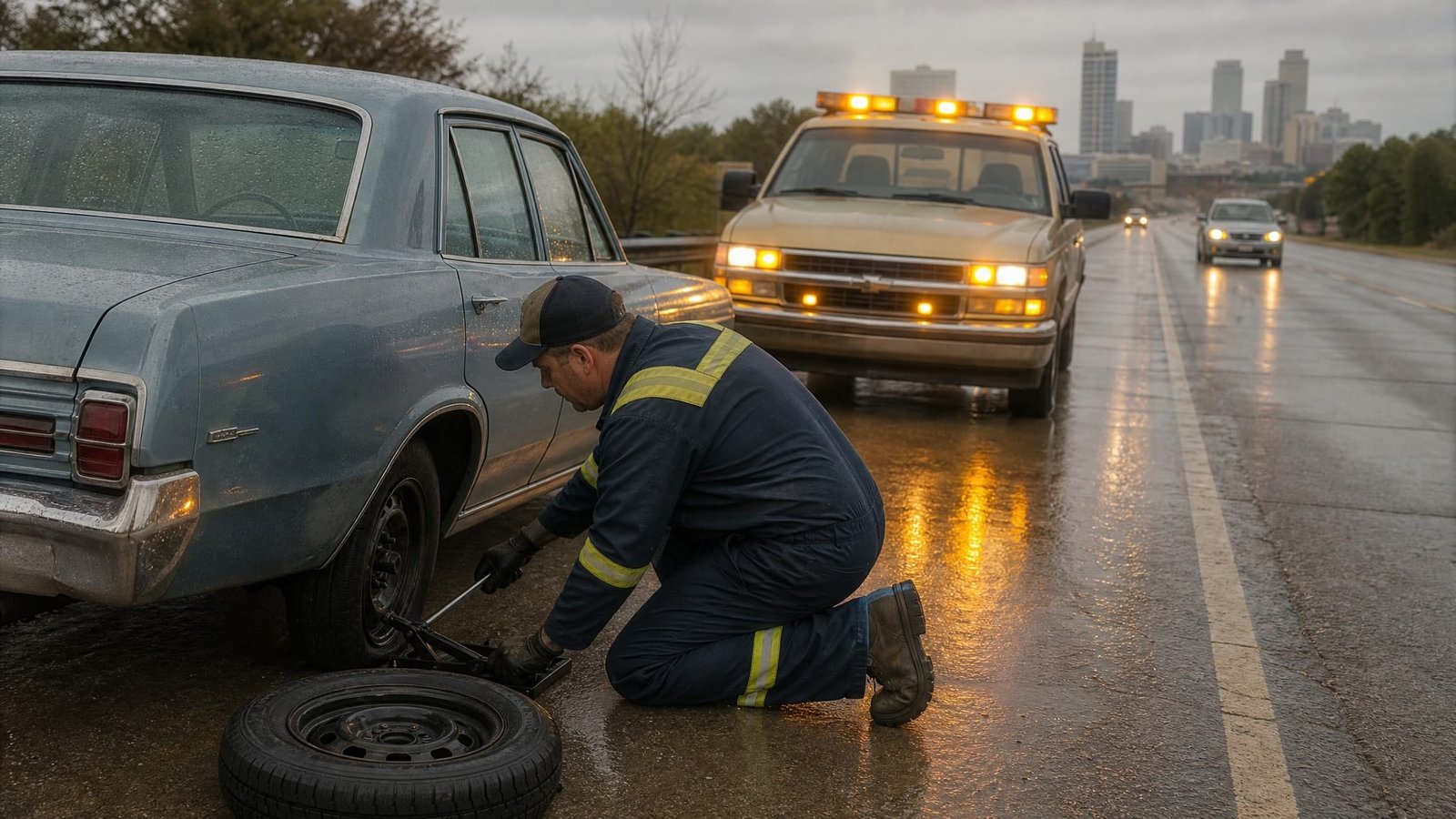
If your spare is properly inflated and your jack kit is complete, a roadside technician can swap the wheel and have you driving again within minutes. This works best when the lug nuts turn freely and the car sits on stable, level ground away from traffic. You skip the cost of a tow, and you skip the hassle of arranging a ride back to retrieve your car later.
Mobile tire service in Tulsa handles these swaps fast because the trucks carry specialized tools built for stubborn wheels, ones that get the job done without marking up your rims.
Signs You Actually Need a Flatbed Tow
Some failures go beyond what curbside tools can fix. If the wheel itself is cracked, the suspension is visibly bent, or the tire has shredded clean off the rim, no amount of roadside effort brings that car back to drivable. Some all-wheel drive vehicles need flatbed transport even for a simple flat, because the differential can’t tolerate mismatched tire diameters if you install a temporary spare.
This kind of call takes professional judgment, not guesswork. We check the mechanical condition before we commit to a repair strategy.
Mobile Tire Service in Tulsa: On-Site Repairs and Plugs
Not every puncture means a spare tire change or a trip to a shop. Modern plug kits let technicians seal many tread-area punctures permanently without pulling the wheel off the car, so you’re back on the road on your original rubber. That keeps your tire balance intact and skips the speed limits that come with a temporary donut.
What Mobile Tire Techs Can Fix Curbside
Nails, screws, and small debris in the central tread area are prime candidates for roadside plugging. The technician reams the hole and inserts a sealing compound that bonds with the tire’s interior as you drive. They can also check your air pressure and inspect for any secondary damage that might compromise safety after the puncture.
You get a permanent fix instead of a temporary one, which matters if you’ve got a long commute ahead or no easy access to a tire shop during business hours.
Limitations of Sidewall Damage and Blowouts
Sidewall failures are a different animal, and no plug or patch handles them safely. The sidewall flexes constantly under load, so any repair attempt there leaves a weak point that could fail at highway speed. A large gash, a bubble, or separation between tread and sidewall means internal damage the tire can’t come back from.
Many newer vehicles skip the spare entirely and come with a tire inflator kit instead, and those kits can’t repair a sidewall blowout or a large puncture. That’s when you need a professional to look at it. An inflator kit buys you mobility for a minor tread issue. It offers nothing for a structural failure, so you’re stuck waiting on a real evaluation either way.
Handling a Tire Blowout on Highway 75 or I-44
High-speed corridors call for different rules than surface streets, because the margin for error disappears out there. Changing a tire on the shoulder of Highway 75 or I-44 puts you right next to passing traffic, which is why professional operators move the vehicle to safer ground before starting any work. Kneeling beside a live lane while handling heavy equipment means exposure to debris strikes and to distracted drivers drifting onto the shoulder.
Oklahoma’s Move Over Law requires drivers to change lanes or slow down for stopped emergency and service vehicles. That’s the state’s own recognition of how dangerous a roadside stop really is. Even so, enforcement varies and reaction times differ from driver to driver, so we never assume the law alone keeps our crew or your family safe during a highway call.
Safe Pull-Off Spots Near Major Tulsa Interchanges
Exits and on-ramps give you wider shoulders and slower traffic than the mainline does. If your car still rolls after a blowout, coasting to the next exit ramp improves your working conditions and cuts your exposure time dramatically. Some interchanges near South Tulsa and Jenks have pull-off areas built for disabled vehicles, with concrete barriers between you and moving traffic.
We know these spots because we drive past them multiple times a shift during peak commute hours.
Why Highway Shoulders Require Professional Assistance
A DIY tire change on an interstate shoulder puts an untrained driver in a spot they can’t safely manage. Passenger vehicles don’t carry the warning lights, reflective gear, or positioning know-how that a professional crew uses to set up a safe work zone. Traffic shifts fast during rush hour, and one bad read on gap timing can end badly.
Professional roadside assistance gets the vehicle off the active roadway first and worries about the tire second, even if that means a short tow to a secure spot before any repair starts.
Spare Tire Change in Tulsa: When DIY Fails
Having a spare doesn’t mean you can install it yourself under real-world conditions. Years of corrosion, missing parts, and unfamiliar hardware can turn a simple swap into a frustrating mess that leaves you stranded longer than you’d have been otherwise. Knowing when the job’s beyond your tools saves you wasted effort and a possible injury.
For those weighing their options before calling, deciding whether to DIY or call for help depends a lot on your specific vehicle and where you’re stuck.
Dealing With Seized Lug Nuts and Missing Tools
Oklahoma’s weather swings cause steel studs and aluminum wheels to bond together over time, and that takes more torque than a standard lug wrench can deliver. Factory jacks often break or slip when forced against seized hardware, which just adds a second problem on top of the flat. Locking lug nuts add another failure point if the key’s lost, stripped, or buried somewhere you can’t find it.
Our technicians carry impact wrenches and extraction tools built for exactly this. What might cost you hours of struggle, we usually clear in minutes.
Run-Flat Tires and Inflator Kits Explained
Run-flat tires give you limited mobility after a pressure loss, but plenty of drivers don’t find out their car has them until they pop the trunk and there’s no spare. The reinforced sidewalls support the car’s weight temporarily, usually for about fifty miles at reduced speed. But drive on a deflated run-flat long enough, and it often takes internal damage that makes it unrepairable no matter how small the puncture was.
Inflator kits seal small punctures with a chemical sealant, but that sealant leaves residue inside the tire that complicates any future repair. Knowing your own vehicle’s setup before an emergency hits saves you the confusion of opening the trunk to find something you weren’t expecting.
Response Times for Roadside Tire Assistance Across Metro Areas
Wait times swing depending on operator density and how much demand is hitting the metro at that moment. South Tulsa and Broken Arrow usually see faster arrivals, thanks to more service vehicles in the area and shorter distances between calls. Outlying areas like Glenpool and Bixby can run slightly longer ETAs during peak hours, since fewer units stage out there overnight.
A local owner-operator dispatch usually beats a national call center on accuracy, because the person answering the phone knows the area instead of routing you through an algorithm. You’re talking to someone who knows what Memorial Drive looks like against Highway 169 right now, not someone reading off a generic map.
National chains promise uniform coverage, but they often just subcontract to a local provider anyway, adding a layer of communication that slows down the actual truck showing up. Call direct and you cut out the middleman.
Choosing Honest Flat Tire Roadside Help in Tulsa
Price transparency matters most when you’re stuck and can’t shop around. A reputable operator quotes you clearly before dispatch and explains anything that could change the final cost, like after-hours premiums or special equipment. Hidden fees break trust fast, and they cause arguments at the exact moment stress is already high.
Learning what to look for in a reliable provider helps you filter out the predatory operators before you ever commit to service.
Avoiding Predatory Pricing After Hours
A legitimate business keeps its pricing consistent no matter when you call. A steep surcharge for a night or weekend call is often a sign of someone exploiting your urgency rather than offering real value. Ask for the total cost, mileage and labor included, before you authorize the dispatch, so nothing surprises you when the bill shows up.
We publish our rates openly, because honest pricing is what turns a one-time call into a customer who recommends us to friends and family.
Verifying Damage-Free Equipment Capabilities
Wrong jacking points and thin wheel protection cause real damage during what should be a routine tire service. Low-profile cars, EVs, and luxury models need specific adapters and techniques that generic equipment just can’t handle safely. Ask whether your provider carries the right tools for your exact make and model before they roll up.
Damage-free work protects what you paid for your car and shows some respect for your property, even on a bad day. If you want to get real pricing without guessing, a direct conversation with a local operator gets you clarity a website never will.
Preparing Your Vehicle Before Calling for Help
A few small things while you wait cut down the service time for everyone involved. Find your spare tire kit, jack, and locking lug nut key before the technician shows up so they can start work the second they arrive. Check your owner’s manual for the jacking points and warnings specific to your model.
Turn on your hazard lights, and set out reflective triangles or flares if you’ve got them, especially in low light. Note the nearby cross streets or mile markers so dispatch can guide the driver straight to you without any back and forth. Those seeking 24/7 help in South Tulsa neighborhoods will want to mention landmarks too, since GPS can miss the mark in some residential areas.
Stay inside your vehicle with your seatbelt on if you’re on a highway shoulder. The cabin protects you far better than standing outside ever will. Understanding roadside safety laws makes clear why staying put in the car beats watching the repair happen inches from traffic.