Staring at a stranded luxury car on the shoulder of I-44, or in a driveway in South Tulsa, creates a specific kind of panic. It’s not just about getting home. It’s about whether the person showing up understands what’s underneath your car.
Choosing a towing company for a luxury car means looking past “are you available” and asking about equipment and training instead. A generic wrecker might get a sedan to a shop fine. That same truck can crack a front splitter or blow out an air suspension system in the first five minutes.
Tulsa Wrecker has run flatbed equipment built for low-clearance and luxury vehicle recovery across the Tulsa metro since 2019. We get it: your car is a serious investment, and often worth more to you than the book price says. This guide walks through what actually happens when a high-end vehicle gets loaded wrong, so you know what to ask before you hand over your keys.
Why Low-Clearance Cars Need Specialized Towing in Tulsa
Standard tow trucks are built for speed and utility, not precision. That’s a problem for a car designed around aerodynamics and a few inches of ground clearance. A traditional wheel-lift or hook-and-chain rig just isn’t built with that math in mind. Force a low-clearance car onto the wrong equipment, and you’ve found the number one cause of preventable damage on roadside calls.
Common Damage Risks for Sports and Exotic Vehicles
Front splitters, carbon fiber diffusers, extended side skirts, these are functional parts, and they sit close to the pavement. Use a truck with too steep an approach angle, and those parts are the first thing to hit the steel deck. A scrape is the good outcome. Cracked carbon fiber or a bent aluminum subframe is what happens when the loading angle is wrong. You want someone who treats every inch of clearance as a real constraint, not a suggestion.
Local Road Challenges for Luxury Car Owners
Tulsa’s own roads add to the risk when a lowered or modified car needs a lift. Steep driveway transitions in South Tulsa and ongoing construction zones create uneven surfaces where a standard flatbed can ground out mid-load. Loading a lowered sports car on Riverside Drive, for instance, takes extended ramp deployment and careful angle management just to keep the front splitter off the pavement transitions there. A driver who knows the terrain will beat a GPS-guided dispatcher every time when it comes to picking a safe spot to load. Check our notes on Riverside Drive towing challenges to see how specific corridors demand adjusted approaches.
Flatbed Towing Specialists vs. General Wreckers
The real difference between a general wrecker and a specialist comes down to the hydraulics and dimensions of the bed itself. Plenty of operators carry flatbeds. Far fewer carry one actually rated and configured for exotic or low-profile cars. That mechanical difference is the single biggest factor in whether your car leaves the scene undamaged.
Understanding Deck Angle and Ramp Length
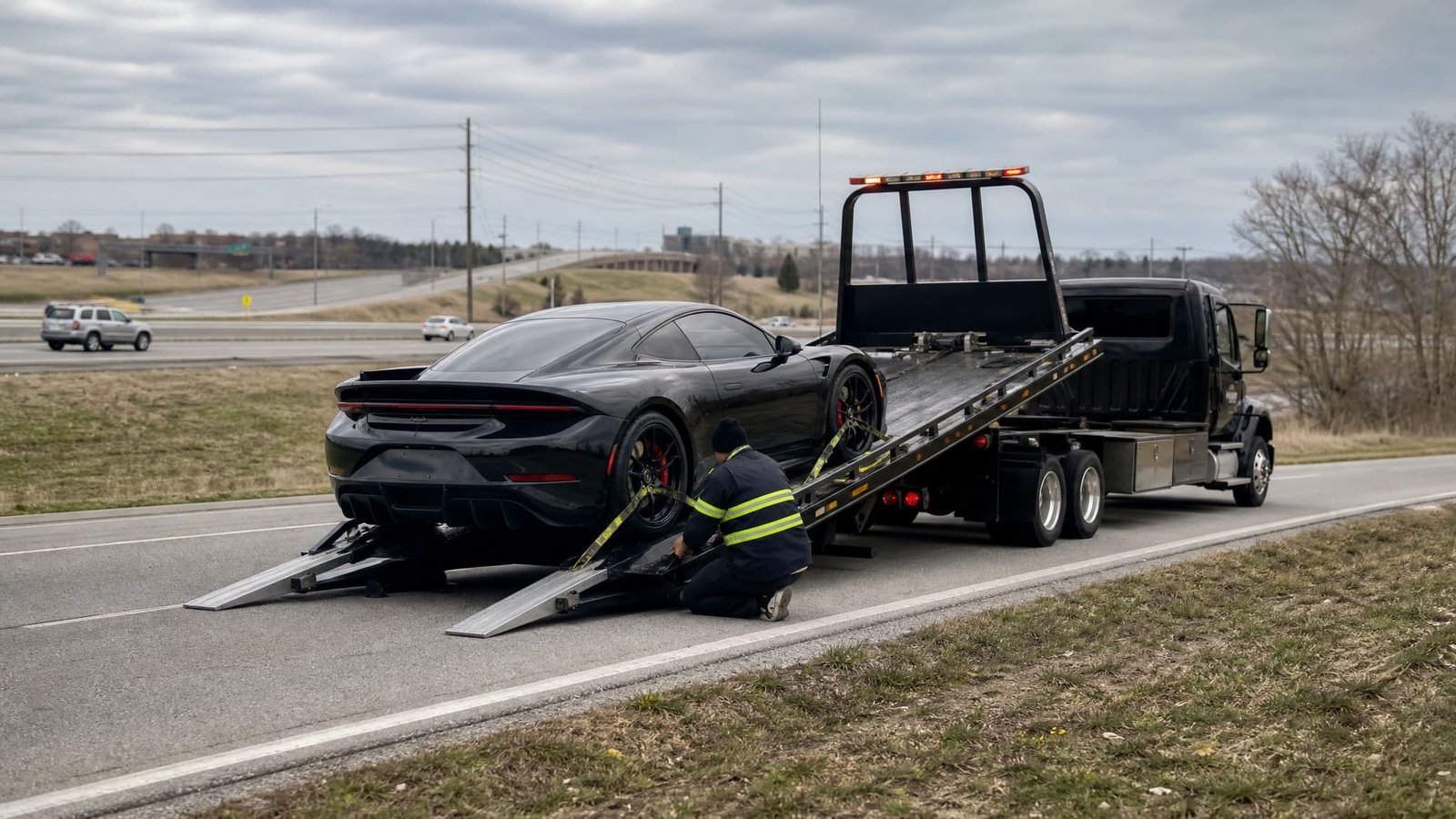
Real sports car flatbed towing needs extended ramps and adjustable tilt hydraulics, so the transition from pavement to deck stays gradual. Standard carriers often run ramp angles past fifteen degrees, which is a near-guarantee of bumper or exhaust contact on a lowered car. Specialized low-angle carriers cut that gradient way down, letting the car roll or winch on without scraping the undercarriage. That equipment costs more to buy and maintain, which is exactly why a lot of general towing outfits skip it.
Why Wheel-Lift Trucks Are Unsafe for Exotics
Wheel-lift trucks are cheap and fast, which is why they’re common for repossessions and impounds. They’re the wrong tool for luxury transport, full stop. Lift a car by its wheels, and the opposite axle drags or hangs at an unsafe angle, loading up stress on the drivetrain and suspension bushings. All-wheel-drive cars have it worse: a transfer case can suffer real damage if all four wheels aren’t spinning freely during the tow. Our flatbed-only towing approach holds the same line for motorcycles and exotics alike, because a partial fix here just becomes a full liability later.
Never accept a wheel-lift tow for a car you actually care about.
Critical Questions to Ask Before Booking a Tow
Verbal assurances feel good in the moment. Specific technical answers are what actually tell you something. Ask the right questions and you force the operator to show their knowledge instead of just their confidence. That short conversation matters more to your car’s safety than any online review.
Verifying Equipment and Operator Experience
Ask about ramp length, deck tilt range, and winch speed controls directly, rather than settling for a promise to “be careful.” Ask if they’ve personally loaded your specific make and model before. Tie-down locations vary a lot between brands, and familiarity matters. Someone who’s actually worked on exotics will describe past jobs in detail, not just recite that they’re insured and licensed. If an operator hedges or goes vague when you ask about strap placement, that’s a sign they don’t have the hands-on experience your car needs.
Confirming Insurance Coverage for High-Value Vehicles
Standard cargo insurance often caps out well below what an exotic or heavily modified car is actually worth. Ask for the specific dollar limit on their cargo policy, and ask whether it covers aftermarket parts, custom paint, or non-factory components, because plenty of policies exclude all of that. You could be left completely exposed even though it sounded like you had coverage. Requesting transparent towing pricing upfront keeps the bill from surprising you, but pricing and insurance are two different questions. Verify both. If their coverage doesn’t match what your car is worth, keep calling until someone’s does.
Safe Strap Placement and Loading Protocols
Where the straps attach matters as much as what kind of truck shows up. Modern luxury cars have specific chassis-mounted tie-down points, engineered to spread the load safely during transport. Skip those and grab a suspension arm or a plastic undertray instead, and you’re inviting a mechanical failure that might not show up for another hundred miles.
Identifying Manufacturer-Approved Tie-Down Points
Proper luxury towing means finding the manufacturer-specified tie-down points, not improvising with suspension parts, which is how you end up with alignment or brake line damage. Those points are usually hidden behind removable panels near the bumper or frame rails, and finding them takes either a service manual or real experience. Straps belong on those reinforced loops only, never wrapped around control arms, sway bars, or splash guards. Soft-tie extensions keep metal off metal, so paint doesn’t get marred and nothing structural takes a hit during transit.
Avoiding Suspension and Brake Line Damage
Air suspension needs its own attention during securing, since too much compression can rupture a bellows or damage a height sensor. Operators need to disable automatic leveling and sometimes switch on a transport mode before any tension goes on the tie-downs. Secondary safety chains and wheel chocks add redundant security instead of relying on strap tension alone, which can overstress delicate parts. A secure load isn’t a crushed suspension. Experienced drivers adjust tension for each car’s weight and ride height.
EV and Tesla Towing Considerations
Electric luxury cars bring their own complications that gas cars just don’t have. Regenerative braking, high-voltage batteries, proprietary software modes, an operator needs to understand the electrical side, not just the mechanical side of securing a load. Treat an EV like a regular car, and you’re looking at motor damage or a battery fault that voids the warranty and costs thousands to fix.
Battery Safety and Transport Mode Requirements
Manufacturers spell out exact steps for putting an EV into neutral or transport mode, which disengages the motors and stops regenerative drag during towing. Skip that step, and spinning wheels can generate electricity back into the system, which can overheat motors or damage inverters, even with the car powered off. High-voltage cables and battery cooling lines also run through spots where a normal strap placement could puncture or pinch something. Reviewing EV towing safety protocols before you actually need a tow means you can talk to the operator about your car’s specific needs on the spot. Always confirm the operator knows your exact model year. Software updates change transport procedures between years more often than people expect.
Vetting Local Owner-Operator Services
National dispatch networks optimize for coverage area and call volume, not specialized equipment or operator skill. Local owner-operators put their own name and business on the line with every job, which builds a kind of accountability a corporate fleet can’t match.
As a local owner-operator service, Tulsa Wrecker gives you direct accountability for damage-free towing, instead of routing you through a third-party dispatch network. Talk directly to the person who owns the truck and maintains the equipment, and you cut out the communication gaps that cause most preventable damage. It also means whoever answers your call knows Tulsa’s terrain firsthand and can tell you the safest place to load before the truck even shows up. For broader context on evaluating providers beyond luxury-specific needs, our guide on choosing a trustworthy towing company covers universal reliability indicators.
What to Do While Waiting for Your Flatbed
Safety and documentation both matter while you wait for the right equipment to show up. Put your hazards on and stay well clear of traffic on busy corridors like I-44 or US-75, especially if visibility is bad. Photograph your car from multiple angles before loading starts: existing scratches, wheel condition, undercarriage state, all of it, for your own records.
That documentation gives you peace of mind and a baseline if any questions come up after delivery. Stay with your car through the loading process. Watch the strap placement, and be ready to answer questions about hidden tie-down points or special settings your car needs. Your being there keeps communication flowing both ways during the minutes that matter most.
If you own a luxury, exotic, or low-clearance vehicle in the Tulsa area, save our number before you need it. Call Tulsa Wrecker at 539-292-3074 for a pre-incident consultation about your specific vehicle’s requirements, or immediate dispatch when seconds count.