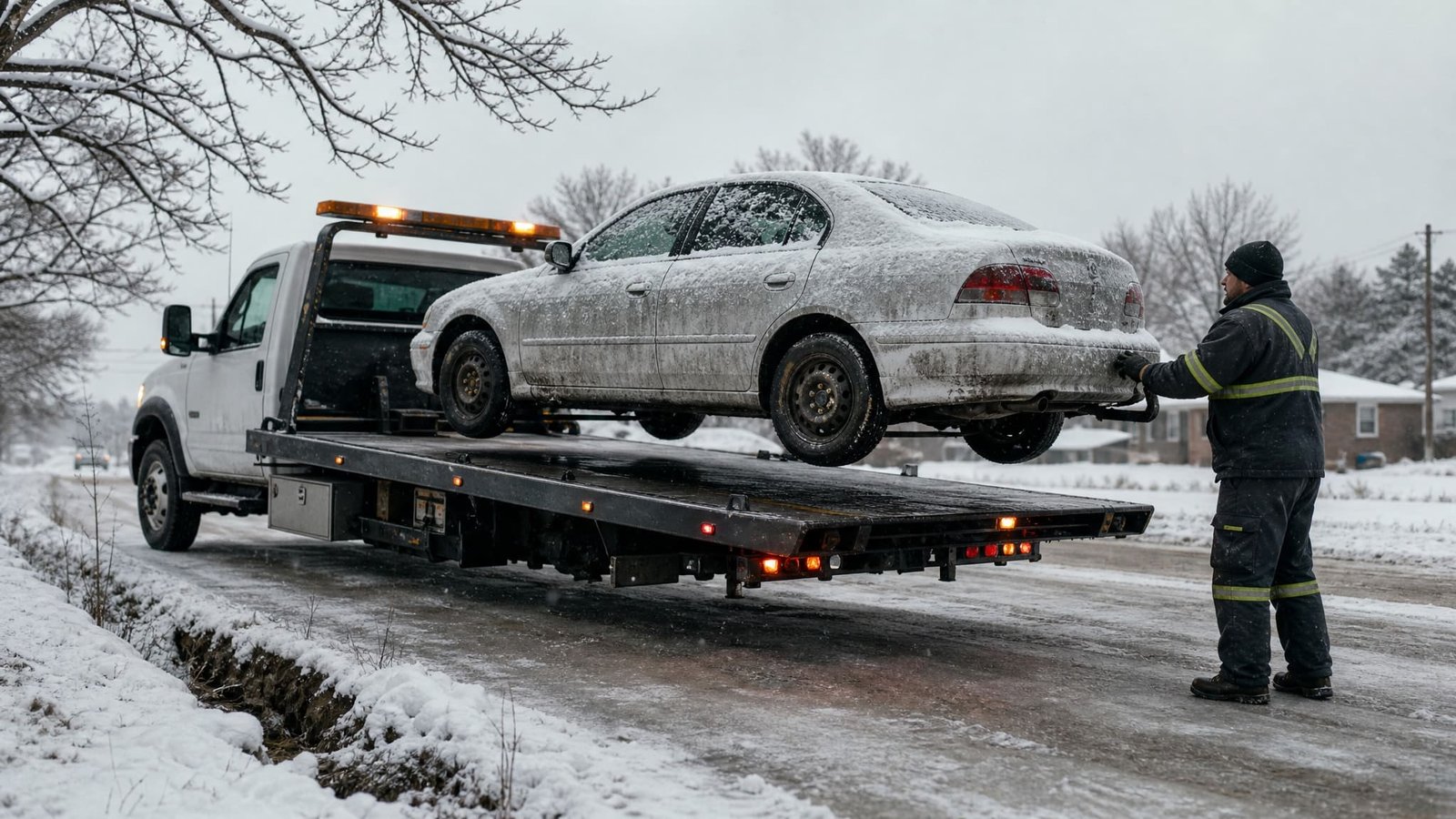
Oklahoma winter weather does not play fair, and neither does a frozen parking lot or an icy hill on South Peoria. When your tires stop gripping and your vehicle slides into a ditch or won’t move at all, you need more than a push. You need a tow truck for stuck in snow Tulsa drivers actually trust. Dragging a modern car across frozen pavement is a quick way to wreck a transmission or ruin an AWD system, so we bring flatbeds to every winter call. Tulsa Wrecker has run damage-free flatbed towing across Tulsa metro since 2019, including plenty of ice storm recoveries where lifting the vehicle completely off the ground was the only safe option.
Key Takeaways
- Flatbed towing keeps all four wheels off frozen pavement to prevent irreversible AWD and EV drivetrain damage during winter recovery.
- South Tulsa steep grades and unplowed Jenks side streets are frequent ice recovery trouble spots requiring terrain-aware dispatch.
- Stay inside your vehicle with hazards on while waiting for a tow, as standing outside on ice exposes you to secondary collision risk.
- Spinning tires for more than thirty seconds polishes ice into glass, making professional extraction necessary rather than optional.
- Call Neptune Towing at 539-292-3074 during active storms for fastest dispatch, as phone contact outperforms online booking for emergencies.
We know the stress of sitting in a cold car while traffic whizzes past on slick roads. Our team stays calm because we’ve been in that driver’s seat ourselves, and we know honest communication matters as much as the equipment we bring. Whether you’re commuting through Broken Arrow or working your way through residential streets in Jenks, getting pulled out safely without adding mechanical damage to your list of problems is the only acceptable outcome.
Why Winter Towing in Tulsa Requires a Flatbed
Frozen asphalt changes the physics of recovery work. Minor traction issues turn into major mechanical risks fast if the wrong equipment shows up. Modern AWD and EV systems can suffer permanent damage if dragged even a short distance on frozen surfaces, because the wheels can’t rotate freely against the ice, which forces torque back through locked differentials and transfer cases. You might still see hook-and-chain trucks running around town, but using one on a vehicle buried in snow or sitting on black ice invites drivetrain failure that costs far more than the tow itself.
Winter Recovery Method Comparison
| Recovery Factor | Flatbed | Hook-and-Chain |
|---|---|---|
| Wheel Contact | All wheels off ground | Drive wheels dragged |
| AWD/EV Safe | Yes | No |
| Ice Slide Risk | Eliminated | High |
| Drivetrain Damage | None | Likely |
Flatbed towing gets around this by keeping all four wheels off the ground during transport and extraction. Owner-operator Remi Carrillo puts it simply: keeping all four wheels off icy pavement prevents secondary accidents during recovery, so your car doesn’t slide sideways into a guardrail or another vehicle while it’s being winched. This method also protects your suspension from the jarring hits of frozen ruts that would otherwise hammer your control arms and struts during a drag-out. We treat your vehicle like it belongs to us, not like dead weight on a chain.
Setup takes a little longer this way. But it’s the difference between driving away later and waiting weeks for transmission repairs.
Common Ice Recovery Scenarios Across Tulsa
Every neighborhood in our service area has its own winter hazards, and they catch even experienced local drivers off guard. South Tulsa neighborhoods with steep grades see vehicles slide into ditches often during freezing rain, especially on the winding roads where braking distance disappears instantly. If you need fast response in South Tulsa during these conditions, knowing the terrain helps us park trucks strategically before the worst of the storm hits.
Residential streets in Jenks and Bixby often stay unplowed longer than main roads, which creates deep ruts that trap low-clearance sedans and crossovers. Glenpool’s hills cause a similar problem: momentum carries a sliding vehicle further than the driver expects, often ending with a bumper wrapped around a mailbox or fence post. Broken Arrow commuters deal with their own hazard when highway runoff freezes on exit ramps and overpasses, leaving invisible sheets of ice that feel perfectly dry until you tap the brakes. These aren’t hypotheticals from a safety manual. They’re the exact calls we answer every time temperatures drop below freezing and precipitation starts falling.
Safety Steps Before Your Tow Truck Arrives
Your first job after losing traction is keeping yourself and other drivers out of a second accident. Stay inside your vehicle with your seatbelt on unless you’re in immediate danger from traffic or fire. Your car protects you from sliding vehicles far better than standing on the ice ever could. Turn on your hazard lights right away to warn approaching drivers that you’re stopped in a travel lane or on the shoulder.
Call for help instead of trying to dig out or rock the vehicle free yourself. Spinning tires on ice usually just melts a deeper hole and polishes the surface into glass. Keep your phone charged and your location ready so dispatch can send the operator straight to you without burning minutes searching in bad visibility. Don’t stand behind or beside your vehicle to check for damage while traffic is still moving nearby, since secondary collisions on icy roads happen faster than anyone can react. Your safety matters more than your schedule, and no tow operator wants to roll up on a scene where the driver took a risk they didn’t need to while waiting.
Flatbed Vs Hook and Chain for Snow Recovery
The difference between these two methods gets critical fast when road grip is gone and visibility is dropping during an active storm. Hook-and-chain towing drags the wheels across the surface, which works fine on dry summer pavement but turns dangerous when those wheels can’t roll freely against packed snow or ice. The sideways forces generated during a drag-out on slick surfaces can snap axles, shred CV joints, or send the vehicle sliding into the next lane. For a deeper technical breakdown of why flatbed beats hook and chain for SUVs, especially on drivetrain protection, our dedicated guide covers the mechanical specifics.
Flatbeds solve this by winching the vehicle onto a level platform where it sits secure for the ride. This takes proper rigging knowledge and patience, especially with a vehicle wedged against a curb or buried in a drift, but it takes tire-to-ice friction out of the equation entirely. You get predictable, controlled movement instead of hoping the chains hold and the differential survives the pull. We chose flatbed-only service because we won’t gamble with your vehicle’s mechanical integrity to save ten minutes on a job.
Damage-free recovery isn’t a marketing slogan here. It’s an engineering decision we make on every dispatch.
Local Response Times for Stuck Vehicles
Weather events create surge demand that tests every towing company’s capacity, and we will never promise you a specific arrival time we can’t guarantee during a blizzard. What we do promise is honest communication about realistic wait times, based on current call volume, road conditions, and truck availability across our coverage zone. Tulsa Wrecker serves Tulsa, Broken Arrow, Bixby, Glenpool, Jenks, and South Tulsa, and we prioritize vehicles blocking traffic or sitting in an unsafe spot.
During active storms, dispatch routes trucks to the most urgent calls first and keeps everyone else posted on where they stand in line. We’d rather tell you the truth about a ninety-minute wait than quote thirty minutes and leave you stranded in the cold twice as long. Local owner-operator service means the person answering your call knows Tulsa traffic patterns and which back roads are still passable when the main streets turn to skating rinks. Trust comes from being straight with you during the chaos, not from a cheerful estimate that falls apart the second the next call comes in.
When Roadside Assistance Can’t Fix It
There’s a real difference between needing a gentle nudge and needing a full mechanical extraction from a winter mess. Light roadside assistance near me works when your tires have lost a little traction and some sand, cat litter, or gentle rocking gets you grip back without risking damage. But if your wheels spin freely without catching anything solid, or your vehicle has already slid into a ditch, embankment, or fixed object, pushing harder only makes it worse.
Deep snow ruts that swallow your wheel wells need winching power and anchoring points that a roadside kit just can’t provide. Vehicles high-centered on ice ridges or buried to the frame rails need real equipment to lift and reposition them without tearing off bumpers or exhaust components. Spin your tires for more than thirty seconds and you’ll usually generate enough heat to melt the ice underneath into a polished surface, which makes the next extraction attempt that much harder. Catching this early saves you time, saves your car, and gets you home faster than stubbornness ever will.
If you’re not sure whether your situation is a simple assist or a full recovery, just describe the conditions honestly when you call and let us make the call.
Booking Emergency Winter Towing in Tulsa
When your car is stuck in snow or ice and conditions are getting worse, picking up the phone is still the fastest way to get help moving toward you. Call Neptune Towing directly at 539-292-3074 for immediate flatbed recovery during active weather, since a live conversation lets dispatch gauge urgency and send the nearest available truck without delay. Online booking through our website works fine for scheduled, non-emergency transports, but a real emergency needs a real conversation to coordinate a safe extraction while conditions keep changing.
You can also book a tow truck online if your situation is stable and you’d rather handle it digitally, though a phone call means nothing gets lost in translation when it matters most. Have your exact location, cross streets, and vehicle description ready when you call, so operators can spot landmarks and access points even in bad visibility. Mention any injuries, traffic blockages, or hazardous positioning up front so dispatch can prioritize the call and send the right resources. We built this business to be the calm, competent voice on the other end of the line when a Tulsa winter tests your patience and your vehicle’s limits.
Frequently Asked Questions
How much does emergency winter towing cost in Tulsa?
Pricing depends on distance, vehicle size, and extraction complexity during storm conditions. Call Neptune Towing at 539-292-3074 for an honest quote based on your specific location and situation rather than generic estimates that may not apply to ice recovery.
Can I try to dig my car out before calling a tow truck?
Light digging around tires is fine if you can do so safely without entering traffic lanes, but avoid spinning tires which worsens the problem. If thirty seconds of gentle rocking fails, stop and call for professional extraction to prevent creating a polished ice surface.
Do you tow electric vehicles stuck in snow differently?
Yes, EVs require flatbed towing exclusively because regenerative braking systems and battery cooling components can be damaged by dragging wheels on any surface. Our operators are trained in EV-specific tie-down procedures and battery safety protocols during winter recovery.
What if my car is stuck in a private driveway or parking garage?
We handle residential and commercial property extractions throughout Tulsa metro, including tight spaces where maneuvering a flatbed requires precision. Describe access constraints when you call so dispatch can send appropriately sized equipment for confined-area recovery.