Modern SUVs make up over half of all passenger vehicles on U.S. roads. That’s not a trivia fact for Tulsa towing providers, it’s the whole job now. When your crossover or truck breaks down on the Broken Arrow Expressway or stalls in a Jenks parking lot, the margin for error during recovery is practically zero.
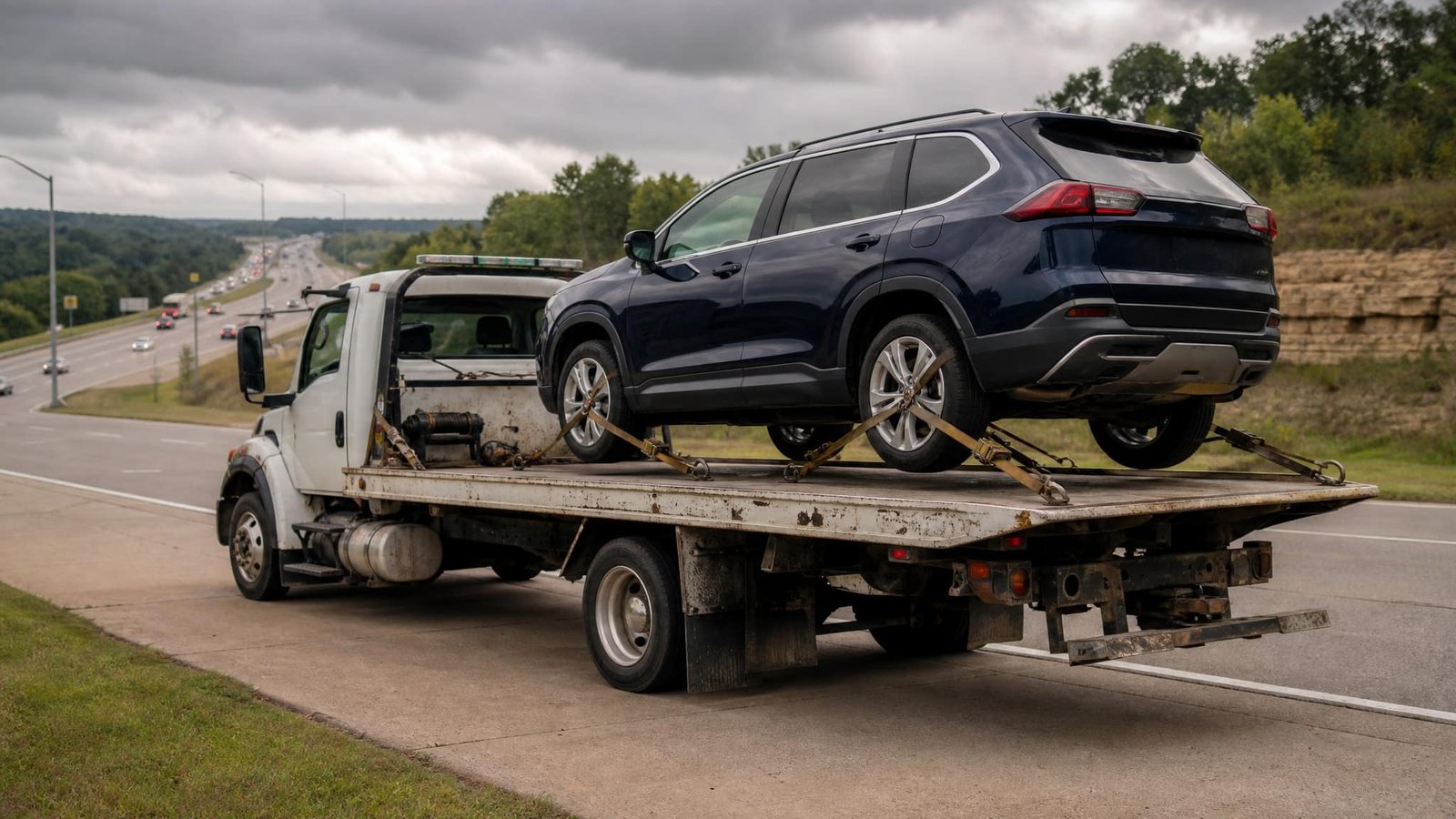
You need an operator who understands that today’s drivetrains demand specific equipment, not just the nearest available truck. As a local owner-operator serving Tulsa since 2019, we’ve recovered SUVs from Highway 75 and Riverside Drive using flatbed equipment built for damage-free transport.
Why AWD SUVs Require Flatbed Towing in Tulsa
Towing an AWD SUV with any wheels on the ground can destroy a transfer case in under five miles. That’s a $4,000 repair bill from what should have been a routine tow. That mechanical reality drives every decision we make when we respond to an all-wheel drive vehicle, because cutting corners costs a lot more than doing it right.
Protecting Drivetrains on Broken Arrow Expressway
High-speed corridors like the Broken Arrow Expressway leave no room for improvisation when your SUV fails. AWD systems need constant rotation across all four wheels, so even a short-distance dolly or wheel-lift tow generates heat and friction inside parts that were never meant to spin without engine lubrication. We use a flatbed-only towing approach for every AWD call, because keeping all four tires off the pavement is the only way to guarantee your transfer case survives the trip to the shop.
Transfer Case Risks with Hook and Chain Methods
Hook-and-chain wreckers belong to a different era of automotive design and have no business touching a modern SUV. These older methods lift one axle while dragging the other, forcing differentials and transfer cases to spin at mismatched speeds with no oil pressure protecting them. Your owner’s manual almost certainly prohibits this type of transport, and ignoring that warning voids your warranty instantly.
Flatbed Towing Specialists vs. Generic Wreckers
You deserve a driver who treats your SUV as a precision machine, not generic cargo. Generalist operators will take any job that comes over the radio. Specialized large-vehicle towing in Tulsa calls for winches rated for heavier loads and decks long enough to handle extended wheelbases without overhang.
Damage-Free Loading Techniques for Heavy SUVs
Loading a heavy SUV onto a flatbed takes patience and the right gear, especially when ground clearance is tight. We use low-angle ramps and adjustable wheel chocks to keep bumpers and suspension components from taking a hit during the winching process. Understanding how flatbed equipment actually works helps explain why our loading times run a little longer than a careless operator’s. That extra minute saves you thousands in body shop repairs later.
Securing Large Vehicles for South Tulsa Roads
South Tulsa neighborhoods and downtown parking garages are tight quarters, and maneuvering a loaded flatbed through them takes real skill. Generic wreckers often struggle here because they haven’t logged the hours navigating residential streets with oversized rigs. Our trucks are sized and driven to handle large vehicle towing in Tulsa’s tight spots without clipping curbs, mailboxes, or the car parked next door.
Tulsa Road Conditions That Challenge Large Vehicle Towing
Oklahoma roads test every tow operator, and heavy SUVs make those challenges worse. Construction zones on Highway 75 throw sudden lane shifts and uneven pavement at you, which demands careful weight distribution and braking discipline from whoever’s behind the wheel. Steep grades near Riverside Drive call for operators who understand momentum on a loaded bed, since stopping distance jumps once you’re hauling three tons of steel and aluminum uphill or down.
This approach won’t make your breakdown disappear any faster. It does mean your vehicle arrives without extra mechanical damage on top of whatever sent it to the shop in the first place. Weather and road work change conditions by the hour, so local experience beats any national dispatch algorithm.
EV and Tesla Capable Towing for Modern SUVs
Electric SUVs bring high-voltage systems and software-dependent controls that most towing training never covers. Handle them wrong and you can trigger safety locks or damage battery cooling systems, turning a simple breakdown into a much more expensive problem.
Battery Safety Protocols During Transport
High-voltage batteries need proper isolation before any tow truck touches your electric SUV. We check that traction batteries are disconnected and that no exposed cabling risks contact during loading or transit. Skip these steps and you’re looking at possible thermal events or module damage that manufacturers won’t cover under warranty.
Regenerative Braking and Tow Mode Settings
Electric SUVs like Teslas need tow mode activated to disable regenerative braking. Skip that step and you risk locked wheels and serious motor damage during loading. Every manufacturer handles this setting differently, and guessing at the procedure isn’t acceptable on a vehicle worth six figures. Our operators carry current reference material for EV models so your SUV gets switched into transport mode correctly before the winch ever engages.
Real Costs of SUV Towing in Tulsa
Flatbed service for SUVs costs more than towing a sedan. The equipment wears faster and the job takes more know-how. Heavier vehicles burn more fuel, need stronger winch cables, and take longer to secure safely, and all of that factors into honest pricing. We don’t hide behind vague estimates or surprise fees once we show up, because trust is worth more than winning a job on a lowball number.
When you need to get a real flatbed price fast, transparency should be the baseline, not a bonus. Distance, vehicle weight, and how complicated the recovery is all shape the final rate, and we walk you through each piece before we ever dispatch a truck.
Choosing a Trustworthy Local Operator Over National Apps
National dispatch apps care about proximity, not capability, and that’s a real risk if you drive an AWD or electric SUV. An algorithm can’t tell you whether the nearest truck actually carries the right ramps or whether its driver knows how to put your vehicle into tow mode. You can read more about local operator advantages over national apps to see why a human on the phone beats an automated match for anything complicated.
Verifying Flatbed Equipment Before Dispatch
Always ask straight out whether the truck they’re sending is a true flatbed before you agree to service for an AWD vehicle. Some companies list “flatbed” as a category but send a wheel-lift truck with add-on accessories that still drags a driven axle. Confirming the equipment type upfront saves you from secondary damage, and from the frustration of watching the wrong truck pull up.
Local Knowledge vs. Algorithmic Dispatching
Local ownership means the person answering your phone has actually driven the routes your tow truck will take. We know which highway shoulders are stable enough to load from and which intersections flood in a storm, details that never show up in a dispatch database. Choosing a provider for high-value vehicles should always mean checking that real local experience is behind the name on the truck.
When to Call for Professional SUV Roadside Assistance
DIY fixes on a modern SUV’s electronics often cause more harm than good, especially on a busy Tulsa road. Transmission, braking, and stability control are all tied together now, which makes roadside troubleshooting risky without the right diagnostic tools. If your SUV throws a drivetrain warning, won’t shift out of park, or shows electrical faults after a dead battery, a flatbed is safer than forcing a restart or changing a tire on the shoulder.
Knowing where that line is protects your vehicle and you. Call Tulsa Wrecker at 539-292-3074 for damage-free SUV towing across Tulsa, Jenks, Bixby, Broken Arrow, Glenpool, and South Tulsa, available 24/7 with honest pricing and real local experience.