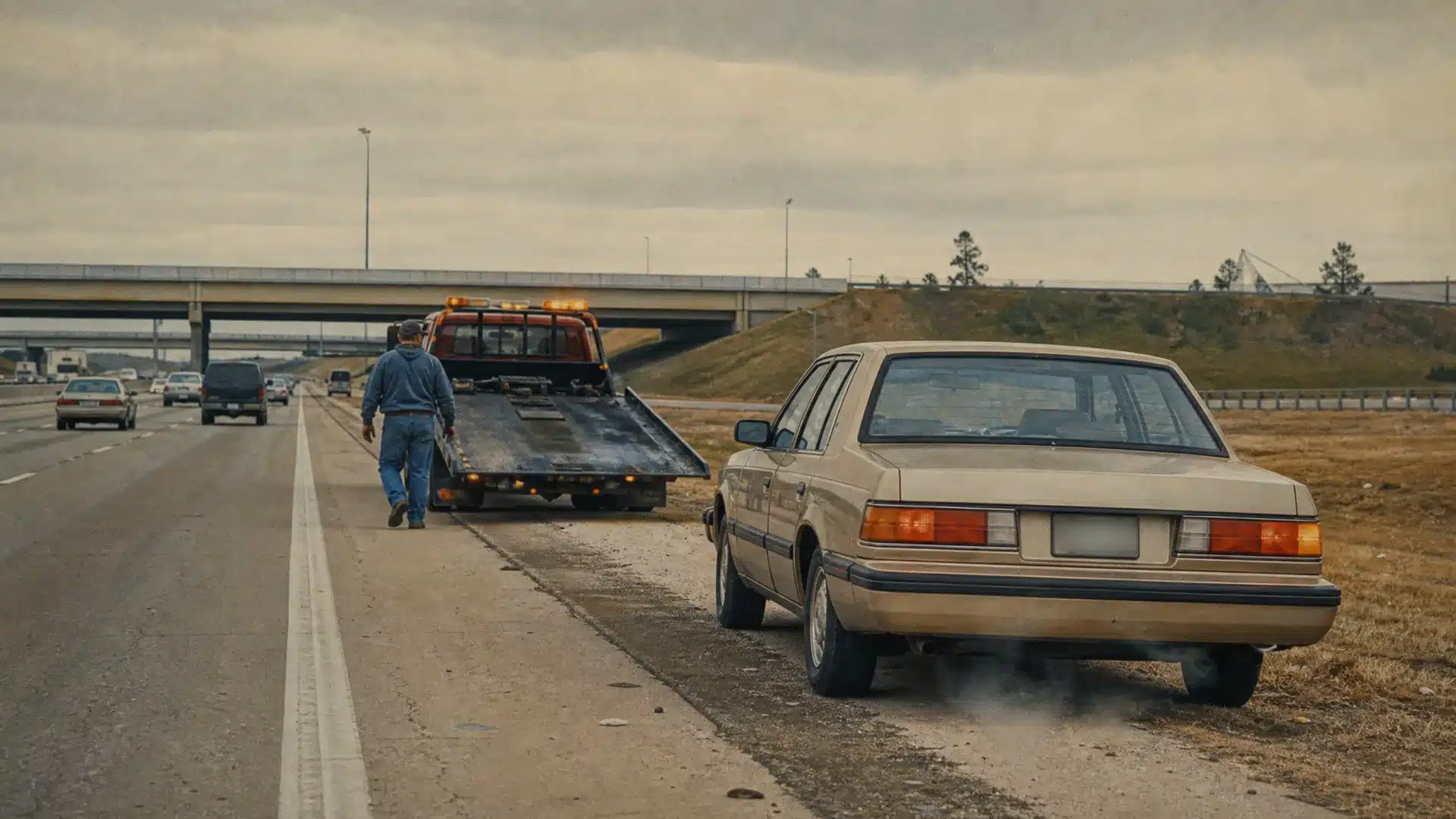
If your car broke down on the highway, the first thirty seconds matter most. The decisions you make right away, where you steer, whether you stay in the car, what you turn on first, directly affect how safe you are while you wait for help. This guide is built for Tulsa drivers on the roads most of us use every day: I-44, I-49, and US-75. Skip the generic national advice. Here’s what actually applies when you’re stranded on a Tulsa highway.
Stay Calm and Get to a Safe Place to Pull Over
The moment something feels wrong, a blowout, sudden power loss, a warning light paired with a rough ride, signal right immediately. Don’t hesitate. Even if you’re in the far left lane, start moving right steadily and let other drivers adjust around you. Your goal is the right shoulder or the nearest exit ramp.
Where to Pull Over on I-44, I-49, and US-75
On I-44 near the Tulsa IDL interchange, the inside lanes carry fast-moving traffic with very little margin. If you lose power there, coasting to the right shoulder or the next exit ramp, Peoria Ave or Harvard Ave, can mean the difference between a manageable situation and a genuinely dangerous one. Aim for exit ramps whenever the vehicle has enough momentum. Ramps give you a wider stopping area away from highway traffic.
On I-49 through South Tulsa and into Jenks, the shoulders are generally adequate, but traffic speed stays high. Pull as far right as possible, ideally past the white fog line, and aim for a wide, flat section of shoulder rather than stopping near a curve or overpass.
On US-75 south of 71st Street through Bixby, the right shoulder narrows significantly in several stretches. If your vehicle can still coast, push toward the 91st Street or 101st Street exit. Breaking down between those exits with a narrow shoulder puts you close to fast-moving traffic, so getting to an exit ramp is worth the extra distance.
What If You Can’t Make It to the Shoulder?
Sometimes the car decides for you. If you’re stuck in a travel lane, don’t try to push the vehicle in moving traffic. Turn on your hazard lights immediately, stay inside the vehicle with your seatbelt fastened, and call 911. Tulsa dispatch can alert other drivers through highway message boards and send a patrol unit to protect your position. A stopped car in a live lane is a serious hazard, your seatbelt and the vehicle’s structure are your best protection until help arrives.
Highway Breakdown Safety: What to Do Once You’re Stopped
You’ve made it to the shoulder. Now slow down and think through the next steps carefully.
Hazard Lights, Reflective Triangles, and Staying Visible
Hazard lights go on first, before you do anything else, even before you pick up your phone. Then angle your front wheels toward the ditch or the shoulder edge. If your car gets hit from behind, that wheel angle helps direct the vehicle away from traffic rather than back into it.
If you carry reflective triangles or road flares, place them behind the vehicle at increasing distances: roughly 10 feet, 100 feet, and 300 feet back. This matters especially at night or in low-visibility conditions. On high-speed corridors like I-44 and US-75, other drivers may be traveling at 70-plus mph and need as much warning distance as possible.
Should You Stay in the Car or Get Out?
This one depends on the situation. Staying inside is generally safer on high-speed Tulsa highways because it keeps a steel barrier between you and passing traffic. The shoulder on I-44 and US-75 can be narrow enough that standing outside puts you dangerously close to the travel lane.
Exit the vehicle only when staying inside becomes more dangerous, if you smell burning, see smoke, or the vehicle is on fire. If you do exit, move well away from the roadway, behind a guardrail if one is available. Never stand between your car and oncoming traffic. If the shoulder has a grass area or embankment, that’s where you want to be while you wait.
What to Do When Your Car Breaks Down: Assess Before You Act
Once you’re safely stopped and visible, take a quick mental inventory. Understanding what went wrong helps you decide whether to call a tow truck, wait for a family member, or handle it yourself.
Quick Checks You Can Do Safely (and Ones You Shouldn’t)
These are safe to assess from inside the vehicle or from the passenger side away from traffic:
- Flat tire: You’ll usually feel it before you see it. If you have a spare, the tools, and you’re on a wide, safe shoulder away from moving traffic, a tire change is manageable. On a narrow I-44 or US-75 shoulder, it’s not worth the risk.
- Dead battery: If the car won’t start and the dash lights are dim or dead, a jump-start from a family member or roadside contact may be all you need.
- Overheating: If the temperature gauge is pegged and steam is coming from the hood vents, don’t open the hood. Let it cool and call for help.
Don’t pop the hood on an active highway shoulder unless you can do so from the shoulder side completely clear of traffic. It’s not worth it.
Warning Signs That Mean the Car Isn’t Moving Under Its Own Power
Some situations take the decision out of your hands. If you see or smell any of the following, the vehicle needs a tow, full stop:
- Burning smell or visible smoke from under the hood: Exit the vehicle immediately and move well away from the roadway. On high-speed Tulsa highways, this is not a situation to troubleshoot yourself.
- Fluid pooling under the car: Coolant, oil, or transmission fluid means something has failed internally.
- Grinding, clunking, or complete loss of drive: If the wheels aren’t responding or the engine cuts out entirely, the vehicle isn’t going anywhere safely.
- Collision damage, even minor: Structural damage can affect steering and braking in ways that aren’t obvious until you’re moving again.
When to Call a Tow Truck vs. Waiting for Family or Help
Towing isn’t always necessary. Here’s a straightforward way to think through it.
Waiting for family or a friend makes sense when:
- You have a flat tire, a spare, and you’re on a safe surface street or wide shoulder
- You need a jump-start and the battery issue is likely minor
- The vehicle is fully off the roadway and you’re in no immediate danger
- It’s daytime, visibility is good, and help is close by
Call a tow truck when:
- The vehicle is undrivable or the engine won’t start after multiple attempts
- You’re on an active highway lane or a narrow shoulder with traffic passing close
- There’s visible damage, smoke, fluid spills, or a burning smell
- It’s late at night and the area is unfamiliar or poorly lit
- You’re unsure whether the vehicle is safe to drive, don’t guess with that one
For honest towing pricing in Tulsa, knowing what to expect upfront removes one more stressor from a bad situation. And if you need an emergency tow truck near you in Tulsa, a local operator can reach most Tulsa-area highways faster than a national dispatch chain.
Roadside Emergency Tips Specific to Tulsa Highways
A few things worth knowing if you drive Tulsa roads regularly:
Know your mile marker. When you call for local roadside assistance in Tulsa, the most useful thing you can tell dispatch is your mile marker. On a busy corridor like I-49, it cuts response time noticeably because the driver heads straight to your position rather than hunting for your vehicle. Mile markers are on small green signs on the right shoulder, look for one as soon as you stop.
Cell service on US-75 south of Tulsa. There are dead zones on parts of US-75 south of the city. If your call drops, try again after a moment or use a passenger’s phone. If you can’t get a signal, turn on your hazards and wait, ODOT assist trucks do run some corridors during peak hours.
ODOT highway assist. The Oklahoma Department of Transportation operates roving highway assist trucks on some Tulsa-area corridors during peak travel periods. These trucks can help with minor issues like fuel or a tire change. They’re not always available, though, and for a serious breakdown on a highway like I-44, a professional tow is still the right call.
Tulsa Wrecker covers Tulsa, Jenks, Bixby, Broken Arrow, and Glenpool, so wherever you end up on these corridors, you’re in the service area.
Disabled Vehicle Help: What to Expect When the Tow Truck Arrives
A lot of drivers feel anxious waiting on the shoulder, especially at night. Knowing what happens next helps.
When you call, the dispatcher will confirm your location, so have your mile marker and direction of travel ready (northbound, southbound, etc.). The driver will call or text when they’re close, so you know when to watch for the truck.
On a highway pickup, a flatbed is the right tool for the job. Flatbed towing is the safest option on a highway because the vehicle rides entirely on the deck, no dragging, no stress on the drivetrain, no damage to the underbody. That matters especially for all-wheel-drive vehicles and EVs. Tulsa Wrecker’s flatbed trucks, powered by Neptune Towing, are equipped to load safely from tight highway shoulders without putting your car at risk.
Once loaded, the driver will confirm your destination and get you moving. The whole process is straightforward.
If you drive Tulsa highways regularly, save this number now: 539-292-3074. That’s Remi Carrillo and the Tulsa Wrecker team, local owner-operators serving Tulsa drivers since 2019. When your car breaks down on the highway isn’t the time to search for someone you can trust. It’s the time to call them.