
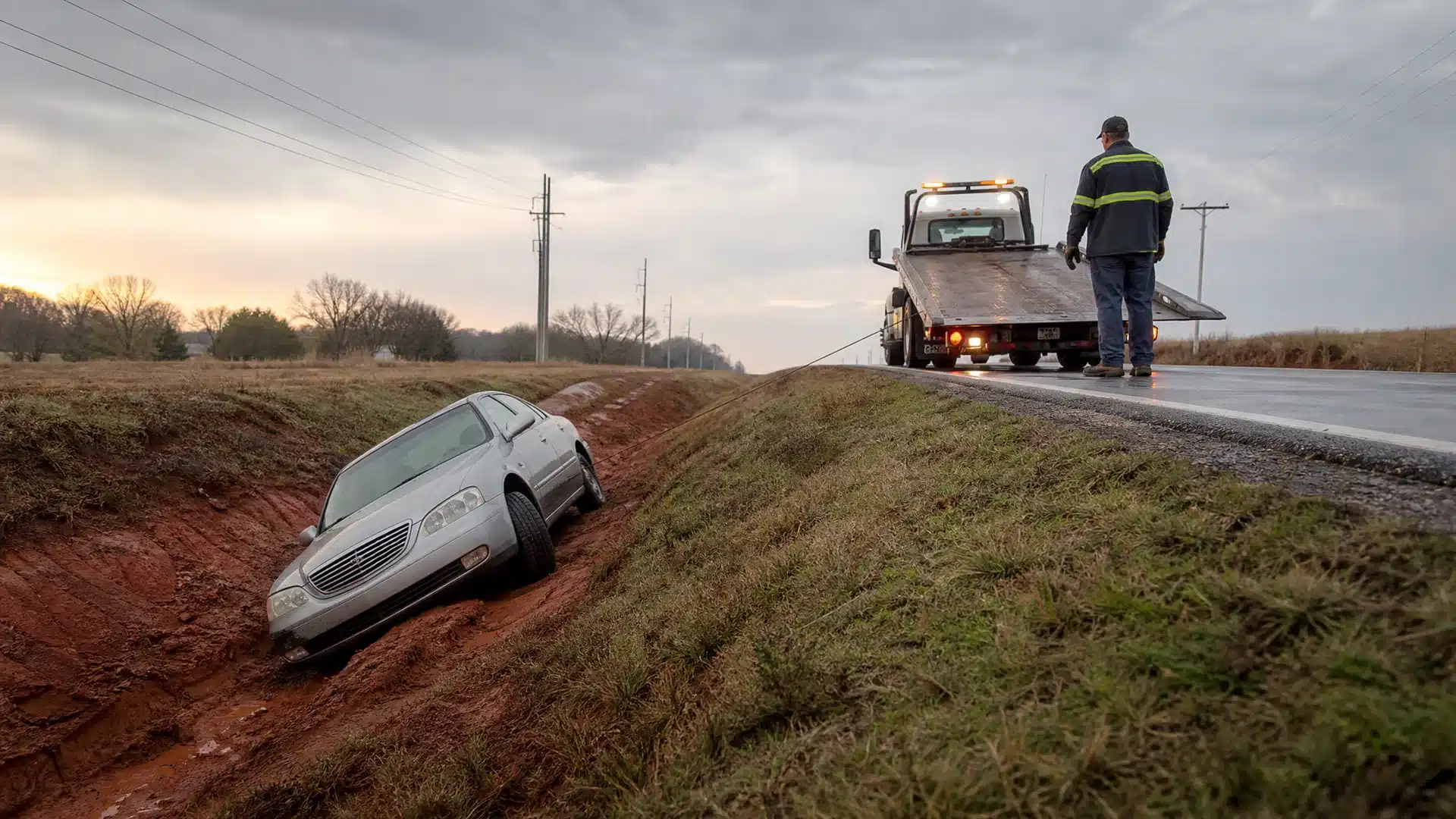
Getting your car stuck in a ditch is one of those situations that hits you all at once, embarrassment, stress, and the sinking feeling that your day just got a lot worse. Take a breath. You’re not alone, and this is fixable. Whether you slid off a wet shoulder or dropped a tire into a drainage channel, the right steps now will make the difference between a quick recovery and a costly repair.
Take a Breath, Getting a Car Stuck in a Ditch Happens More Than You Think
Tulsa roads have a way of catching drivers off guard. South Tulsa corridors, the soft shoulders along Jenks road cutoffs, and the drainage ditches near Broken Arrow’s edge roads all see stuck vehicles regularly, especially after rain. The clay soil here doesn’t drain fast, and what looks like a solid shoulder can swallow a tire before you even react.
From the calls we run at Tulsa Wrecker, a good chunk of our stuck-vehicle responses happen on soft shoulders and drainage ditches across South Tulsa, often after rain. The good news: most of these recoveries are straightforward when handled correctly. The vehicles that come out with zero damage are almost always the ones where the driver stopped early and made the right call.
This isn’t a disaster. It’s a problem with a solution.
Assess the Situation Before You Touch the Gas
The worst thing you can do right after getting stuck is immediately floor the accelerator. Before anything else, figure out where you are and what’s around you.
Check for Safety First
The moment the vehicle stops, flip on your hazard lights. If you’re on a busy road, what to do when your car breaks down on a Tulsa highway covers this in more detail, stay inside the vehicle if traffic is moving nearby. A stopped car in a ditch is visible. A person standing behind it is not.
If you’re on a quiet side road or a rural stretch east of Tulsa, you have more room to step out safely. But stay well off the travel lane and never stand directly behind the vehicle.
Evaluate How Deep or Angled the Car Is
Walk around the vehicle carefully and look at a few things:
- Tilt and lean. Is the car sitting level or leaning significantly to one side?
- Underbody contact. Is the frame or underbody resting on the ditch edge?
- Fluid leaks. Any oil, coolant, or fuel visible underneath?
- Tire damage. Are all four tires still intact and making ground contact?
If the car is tilted more than a few degrees, resting on its frame, or leaking fluid, skip self-recovery entirely. Call a professional vehicle extraction service before you make things worse.
Safe Self-Recovery Methods for a Stuck Vehicle
If the vehicle is relatively level, all tires have contact with the ground, and the ditch is shallow, you may be able to free it yourself. The key word is carefully.
The Rock-and-Release Technique
Rocking works by using the vehicle’s own momentum to walk it out. Here’s how to do it without causing damage:
- Shift into Drive, apply gentle throttle until the car moves slightly forward, then release.
- Shift into Reverse, apply gentle throttle until it moves slightly back, then release.
- Repeat in a smooth rhythm, letting momentum build each cycle.
The critical rule: short bursts only, no hard acceleration. Spinning your wheels hard in mud or soft soil doesn’t free the car, it digs deeper and can overheat an automatic transmission within minutes. The most expensive ditch recoveries we handle are the ones where the driver tried to power out for too long before calling for help.
If you’re not making progress after four or five gentle attempts, stop. You’re past the point where self-recovery helps.
Using Traction Aids (Floor Mats, Sand, Gravel)
If the tires are spinning on slick soil, adding traction under the drive wheels can make a real difference. Jam a floor mat, small piece of cardboard, or a handful of gravel directly in front of (or behind) the spinning tires, depending on your exit direction.
This works well in shallow, dry-ish situations. In deep mud or standing water, don’t count on it. The moment your effort stops making progress, stop trying.
When to Call a Car Stuck Recovery Professional
Some situations are beyond safe self-recovery, and pushing past that line costs real money. Here’s when to call a 24/7 emergency towing in Tulsa professional instead:
- Deep mud or standing water around the tires, the suction alone will fight you.
- Significant tilt or lean, the vehicle can shift further or roll with the wrong force applied.
- Underbody resting on the ditch edge, any wheel spin grinds the frame against the ground.
- AWD or 4WD vehicle already fully committed, four-wheel drive trucks are not immune. Drivers often trust the system longer than they should, and by the time all four wheels are buried, no amount of drivetrain technology will help. A proper off-road recovery setup is the only safe option at that point.
- You hear scraping from underneath, stop immediately.
A safe vehicle recovery by a flatbed or wrecker costs far less than a transmission repair, drivetrain damage, or bent frame rail. Roadside ditches and soft-shoulder drop-offs are among the most common non-collision incidents that generate tow calls in the Tulsa metro. The ones that turn expensive are nearly always the cases where the driver kept trying past the warning signs.
Think of roadside assistance in Tulsa as the cheaper option, not the last resort.
What Happens When the Tow Truck Arrives
A lot of drivers feel anxious when the tow truck pulls up, like they’ve handed control to a stranger. Here’s what actually happens so you know what to expect.
The operator walks the scene first. He checks the ditch angle, the vehicle’s lean, what the ground is doing under the tires, and where the attachment points are on the vehicle. That assessment takes two minutes and shapes everything else.
Depending on the situation, the approach is either a direct winch pull, using proper rigging and a snatch block when needed to control the angle of force, or a flatbed positioned to load the vehicle directly. Understanding how flatbed towing works in Tulsa helps explain why this method protects vehicles that a wheel-lift could damage.
One situation that comes up often: a driver slides off a wet shoulder on Memorial Drive near 91st Street. The ditch looks shallow, but the soft creek soil means all four wheels lose contact almost immediately. Rocking makes it worse. A flatbed with a snatch block gets it out in under twenty minutes with no undercarriage damage. That’s the goal every time.
The key difference between a professional extraction and a DIY yank from a friend’s truck: controlled angle, proper rigging, no dragging. For tighter situations, the comparison of flatbed vs. wheel-lift recovery is worth understanding before you decide what kind of help to request.
Off-Road Recovery and Stuck Vehicle Help Around Tulsa
Not every stuck vehicle is a roadside ditch situation. Tulsa Wrecker handles car stuck recovery across a range of scenarios, muddy fields after an event, creek crossings on rural property roads east of Tulsa, unpaved turnoffs in Bixby and Glenpool, and soft pull-offs throughout the South Tulsa area.
Our service area covers Tulsa, Jenks, Bixby, Broken Arrow, Glenpool, and the surrounding metro. If you’re stuck somewhere that feels off the beaten path, call anyway. We’ve pulled vehicles out of spots that most standard tow calls never see.
If your car is stuck in a ditch and you’re done fighting it, give us a call at 539-292-3074. We’re local, we’re fast, and we use affordable tow truck service in Tulsa pricing with damage-free techniques. No yanking, no guessing, just a calm, experienced operator who’s handled this exact situation more times than we can count.
You don’t have to stay stuck. Call Tulsa Wrecker / Neptune Towing at 539-292-3074 and we’ll get you back on the road.