Not every tow truck is built the same, and not every tow job should be handled the same way. When your car breaks down on the side of Memorial Drive or you blow a tire near the I-44 interchange, how your vehicle gets moved matters, sometimes a lot. Understanding flatbed vs wheel lift towing isn’t just trivia. It can be the difference between your car arriving at the shop in the same condition it left the roadside, or arriving with a new problem you didn’t start with.
Here’s a plain-language breakdown of both methods, when each one makes sense, and what to ask when you call a tow truck in Tulsa.
The Real Difference Between Flatbed and Wheel Lift Towing
How a flatbed works
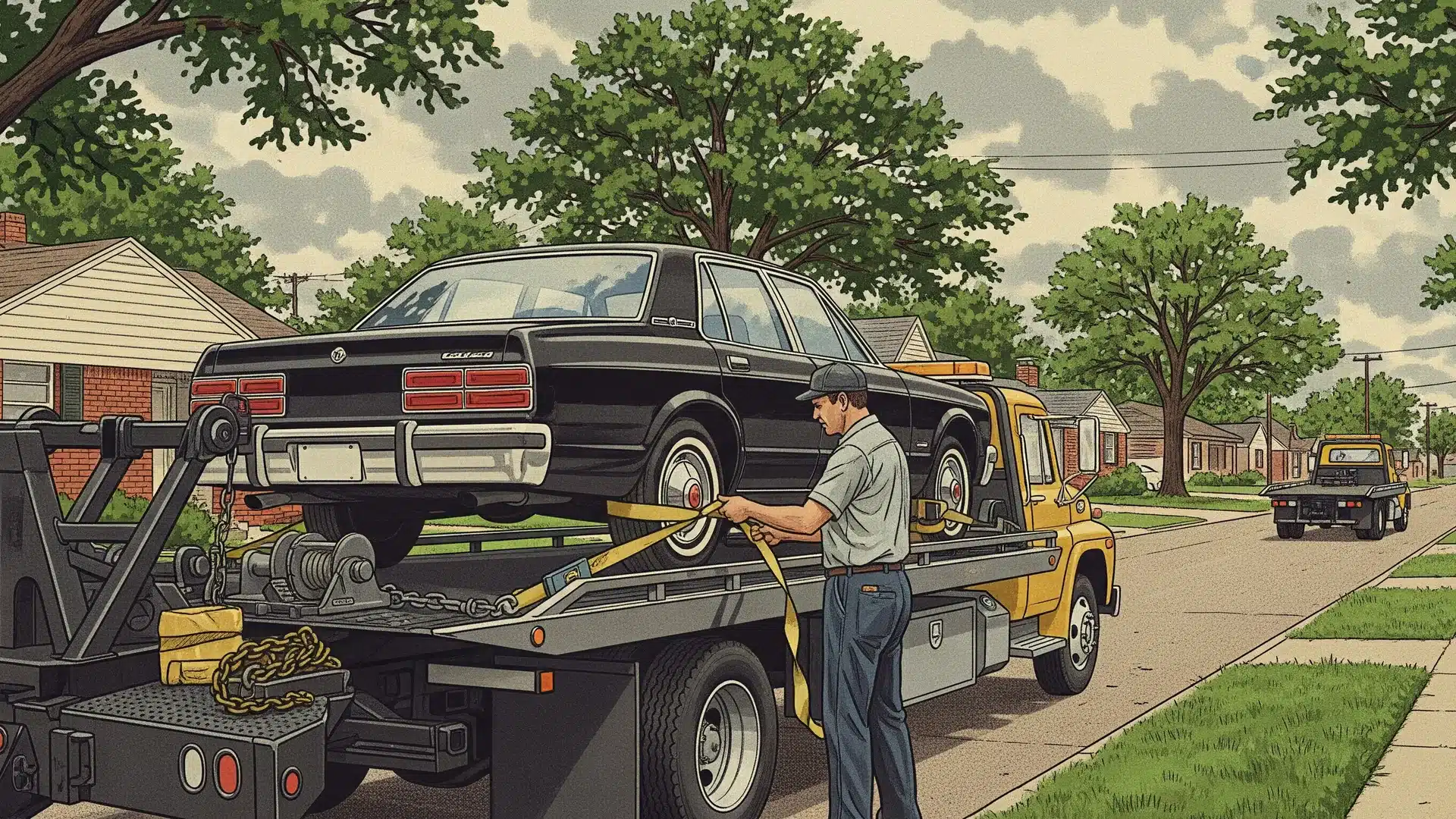
A flatbed tow truck has a long, flat platform on the back that tilts down to road level. Your vehicle drives or rolls onto the deck, and all four wheels are strapped down securely. The entire car rides elevated, with no part of it touching the asphalt during transport. For a closer look at the equipment and process, check out how flatbed towing works in Tulsa.
How a wheel lift works
A wheel lift truck uses a metal yoke that slides under either the front or rear tires. It lifts one end of the vehicle off the ground while the other end rolls on its own wheels. The car moves along on two tires for the duration of the tow. It’s faster to hook up and works fine in the right situations, but “the right situation” matters more than most people realize.
When Wheel Lift Towing Works Fine
Wheel lift towing has a legitimate role. For a standard front-wheel-drive sedan with decent ground clearance, say, a Honda Civic or a Chevy Malibu with an intact drivetrain and all four tires holding air, a short wheel lift tow is generally fine. A quick move around midtown Tulsa or a short haul down Peoria Avenue to a nearby shop is exactly the kind of job a wheel lift handles without issue.
It’s also faster to set up in tight spaces, which can matter when a disabled car is partially blocking a lane on a busy street. For standard vehicles in low-clearance, low-stakes situations, a wheel lift truck is a reasonable call.
The limits kick in when the vehicle type, drivetrain, or ride height doesn’t match what a wheel lift was designed for. That’s where things get expensive.
Vehicles That Need Flatbed Towing (And Why)
Sports cars and lowered vehicles
Ground clearance is the first problem. A lowered Dodge Charger or modified Mustang, both common on Tulsa streets, sits close enough to the ground that even a careful wheel lift hookup risks scraping the front air dam or bumper cover on the approach ramp. Those parts aren’t cheap. A flatbed eliminates that risk entirely because the deck tilts down and the vehicle rolls on at a controlled angle.
Stock sports cars aren’t immune either. A Corvette, a Genesis G70, or a WRX all sit lower than a standard sedan and face the same scraping risk during hookup. If you’ve put money into your car’s appearance or its aerodynamic components, flatbed is the only reasonable choice.
Luxury and all-wheel-drive vehicles
AWD vehicles like a Subaru Outback, Audi Q5, or Jeep Grand Cherokee must never be towed on two wheels. Spinning the front or rear axle independently while the other axle is stationary can damage the center differential and transfer case, turning a simple tow into a drivetrain repair that costs far more than the tow itself.
This applies to most modern crossovers and SUVs, even ones that don’t feel particularly sporty. If your vehicle has AWD or full-time 4WD, flatbed is the required method, not just the preferred one. Many OEM owner’s manuals say exactly this.
EVs, Teslas, and vehicles with dead transmissions
Tesla and other electric vehicles have strict no-wheel-spin towing requirements written into their owner’s manuals. Rotating the motor axle without power causes regenerative braking resistance and can damage the motor or void the warranty. Flatbed is the only recommended method for any EV, full stop.
The same logic applies to any vehicle with a seized or failed transmission. If the transmission can’t rotate freely, dragging the vehicle on two wheels puts direct stress on components that are already compromised. Flatbed removes that risk by taking all four wheels off the ground.
Wheel Lift Towing Damage: What Can Go Wrong
The risks of the wrong tow method aren’t always visible at the scene, that’s what makes them easy to underestimate. Here’s what can actually happen:
Transmission and drivetrain damage is the biggest concern for AWD and 4WD vehicles. Towing on two wheels forces one axle to rotate while the other stays still. The transfer case and differentials aren’t designed to handle that. The damage may not show up immediately, but it accumulates and often surfaces as grinding, slipping, or full drivetrain failure within miles or weeks.
Scraping during hookup is a real and immediate risk for lowered cars. The approach angle of a wheel lift isn’t designed for vehicles with minimal clearance. Front spoilers, air dams, and bumper covers are the most common casualties, and on a newer car or a car you’ve built up, that’s a frustrating and avoidable repair bill.
Axle seal stress is a subtler issue. Even on vehicles that aren’t AWD, towing on two wheels for a long distance transfers vibration and load through the live axle seals. Over time, this accelerates wear on seals that keep gear oil where it belongs.
The pattern is consistent: the cost of the damage almost always exceeds the cost of a flatbed tow. Choosing the right method upfront is just the smarter call.
Flatbed Towing Safety: Why All Four Wheels Off the Ground Changes Everything
When all four wheels are secured on a flatbed deck, the vehicle isn’t rolling, flexing, or absorbing road vibration through its drivetrain. It’s riding as a passenger, not a participant. That distinction matters.
Tulsa roads give plenty of reasons to care about this. The construction stretch on I-44, the rough patches on 169 near Broken Arrow, the transition joints on the Creek Turnpike, these aren’t smooth surfaces, and a vehicle being dragged on two wheels feels every one of them through its axles. On a long haul from Broken Arrow to a shop in midtown, a flatbed keeps all four wheels secured on the deck, cutting out the road vibration and axle stress that a two-wheel tow would transfer directly into the drivetrain.
Flatbed also improves stability for the tow truck itself. A car properly strapped to a deck doesn’t sway or shift the way a wheel-lifted vehicle can during sudden stops or lane changes. For highway towing across the Tulsa metro, that’s a real safety difference, for your car and for everyone else on the road.
This is the foundation of our damage-free towing service in Tulsa. For the right vehicles, flatbed isn’t the premium option, it’s the only method that doesn’t introduce new risk.
How to Choose the Right Tow Method, and the Right Company in Tulsa
The decision is simpler than it sounds. When you call for a tow, lead with your vehicle type. Tell the dispatcher:
- Whether it’s AWD, 4WD, or all-wheel drive
- Whether it’s lowered or a sports car
- Whether it’s an EV or a Tesla
- Whether the transmission is engaged or seized
A good Tulsa towing company will ask these questions before they dispatch, not after the truck arrives. At Tulsa Wrecker, we ask about vehicle type before we send anyone out. That one question changes which truck we send.
If a dispatcher doesn’t ask anything and just sends the nearest truck, that’s worth noticing. The nearest truck isn’t always the right truck.
If you’re not sure what you need, just ask for a flatbed. It’s the safer default for anything other than a basic front-wheel-drive sedan on a short move. Knowing what to do when your car breaks down on a Tulsa highway can also help you stay calm and make smart decisions in the moment.
And if you’re wondering whether the safer method will cost you significantly more, what flatbed towing costs in Tulsa breaks that down clearly.
If your vehicle is AWD, lowered, an EV, or a luxury car, don’t leave the tow method up to chance. Call Tulsa Wrecker, powered by Neptune Towing, at 539-292-3074 and ask specifically for a flatbed. It’s one question that takes ten seconds and can save you a repair bill well into the hundreds or thousands. We’ve been doing this across Tulsa since 2019, and we’ll ask the right questions back so we send the right truck. For 24/7 emergency towing in Tulsa, we’re ready when you need us.