
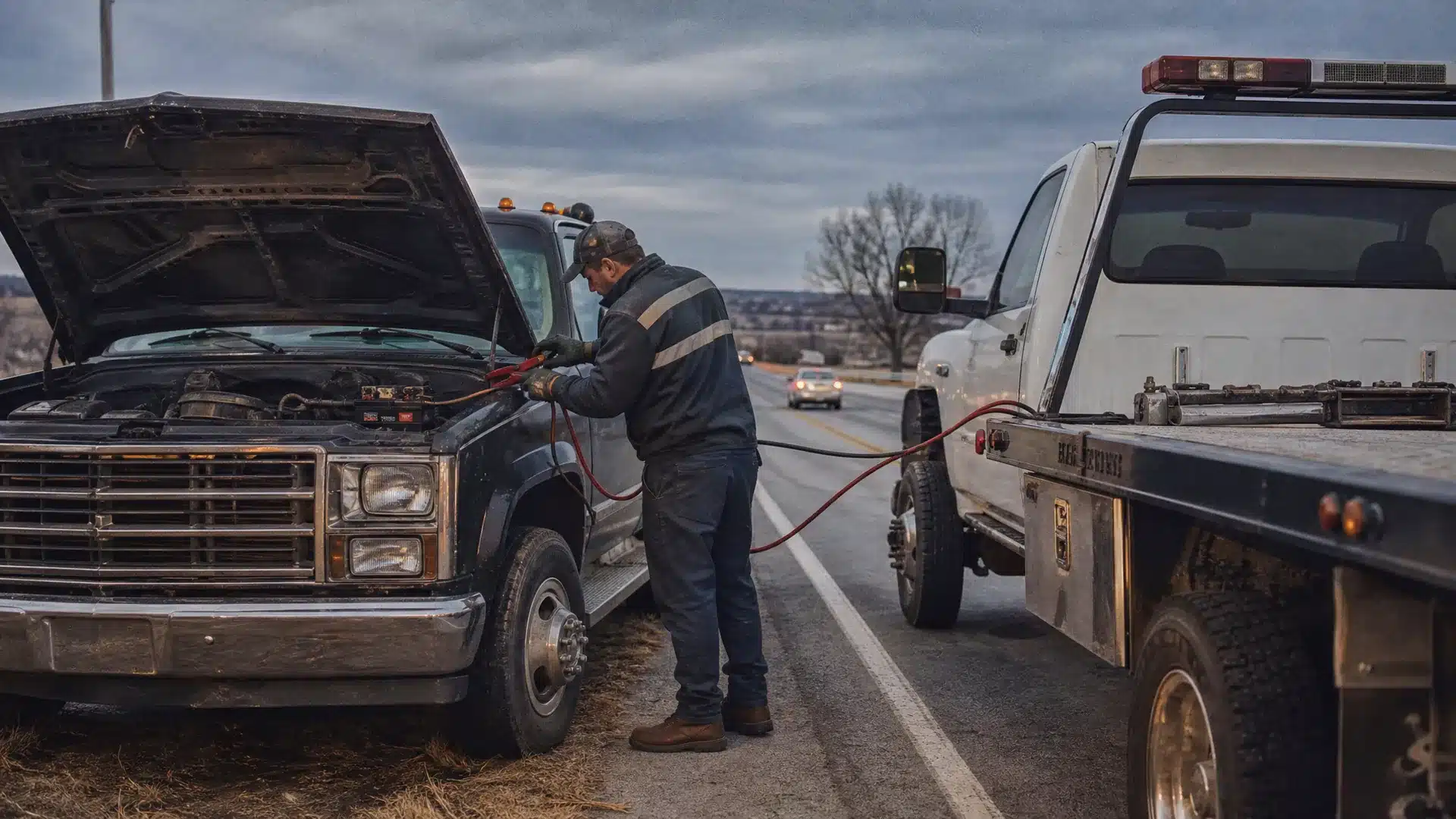
A heavy duty jump start isn’t something most drivers think about until they’re standing next to a dead diesel truck at 6 a.m. on a cold Oklahoma morning. When that moment comes, it helps to know exactly what you’re dealing with, and whether your roadside gear is actually up to the job.
What Is a Heavy Duty Jump Start?
A heavy duty jump start uses commercial-grade equipment, high-amperage cables, heavy-gauge clamps, and large-capacity battery packs, to restart vehicles with big engines and demanding electrical systems. We’re talking diesel pickups, box trucks, RVs, large work vans, and oversized SUVs. These vehicles need significantly more cranking power than a standard gasoline passenger car, and the equipment has to match that demand.
For standard dead car battery help in Tulsa, a basic 12V jump pack or a set of cables from another car usually works fine. A heavy duty call is a different situation entirely.
How It Differs from a Standard Jump Start
A typical passenger car jump start delivers enough amps to turn over a small-to-mid-size gasoline engine. It works because the battery and the engine are sized for each other.
Heavy vehicles, especially diesel trucks, run dual-battery systems and require far higher cold cranking amps (CCA) to fire a large diesel engine. The cables need to be heavier gauge to carry that current safely. The clamps need a solid, clean bite on large commercial terminals. And the power source has to be rated for the load, or you risk a failed attempt, overheated cables, or worse.
Vehicles That Need a Heavy Duty Jump Start
If a vehicle runs a diesel engine or carries a large battery bank, assume it needs heavy duty equipment. That includes:
- Diesel pickup trucks, F-250, F-350, Ram 2500/3500, Silverado HD, Sierra HD
- Box trucks and delivery vehicles
- Work vans, cargo and passenger configurations
- Motorhomes and RVs, especially Class A and Class C
- Large commercial SUVs used in fleet service
- Buses and shuttle vehicles
Common Scenarios Around Tulsa
Fleet and commercial vehicles left overnight through an Oklahoma winter are among the most common heavy duty jump start calls. Cold temperatures dramatically reduce battery cranking capacity in large diesel engines, and Tulsa winters can deliver sharp overnight drops that catch fleet managers off guard.
Real calls look like this: a diesel work truck stalled on the IDL during morning rush, unable to crank. A contractor’s box truck sitting dead in a Broken Arrow parking lot after a cold overnight. A Class A motorhome with a dead chassis battery in a Bixby lot, holding up a family’s weekend trip. A fleet van at a South Tulsa job site that won’t turn over.
These aren’t edge cases. They’re regular calls for a local towing company covering the Tulsa metro every day.
Why a Regular Jump Box Won’t Always Do the Job
Consumer jump starters, the kind sold at auto parts stores and warehouse clubs, are built for passenger cars. They carry a useful charge for a 4-cylinder or small V8 gasoline engine, and they’re convenient to keep in a trunk. But they’re not rated for heavy diesel applications.
The core problem is cranking amps. A large diesel engine needs a sustained high-amp delivery to turn over compression ratios that a gasoline engine never has to overcome. Consumer packs typically top out well below what a dual-battery diesel system demands. When you connect an underpowered pack to a heavy truck and crank, you’re asking the pack to do work it wasn’t built for.
A few things can happen. The pack drains immediately without turning the engine. The cables overheat. Or, on modern vehicles with sensitive electronics, a voltage sag or spike during a failed crank triggers ECU faults that create a separate problem on top of the dead battery.
Modern heavy diesel engines rely on precise voltage thresholds during cranking. Reverse polarity or an unstable power source from an underpowered jump attempt can damage sensitive engine management electronics. That’s a repair bill, not just a roadside inconvenience.
The same logic applies to passenger cars jumping a heavy truck. A Honda Civic’s alternator and battery were never meant to carry the load of cranking a 6.7L diesel. Attempting it doesn’t just fail, it can stress the smaller vehicle’s electrical system.
The Heavy Duty Jump Start Process, Step by Step
Done correctly, a heavy duty jump start follows a clear sequence. Skipping steps is where things go wrong.
Safety Checks Before You Connect
Before any cables come out, a trained tech checks:
- Battery condition, Look for swelling, cracking, corrosion, or leaking. A damaged battery should not be jumped; it can rupture or vent hydrogen gas.
- Terminal condition, Heavy corrosion on terminals creates resistance that defeats the jump attempt. Terminals need to be clean and tight.
- Voltage confirmation, Verify the vehicle is a 12V system (most diesel trucks) or 24V (some commercial equipment). Connecting the wrong voltage destroys electronics.
- Environment, Check for fuel leaks, sparks nearby, or standing water before connecting high-amperage cables.
- Cable gauge and clamp size, Heavy duty cables are physically larger. Undersized cables on a heavy vehicle get hot fast.
What a Professional Does Differently
Positive-to-positive, negative-to-ground. That’s the sequence, and it matters. Connecting negative to the dead battery’s negative terminal instead of a chassis ground creates a spark right next to the battery. On a diesel system with dual batteries wired in parallel, getting the sequence wrong risks arc flash or reverse polarity. Arc flash from heavy cables is not a minor event.
A professional also knows how dual-battery diesel systems are wired. Some trucks run batteries in parallel for 12V; some commercial equipment runs them in series for 24V. The configuration changes the connection point and the procedure entirely.
After the jump, the tech confirms the alternator is charging, watches for warning lights, and makes sure the engine is running stably before clearing the scene. On a heavy commercial vehicle, that confirmation step catches charging system faults that a DIY attempt would walk away from.
As Remi Carrillo, owner-operator of Tulsa Wrecker, puts it: “When you’re dealing with a dual-battery diesel or a large RV, the equipment matters as much as the technique. The wrong cables or a weak jump pack can leave you worse off than when you started.”
When to Stop Trying and Call a Pro
A jump start fixes a discharged battery. It doesn’t fix a failing battery, a bad alternator, or an underlying electrical fault. Know the difference before you spend an hour on the side of the road.
Call a pro when you see any of these:
- The battery won’t hold a charge after jumping, the engine starts, but dies again within minutes or hours.
- Repeated dead battery, if this is the second or third dead-battery event in a short stretch, the battery or charging system is failing.
- Corroded, swollen, or physically damaged terminals, corrosion this severe means the battery is near end of life, and a jump may only be a temporary fix.
- No crank after a proper jump attempt, if a legitimate heavy duty jump pack is connected correctly and nothing happens, the battery is likely dead rather than discharged, or there’s a deeper electrical issue.
- Warning lights that stay on after starting, especially charge system warnings or ECU fault lights.
If you’re broken down on a Tulsa highway, getting to safety is the first priority. Repeated failed jump attempts on a highway shoulder increase exposure time and risk. One call to a professional gets you assessed, jumped if possible, and towed if needed, all in one stop.
Heavy Duty Jump Start Service in Tulsa
Tulsa Wrecker, powered by Neptune Towing, has handled heavy duty jump starts across the Tulsa metro since 2019, diesel pickups, work trucks, RVs, and fleet vehicles stalled on local highways, job sites, and parking lots. We carry professional-grade equipment rated for heavy commercial applications and dispatch fast to Tulsa, Broken Arrow, Jenks, Bixby, Glenpool, and South Tulsa.
If you need roadside assistance in Tulsa for a heavy vehicle, or anything else on the road, call us at 539-292-3074. A real local Tulsa tow truck driver picks up, not an answering service.
For the full picture of what we handle, see our Tulsa towing and roadside service page.