If your car won’t move, not because of a flat tire, but because the engine seized, the transmission died, or a collision buckled the frame, you’re dealing with a non-drivable vehicle towing situation. That’s a different animal than a standard tow. It requires the right equipment, the right technique, and an operator who won’t make your bad day worse. Here’s exactly what happens, how we load it safely, and where it goes when we’re done.
What Makes a Vehicle Non-Drivable
A non-drivable vehicle is any car, truck, or SUV that cannot move under its own power and cannot be safely driven or rolled onto a tow truck in the normal way. If you’re unsure whether your situation qualifies, when it’s time to call a tow truck is a good place to start.
Accident Damage
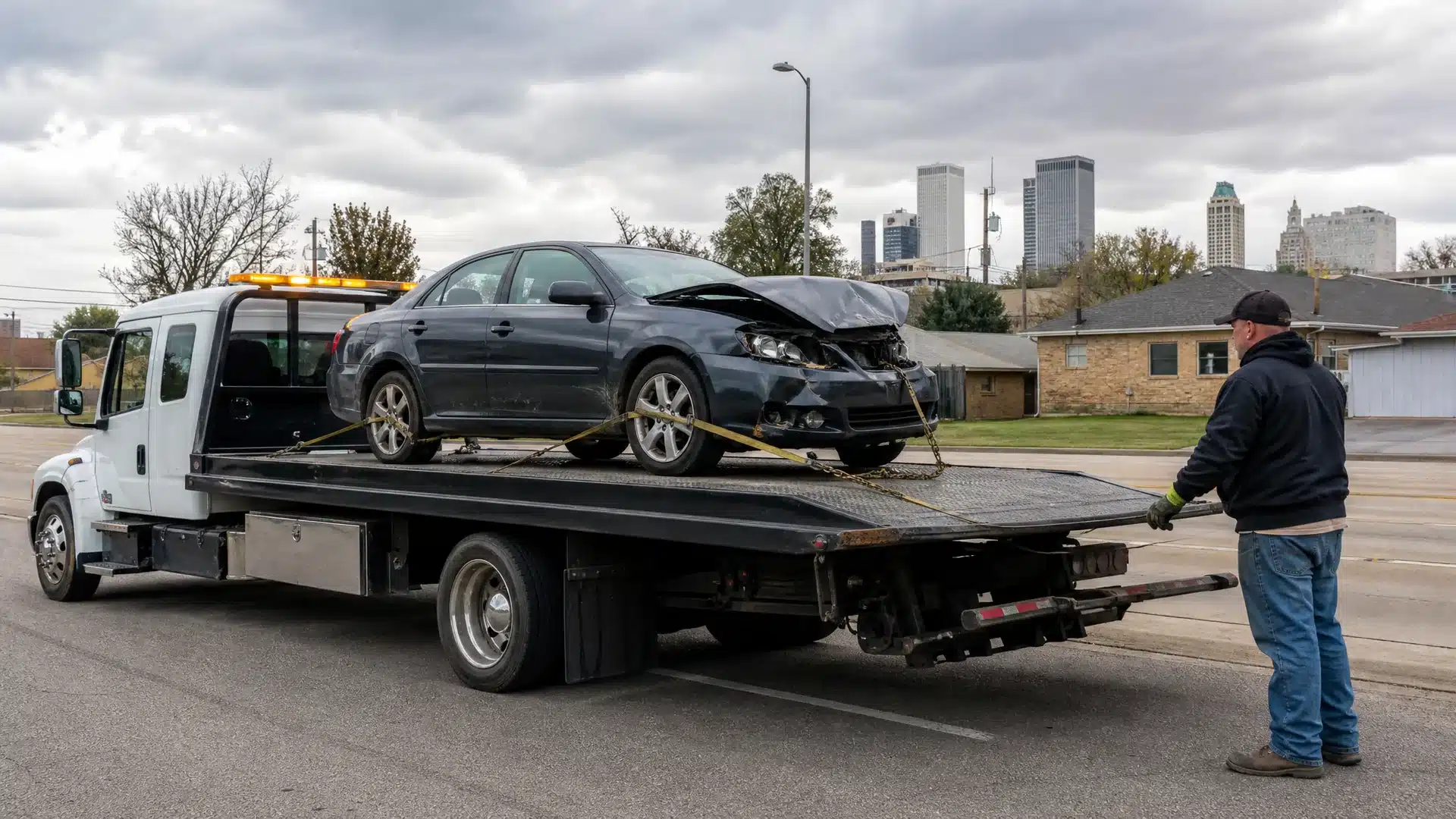
Collision damage is one of the most common reasons vehicles end up immobile. A rear-end hit near 71st and Memorial can buckle a rear axle. A side-impact can lock the steering. A hard front-end collision can crumple the frame and jam the front wheels at an angle that won’t budge. In any of these situations, the vehicle has to be loaded, not driven or rolled, onto the flatbed. Read what to expect after a car accident tow in Tulsa for a full breakdown of that process.
Major Mechanical Breakdown
Mechanical failures can be just as immobilizing as crash damage. A blown engine, a seized transmission, a snapped axle shaft, a deflated air suspension, these all produce the same result: a vehicle that won’t move. Highway breakdowns on the Creek Turnpike are a frequent call for us. The car shifts into park and stays there. No power, no rolling, no options except a proper tow.
Know the signs early. If your car is making sounds it shouldn’t, what to do when your car breaks down on a Tulsa highway walks through the immediate steps before help arrives.
How Non-Drivable Vehicle Towing Actually Works
Non-drivable doesn’t mean untowable. It means the process takes more care and the right equipment.
Safe Loading Without Rolling Wheels
When a vehicle has locked wheels, from a seized drivetrain, a jammed brake, or collision damage, forcing it to roll causes more damage. A trained operator uses wheel skates or a winch line to move the vehicle onto the flatbed deck without rotating the wheels at all.
Here’s the process in plain terms:
- Assessment, The operator checks wheel position, frame condition, and whether any components are dragging or at risk of catching on the deck.
- Winch-out or skate dolly, If the wheels won’t roll, wheel skates (small rolling platforms placed under each tire) let the vehicle slide onto the deck. A winch line pulls it up steadily and controlled.
- Flatbed deck loading, The vehicle rides fully on the deck, all four wheels off the ground, with zero ground contact from pickup to drop-off.
- Securements, Wheel straps and safety chains lock the vehicle in place before the truck moves an inch.
This is damaged car towing done right, no dragging, no grinding, no adding repair costs on top of what the driver already faces.
Why a Flatbed Is the Right Call
When wheels are locked or a frame is compromised, a flatbed isn’t just the better option, it’s the correct one. Learn more about how flatbed towing works in Tulsa and why the equipment choice matters for safe vehicle transport.
A flatbed keeps the vehicle completely off the ground from the moment it’s loaded to the moment it’s set down at the destination. No tire contact with the road, no stress on a damaged drivetrain, no risk of a locked wheel dragging across asphalt.
Major Breakdown Towing vs. Standard Towing
A standard tow is straightforward: a car with a flat tire or a dead battery, wheels that roll freely, nothing structurally wrong. A wheel-lift truck hooks the drive wheels and lifts them while the other two roll behind. That works fine for a car that’s otherwise intact.
Major breakdown towing is different. When the engine has seized, the transmission is locked, or the frame has taken a hard hit, the drivetrain may not rotate at all. Forcing a wheel-lift onto those vehicles risks bending control arms, dragging brake components, and a significantly higher repair bill.
That’s why a flatbed with a winch is the right tool for non-drivable vehicles. For a deeper look at the equipment difference, see flatbed vs. wheel-lift towing. The short version: if the car can’t roll safely, it shouldn’t be asked to.
Where Does Your Vehicle Go After a Non-Drivable Tow?
This is a real concern for drivers in a stressful moment, and the answer is simple. You decide.
Your mechanic. A body shop. A dealership. Your driveway. Wherever you need the vehicle to go, that’s where we take it. Before the truck rolls, you tell the operator the drop-off destination and we confirm it. That’s it.
This vehicle removal service is about getting your car where it can be fixed, not warehoused somewhere you didn’t choose. If you’re unsure which shop to use, that’s okay, call us, we’ll load the vehicle and you can sort the destination while we’re en route. We work with drivers, not around them.
Disabled Vehicle Recovery in Tulsa: What to Expect From Us
Tulsa Wrecker is run by local owner-operator Remi Carrillo and powered by Neptune Towing. We’ve been handling non-drivable vehicle towing across Tulsa and the surrounding area since 2019, seized engines, smashed frames, locked wheels, vehicles that haven’t moved in days.
Our service area covers Tulsa, South Tulsa, Broken Arrow, Jenks, Bixby, and Glenpool. We run 24 hours a day, every day. When you call, you’re reaching a real local operator, not a dispatch center in another state. Response times vary by location and time of day, but we move fast and communicate clearly while you wait.
If your car is off the road and stuck somewhere it shouldn’t be, safe recovery steps when your car is stuck covers what to do while you wait for the truck to arrive. Disabled vehicle recovery is one of our most common calls, and we handle it without adding drama to an already stressful situation.
Call us directly: 539-292-3074, or visit tulsawrecker.com for emergency towing service in Tulsa.
Choosing the Right Towing Company for a Non-Drivable Car
When your car can’t move and you’re making a quick decision from the side of the road, here’s what actually matters:
Flatbed-equipped. Any towing company you call for a non-drivable vehicle needs a flatbed with a winch, not just a wheel-lift truck. Ask before they dispatch.
Experience with damaged vehicles. Loading a car with locked wheels or a compromised frame takes skill. An inexperienced operator can cause damage during the tow itself. Ask how they handle vehicles with non-rolling wheels.
Transparent pricing. You shouldn’t get a surprise invoice at drop-off. A trustworthy towing company tells you the rate upfront and sticks to it. We do.
A local operator you can actually reach. Big dispatch networks often route your call through a third party. With Tulsa Wrecker, you reach Remi directly, someone who knows Tulsa streets and will give you a straight answer.
For more guidance on vetting your options, finding the best towing company in Tulsa covers the key questions to ask.
When you’re ready, call 539-292-3074. We’ll handle the hard part.