If your transmission won’t shift in Tulsa, the first question isn’t “which shop should I call?”, it’s “should I be driving this car at all?” That distinction matters more than most drivers realize, and making the wrong call can turn a repair into a full replacement before you’ve gone two miles. This guide breaks down what the symptoms actually mean, when to stay put and call a tow, and what to expect when Tulsa Wrecker shows up.
What It Actually Feels Like When Your Transmission Won’t Shift
Transmission problems rarely announce themselves clearly. More often, they show up as something that feels slightly off, and then gets worse fast.
Common Symptoms Tulsa Drivers Notice First
- Slipping between gears, the engine revs climb but the car doesn’t accelerate. You feel it most when merging onto US-169 from 71st Street and the car hesitates like it can’t find a gear.
- Grinding or clunking, a hard clunk when shifting from park to drive, or a grinding sensation under load at a red light on Memorial Drive.
- Refusal to engage, you move the selector to Drive and nothing happens. The car sits there, engine running, going nowhere.
- Delayed engagement, a long, unsettling pause before the transmission catches, often accompanied by a thud.
- Stuck in one gear, the car moves but won’t upshift, so you’re screaming down the highway at 3,500 RPM and 45 mph.
Any one of these is a warning. Two or more together means stop driving and think before you turn that key again.
Transmission Stuck in Park: Why This Happens and What Not to Do
A transmission stuck in park is one of the most disorienting breakdowns a driver can face, because nothing looks wrong from the outside.
Two of the most common causes are a failed shift-lock solenoid and a brake interlock malfunction. The shift-lock solenoid is what releases the shifter when you press the brake pedal. When it fails, the lever won’t budge no matter how hard you press. A brake interlock fault does the same thing, the system thinks the brake isn’t being pressed, so it refuses to release the shifter.
Here’s the thing: a transmission stuck in park from a solenoid failure looks identical to a catastrophic internal failure from the driver’s seat. Both present as “it won’t shift.” The difference matters enormously for what comes next, which is exactly why a quick roadside assessment before any tow attempt is worth the few minutes it takes.
What not to do:
- Do not force the shifter. Forcing it can snap the shift cable or damage the linkage, adding repair costs that have nothing to do with your original problem.
- Do not rock the vehicle aggressively trying to free it. That puts unnecessary stress on the drivetrain.
- Do not keep cycling the ignition hoping it resets. If it hasn’t shifted after two or three tries, it’s not going to.
Put the car in Park, set the parking brake, turn on the hazards, and call for help.
When a Stuck Transmission Is a Towing Situation, Not a Drive-It-In Situation
This is the question that separates a manageable repair bill from a catastrophic one.
Signs Your Car Won’t Go Into Gear Tulsa, and Shouldn’t Be Driven
Some transmission symptoms leave room for a careful, short drive to a shop. Others don’t. Here’s a direct breakdown:
Call a tow truck, do not attempt to drive:
- The vehicle won’t engage any forward or reverse gear at all
- You’re leaking transmission fluid (red or brownish fluid under the car)
- The transmission is slipping so badly the car can barely move
- You hear grinding, banging, or clunking when trying to select a gear
- The car is stuck in park and won’t release
A careful drive may still be an option, but call first:
- The car shifts but feels slightly sluggish or delayed with no other symptoms
- The check engine light is on with no other driving issues
When in doubt, when to call a tow truck is always the safer answer for transmission problems. The downside of an unnecessary tow is a tow bill. The downside of driving a failing transmission is a destroyed gearbox.
Non-Drivable Transmission Failure: How to Tell the Difference
Driving even a short distance on a failing automatic, especially one that won’t engage a forward gear cleanly, generates enough internal heat and friction to cause damage that wouldn’t have existed had the vehicle been flatbed-towed immediately.
A front-wheel-drive sedan with a slipping automatic that “almost makes it” to the shop on the BA Expressway is a textbook case of turning a transmission repair into a full replacement. The heat and load during that drive finishes off clutch packs already on the edge.
Short hops on I-44 or the BA Expressway feel quick, but highway speeds demand more from a transmission than surface street driving. That’s exactly the wrong environment for one already in distress. If you’re not sure whether your vehicle is drivable, treat it as non-drivable vehicle towing in Tulsa territory until a professional says otherwise.
For related fluid concerns, the transmission fluid leak towing guide covers what to watch for when a leak is part of the picture.
Why Flatbed Towing Is the Right Call for Transmission Problems
Emergency Transmission Towing: Flatbed vs. Wheel-Lift
A wheel-lift tow truck picks up either the front or rear wheels and drags the other set along the ground. For a vehicle with a healthy drivetrain, that’s usually fine. For a vehicle with a transmission fault, it can cause additional damage.
AWD and FWD vehicles, which make up the majority of passenger cars on Tulsa roads, are especially vulnerable during wheel-lift towing when there’s a transmission fault. On an FWD vehicle towed from the rear, the front wheels are still on the ground and can transfer torque through a damaged drivetrain. On an AWD vehicle, all four wheels are mechanically linked, so dragging any of them risks spinning internal components that are already compromised.
A flatbed keeps all four wheels completely off the road from the moment it’s loaded. Nothing is turning, nothing is being dragged, and your drivetrain is protected the entire trip to the shop. That matters especially for automatics that have already been heat-stressed, even passive rotation during towing can make the damage worse.
Tulsa Wrecker’s 24-hour flatbed towing service is built around exactly this kind of damage-free transport. If you want to understand flatbed towing cost in Tulsa before you call, that’s a reasonable thing to check, but for a transmission problem, the flatbed isn’t optional.
Tulsa Roadside Assessment: What Happens When We Arrive
Tulsa Wrecker has been handling transmission towing calls across Tulsa, Broken Arrow, Jenks, Bixby, Glenpool, and South Tulsa since 2019. Owner-operator Remi Carrillo has loaded vehicles with failed transmissions on everything from quiet neighborhood streets to the shoulder of I-44 at rush hour.
When a Tulsa Wrecker driver arrives at your location, here’s what actually happens:
- Safety first. The driver checks the scene, traffic conditions, vehicle position, road surface, before approaching the car. If you’re on a busy road, they’ll position the wrecker to create a buffer between your vehicle and traffic.
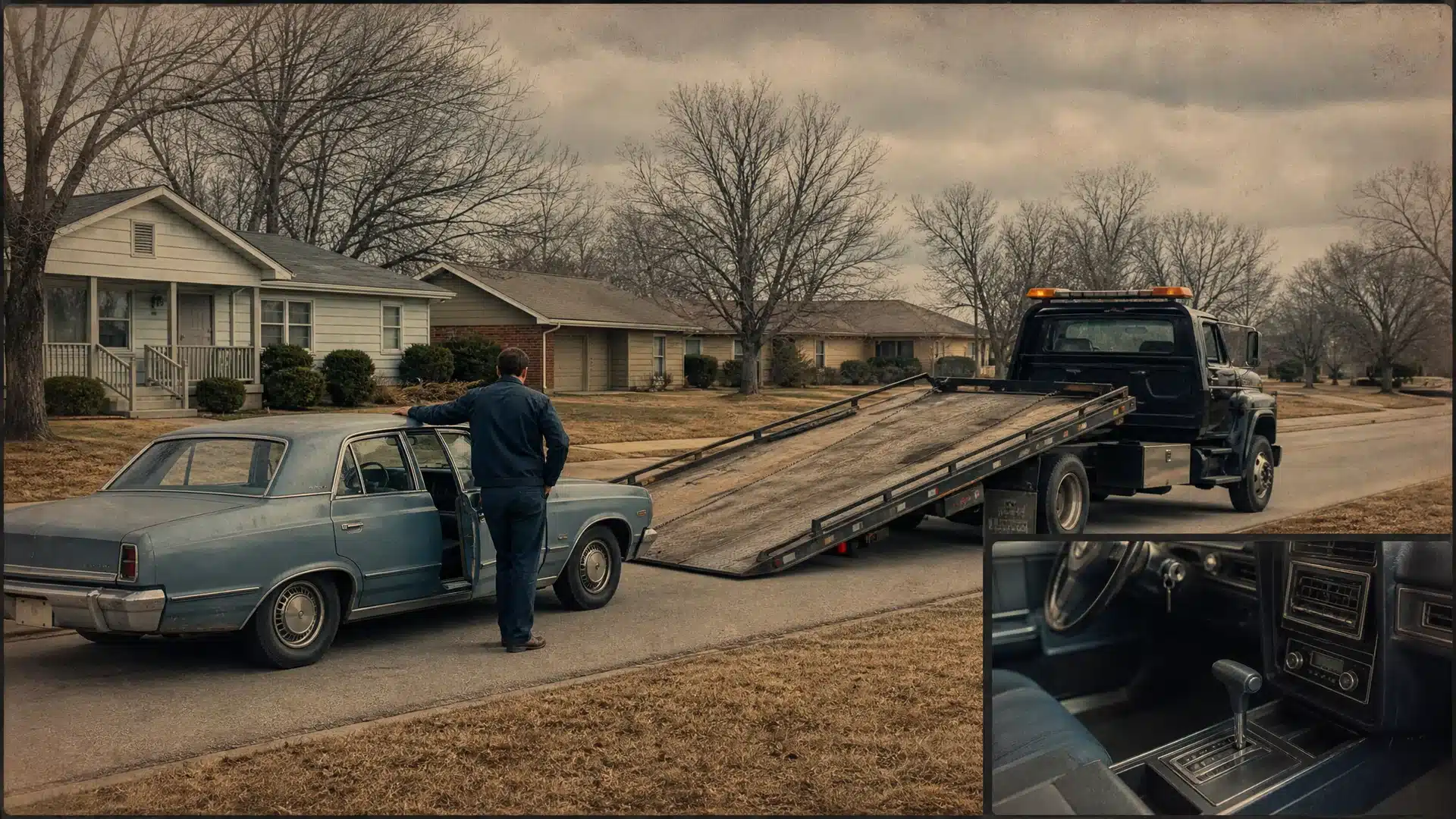
- Quick visual assessment. The driver looks at the vehicle, checks for fluid leaks, and asks a few questions about what happened. This takes two or three minutes and helps determine the right equipment and approach.
- Equipment selection. For transmission problems, the flatbed is almost always the right call. The driver confirms the vehicle’s drivetrain configuration (FWD, RWD, AWD) before deciding how to load it.
- Safe load. The vehicle is winched or driven onto the flatbed, secured with proper straps, and inspected before moving.
You’ll know what’s happening at every step. No surprises, no rush that puts your car at risk, no guesswork about whether the equipment is right for your situation.
For drivers not yet certain whether they need a tow, it’s worth understanding when DIY fixes are reasonable vs. when a tow is the safer call, but for a transmission that won’t shift, the answer is almost always a tow.
Service coverage includes Tulsa proper, Broken Arrow, Jenks, Bixby, Glenpool, and South Tulsa. The towing service covering Glenpool and Bixby area is part of regular dispatch, you’re not calling an out-of-area operator when you call Tulsa Wrecker from those communities.
For a broader look at what Tulsa Wrecker can handle, the full wrecker service guide for Tulsa drivers covers capabilities and equipment.
How to Stay Safe While You Wait for a Tow in Tulsa
Once you’ve decided to call a tow truck, your job is to stay safe until the driver arrives.
Turn on your hazard lights immediately. This is the single most effective thing you can do, especially on high-traffic roads like Riverside Drive or the Creek Turnpike.
Get off the travel lane if at all possible. If the car moves at all, even slowly, get it to a side street, parking lot, or as far right onto the shoulder as you can. A broken-down vehicle in a travel lane is a serious hazard.
Stay in the vehicle if you’re on a highway. On I-44, the BA Expressway, or any high-speed road, staying buckled inside the car is safer than standing outside near moving traffic, unless the car presents a fire or safety hazard, in which case get out and move well away from the roadway.
On surface streets, if you can safely exit the vehicle and stand away from traffic behind a barrier or guardrail, do so. Stay visible without standing in the road.
Don’t keep trying to drive the car. If the transmission is failing, every attempt to move it risks more damage or a complete breakdown somewhere worse.
If your transmission won’t shift in Tulsa and you’re not sure what to do next, call Tulsa Wrecker at 539-292-3074. Remi and the team dispatch flatbeds 24/7 across Tulsa, Broken Arrow, Jenks, Bixby, Glenpool, and South Tulsa. Getting a flatbed on scene fast is the difference between a transmission repair and a transmission replacement, and that call costs you nothing to make.