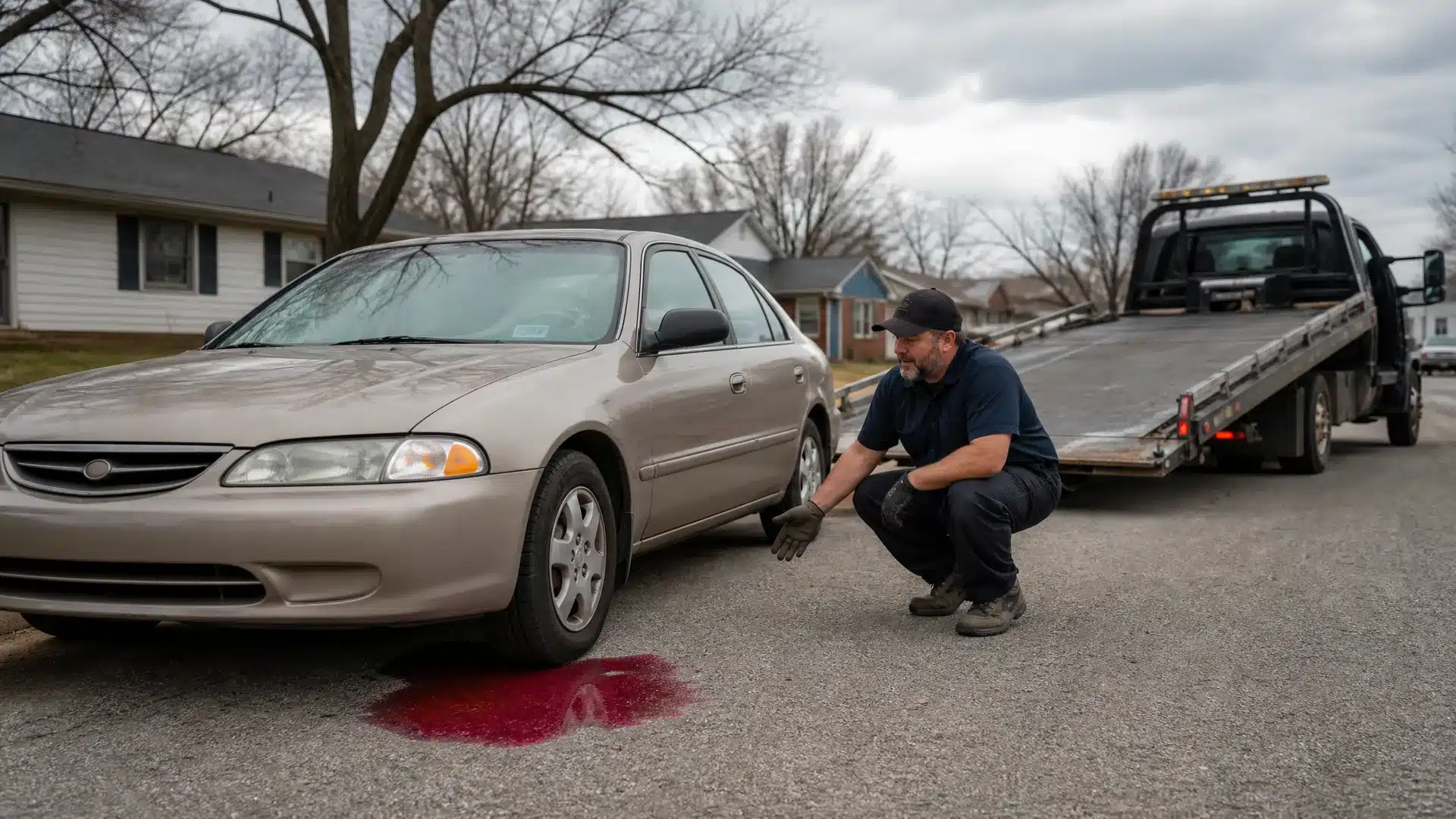
If you just spotted a puddle of red fluid under your car, you’re right to stop and think before turning that key. A transmission fluid leak tow is one of the most common breakdown calls we handle, and almost every time, the driver waited longer than they should have. Here’s how to read what your car is telling you, decide whether to drive or stop, and get help fast if you need it.
What That Red Fluid Under Your Car Is Telling You
Most drivers see a puddle and assume oil. But the color matters a lot here, and transmission fluid has a distinct look.
How to Spot a Transmission Fluid Leak vs. Other Fluids
Fresh transmission fluid is translucent red or bright pink, with a slightly sweet, oily smell. It’s slippery between your fingers and thinner than engine oil. As it ages, it turns darker, brownish red or even black, but it still pools under the center or front of the vehicle, near the transmission pan or cooler lines.
Here’s a quick comparison:
- Engine oil, dark brown or black, thicker, usually under the front of the engine
- Coolant, bright green, orange, or pink but watery, sweet smell, often near the front or under the radiator
- Brake fluid, nearly clear to light yellow, very thin, near wheels or master cylinder
- Power steering fluid, can also be reddish, but pools near the front wheels and steering rack
- Transmission fluid, red to dark reddish-brown, slippery, under the center-to-front of the vehicle
If the puddle is red and sitting under your car’s middle section, treat it as a transmission leak until proven otherwise. This is not a wait-and-see situation, fluid is escaping a closed hydraulic system under active mechanical stress.
Can I Drive With a Transmission Fluid Leak in Tulsa?
This is the question most drivers are actually Googling at the side of the road. The honest answer: it depends on the severity, but in most real-world cases, driving on a transmission fluid leak is a gamble that rarely pays off.
Warning Signs That Mean Stop Right Now
Pull over immediately and call for a tow if you notice any of these:
- Gears slipping or hesitating, the transmission loses hydraulic pressure as fluid drops, so delayed shifts are an early warning
- Burning smell, heat is already building inside the transmission; fluid is critically low
- Red fluid actively dripping, not a residual stain, but an active drip or stream
- Transmission warning light, your car is telling you directly
- Rough or jerky shifts, clutch packs are struggling without adequate lubrication
Transmission fluid works as both a lubricant and a hydraulic fluid. When the level drops, the transmission loses the pressure it needs to engage gears cleanly. Slipping or delayed shifts are usually the first thing a driver notices, and by that point, heat damage may already be starting.
When a Short Drive Might Be Okay (and When It’s Not)
A very slow seep, a few drops after sitting overnight, might allow a careful, short drive to a nearby shop, assuming you check the fluid level first and the car shifts normally. “Nearby” means a few miles at most, not across town.
Tulsa’s summer heat makes this worse. On Highway 169 in stop-and-go traffic, or on 71st Street during evening rush hour, transmission temps spike fast even without a leak. Add low fluid to that and you’re looking at heat damage inside a few miles.
The Creek Turnpike is a common scenario: a driver notices a red puddle in a parking lot off 71st, figures it can wait, and drives home on the turnpike. By the time the car arrives, the transmission has overheated and what started as a seal replacement has become a much larger repair. That story plays out around Tulsa more than it should.
If you’re unsure, calling a local tow truck costs a fraction of what’s at stake.
The Real Cost of Driving on a Transmission Fluid Leak
Here’s the financial reality: a tow costs far less than a transmission repair, and a transmission repair costs far less than a full replacement.
When transmission fluid drops too low, what’s left heats up faster because there’s less volume to absorb and dissipate that heat. It warps seals, burns clutch packs, and can score the valve body or torque converter. Running a transmission even a few miles with critically low fluid can generate enough heat to warp internal components, turning a manageable seal replacement into a full rebuild or replacement.
A minor seal or gasket leak caught early is a straightforward repair. A transmission that overheated because someone drove on low fluid is a different problem entirely, one that can cost several times more. Calling for a tow when you first see red fluid is the financially smart move, not just the cautious one.
What flatbed towing costs in Tulsa is a fraction of what you’d pay for a transmission rebuild. That math is easy.
Why a Flatbed Tow Truck Is the Safe Way to Move a Leaking Car
Not all tow trucks are the same, and when your car is leaking transmission fluid, the type of tow matters.
How Flatbed Towing Protects a Transmission During a Leak
Wheel-lift and dolly towing leave some of your drive wheels on the ground and rolling. On many vehicles, especially front-wheel-drive and all-wheel-drive cars, that means the drivetrain is still turning during the tow, which circulates fluid through the transmission. If fluid is critically low or actively leaking, that movement can cause more damage during the tow itself.
A flatbed keeps all four wheels completely off the ground. The drivetrain stays static, nothing turns, and no additional stress is added to an already compromised transmission. That’s the practical reason why flatbed towing beats wheel-lift for a leaking car.
Tulsa Wrecker runs flatbed-only transport for leaking or mechanically compromised vehicles. It’s a deliberate policy built around damage-free handling, the same standard that owner-operator Remi Carrillo has applied to every job since launching the company in 2019. If your car is leaking transmission fluid, you want it on a flatbed. Full stop.
For non-drivable vehicle towing in Tulsa, a flatbed isn’t optional, it’s the only approach that doesn’t risk making things worse.
What to Do Right Now if You’re Stranded in Tulsa With a Fluid Leak
Stay calm. Here’s exactly what to do:
- Get safely off the road. Signal, pull to the right, and get as far onto the shoulder or into a parking lot as you can. Don’t keep driving to find a better spot.
- Turn off the engine. Every minute a leaking transmission runs is potentially costly. Shut it down.
- Note your location. Give the dispatcher something specific: the intersection, a nearby business, a highway mile marker, or a landmark. “I’m on the BA Expressway near the 145th East Avenue exit” is more useful than “somewhere in Broken Arrow.”
- Call a local tow truck. Reach Tulsa Wrecker / Neptune Towing at 539-292-3074. Remi and the team handle these calls across Tulsa and the surrounding area, they know the roads and they’ll give you an honest ETA.
- Stay with your vehicle if it’s safe. Hazard lights on, stay inside or away from traffic.
That’s it. You don’t need to diagnose the car or figure out the repair right now. Your only job at this point is to stop the damage from getting worse.
Stranded right now? Call emergency towing service in Tulsa at 539-292-3074. Tulsa Wrecker dispatches fast, runs flatbeds, and has been handling transmission fluid leak towing calls across Tulsa since 2019. Remi’s team will get to you, load your car safely, and get you to your shop without adding any more damage to an already stressed vehicle.
Emergency Towing for Fluid Leaks Across Tulsa and Surrounding Areas
Tulsa Wrecker covers the full metro area, South Tulsa, Broken Arrow, Jenks, Bixby, and Glenpool included. If you’re broken down near the Creek Turnpike interchange in Bixby or sitting in a parking lot off Elm Street in Jenks, you get the same response priority as a breakdown on the IDL.
For drivers in Broken Arrow specifically, towing service in Broken Arrow is part of the regular service area, not an add-on or a long-wait call.
Since 2019, Remi Carrillo and the team at Tulsa Wrecker (powered by Neptune Towing) have been loading and transporting vehicles with fluid leaks, transmission problems, engine failures, and every other breakdown Tulsa roads produce. The dispatcher knows what questions to ask, the driver shows up with the right equipment, and your car gets handled correctly from the moment the flatbed arrives.
Transmission fluid leak towing isn’t complicated when it’s done right, flatbed, four wheels up, drivetrain static, delivered to your shop without additional damage. That’s the standard every call is held to.
If you see red fluid under your car and you’re not sure what to do next, that’s what the phone is for. Call 539-292-3074 and talk to a real local operator who has handled exactly this situation, on Tulsa roads just like the one you’re parked on right now. The 24-hour flatbed towing service is ready when you need it.