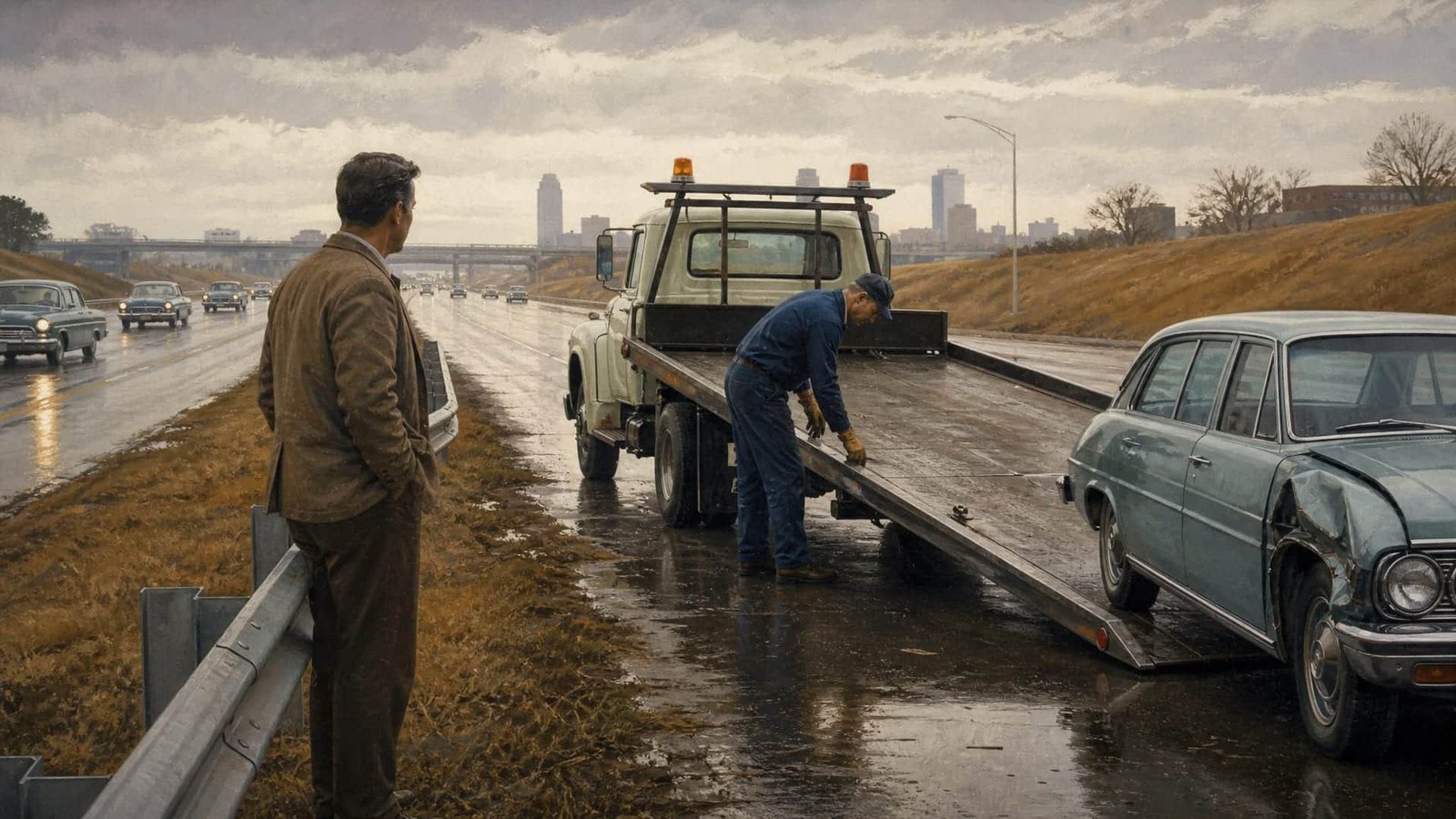
The adrenaline hits before the realization does. You’re standing on the shoulder of I-44, or staring at a crumpled fender in a Glenpool parking lot, and your mind is racing faster than the traffic still whizzing past. In that first chaotic minute, most drivers freeze or panic. But what you do before calling for help decides whether your car survives the recovery intact.
An accident tow truck Tulsa drivers can trust doesn’t just haul metal. It manages a crisis scene with precision and care. Insurance checklists tell you to exchange information, but they rarely explain how to keep yourself safe from a second collision, or how to make sure your damaged car isn’t dragged wrong by the first truck that shows up. This comes straight from the operator’s seat, the kind of practical advice you need when seconds count and stress is running high.
Secure the Scene on Tulsa Roads First
Your safety matters more than your bumper. No amount of paperwork fixes an injury you got standing in active traffic. Before you assess damage or call anyone, get your body out of the path of moving vehicles. Secondary accidents on Tulsa highways often cause worse injuries than the original impact.
Get Off the Travel Lanes Safely
On high-speed corridors like I-44 and US-75, get the vehicle to the shoulder before you assess anything. That’s what prevents a second wreck and lets us position the flatbed safely once we arrive. If your car still rolls and you have steering control, ease onto the right shoulder or into a median crossover if one is close and safe to reach. Never stop in a live lane to inspect damage unless the car is completely stuck.
If you can’t move it, stay inside with your seatbelt on until help arrives. The cabin protects you far better than standing outside near traffic does. Your job right now is building a buffer zone between your wreck and the commuters heading toward Broken Arrow or South Tulsa.
Use Hazards and Reflectors Correctly
Visibility saves lives in those minutes between the crash and the first responder showing up. Hit your hazard lights right away, especially during dawn commutes or evening rush hour when visibility drops fast. If you carry reflective triangles or flares, set them behind your vehicle, spaced far enough back that oncoming traffic has time to react and merge.
These same visual cues protect the tow operator too, since we’ll soon be working inches from live lanes. Understanding Tulsa Move Over Law protections for tow operators explains why setting up this perimeter right makes the job safer and faster for everyone involved.
Document Damage Before Wrecker Recovery Tulsa Begins
Photographs serve two masters at an accident scene: your insurance adjuster and your tow operator. Snap the right images before the wrecker gets there, and you speed up both the claims process and the loading itself, because the operator knows what they’re dealing with before winching starts.
Photos That Help Insurance and Towing
Get wide shots showing your car’s position relative to landmarks, lane markings, and debris. That context matters for police reports and insurance later. Then zoom in tight on fluid leaks, hanging suspension parts, and wheel alignment, because those details tell us which loading equipment to bring.
A photo of a bent axle or leaking transmission fluid tells us whether we need dollies, skates, or specialized rigging before we even put the truck in gear. Document the scene well, and car accident towing Tulsa services move without the surprises that delay clearance or risk more damage.
Note Pre-Existing vs. Accident Damage
Separating fresh impact damage from old wear protects you from bad repair estimates and liability arguments later. Take close-up photos of rust patterns, old dents, and faded paint around the new damage. That builds a clear timeline for your claim.
Point out these distinctions to the tow operator too. Knowing what was already broken helps us avoid putting stress on areas that were already weak. Honest documentation builds trust with everyone involved, and it means you only pay for repairs tied to this specific wreck.
Requesting a Specific Tow Truck After Accident Tulsa
Plenty of drivers assume they have to accept whatever service the police dispatcher sends. They don’t. Oklahoma law gives you the right to pick your own provider for non-evidentiary tows. Exercise that choice, and your car gets specialized handling instead of generic transport, which matters a lot when frame damage or deployed airbags are in the mix.
Your Right to Choose Your Towing Company
You can request Tulsa Wrecker directly even with police on scene, as long as the vehicle isn’t being held as evidence in a criminal investigation. Officers usually assign rotation companies to clear the scene fast, but they’ll honor your preference if you state it clearly and calmly at the roadside.
That distinction matters because rotation assignments prioritize speed over specialized care. A direct request gets you a team focused on damage-free accident towing from the start. Learning about choosing a trustworthy towing company after a wreck beforehand gives you the confidence to speak up when stress makes decisions hard.
What to Say When Calling Dispatch
Clarity beats brevity when you’re talking to dispatch in an emergency. State your exact location first, using cross streets or mile markers, then describe the vehicle’s condition and ask directly for flatbed service.
Mention if the car is electric, has all-wheel drive, or can’t roll, so the dispatcher sends the right equipment the first time. Give these specifics up front and you skip the return trips. The operator who shows up is prepared for the actual job, not the assumed one.
How Flatbed Recovery After Wreck Protects Your Vehicle
Flatbed towing is the only method that fully supports a non-drivable accident vehicle, whether it has frame damage, deployed airbags, or an EV battery pack on board. Wheel-lift trucks drag wheels across pavement. That destroys transmissions, stresses bent frames, and risks real damage to modern EV batteries.
Why Wheel-Lift Isn’t Enough for Accidents
Dragging a compromised vehicle piles new problems on top of the original damage, and often the kind insurance won’t cover. Wheel-lift methods put torque on suspension parts that may already be fractured, turning a minor bend into a total loss during transit.
For Tesla owners and other EV drivers, lifting the wrong way can puncture a battery pack or trigger a thermal event that puts everyone nearby at risk. Reading about safe flatbed towing for electric vehicles after accidents explains why specialized equipment isn’t optional on modern cars. It’s mandatory.
Loading Non-Drivable Vehicles Safely
We look at each wreck individually before a single strap or chain goes on, to figure out the safest way to load it. We use wheel dollies for locked brakes, skates when a tire’s missing, and winch lines pulled along the vehicle’s centerline instead of against a damaged corner.
Understanding how flatbed wreckers handle accident recovery shows you the difference full-support transport makes over a partial lift. This is what separates real accident recovery towing Tulsa drivers can rely on from careless hauling that treats every wreck like scrap metal.
Coordinating With Police and Insurance at the Scene
While you’re waiting on the tow truck, you’ll likely deal with officers and maybe an insurance rep, and both need specific information to work the scene. Keep it factual and short so you can focus on the vehicle handoff instead of getting stuck in procedure.
Hand over your license, registration, and insurance promptly. Skip the guessing about fault, and stick to what you actually saw. Ask the officer if the car is cleared for private towing before the wrecker shows up, so you don’t get stuck in jurisdictional back-and-forth. Keeping this part moving gets everyone off the roadside faster.
Waiting Safely for Emergency Towing After Accident
Patience feels impossible when you’re stranded on the side of the road. But where you stand while you wait matters, because distracted drivers are a real danger. Get behind guardrails or well off the pavement when you can, and keep a solid barrier between your body and approaching traffic rather than standing next to your car.
Get your details ready now, so the operator can start working the second they arrive instead of asking questions you’re too rattled to answer clearly. Grab your keys, know your drivetrain, and note any aftermarket parts that might affect where we can attach. Having that ready shows respect for the operator’s time, and it’s what gets your emergency towing after accident wrapped up as fast as conditions allow.
Choosing Damage Free Accident Towing Over Default Options
Generic roadside assistance handles breakdowns fine, but accident recovery calls for equipment and know-how that a generalist just doesn’t carry. A local owner-operator brings knowledge of Tulsa roads, traffic patterns, and vehicle-specific recovery that a national dispatch algorithm can’t match.
Tulsa Wrecker has provided damage-free flatbed accident recovery across Tulsa, Jenks, Bixby, Broken Arrow, Glenpool, and South Tulsa since 2019, under local owner-operator Remi Carrillo. That’s years of pulling vehicles off nearly every intersection and highway segment in the metro, and the kind of lessons that only come from doing it for real, over and over.
Tulsa Wrecker runs 24/7 with fast dispatch for emergency accident towing across the metro, because every minute you’re waiting is another minute of exposure and stress. Save our number, 539-292-3074, in your phone today, so you can request 24/7 accident towing dispatch in Tulsa the moment something goes wrong, instead of gambling on a default option during the worst moment of your driving day.