If you drive a Tesla in Tulsa, you’ve probably wondered who you’d call when it won’t move. Most tow outfits can hook up an ordinary sedan without much thought. A low, heavy electric car with a battery in the floor is a different job, and the company you pick decides whether it’s a calm hour or a repair bill.
Key takeaways
- A flatbed that takes all four wheels off the pavement is the safe default for a Tesla, in line with Tesla’s general owner guidance.
- Low-clearance scrapes happen where the ramp meets the street or driveway lip, so the operator should check the approach, bed height and the car’s path before the winch starts.
- Rolling a Tesla on its drive wheels can spin a drive unit that isn’t set up to turn that way, so the whole car should be off the ground.
- A tow truck usually can’t put a meaningful charge into a Tesla on the roadside, so a dead pack typically means a flatbed ride to a charger or service center.
- Ask for a written price before hookup, and photograph the front lip, wheels and underbody before loading.
This is how we’d sort the good from the rest, from the people who load these cars on Tulsa streets.
Why a Tesla is a different tow than an ordinary car
Here’s a call that fits any Tulsa weekday. A Tesla owner has parked outside a grocery store near 71st and Yale, the screen is throwing an error, and the car won’t go into drive. What they need is an EV towing company in Tulsa that won’t treat it like a ten-year-old Camry.
Three things make many Teslas a different job on a tow truck.
- A low nose. Many models sit close to the ground, and the lower front skirt has very little room before it meets a ramp, a curb or a driveway apron.
- A battery pack along the floor. The underside of the car is part of the battery, so a hard scrape is more than a cosmetic worry.
- Drive wheels that shouldn’t roll on pavement. More on that below, because it’s the mistake that costs the most.
A standard hook setup asks a low car to be lifted and pulled by its nose, and that’s exactly where the risk sits. You can fix a scuffed skirt. You’d rather not find out what a gouge near the pack costs.
Flatbed for a Tesla in Tulsa is the safe default
Tesla’s owner documentation generally points toward flatbed transport with the drive wheels off the pavement. That’s the manufacturer’s general guidance, so check the owner’s manual for your own car and model year.
A flatbed takes every wheel off the road. The car rides level on the bed, nothing turns underneath it, and nothing hangs from the nose. If you want the car-by-car reasoning, we wrote up flatbed versus hook towing in plain terms.
Saying “flatbed” on the phone isn’t enough, though, so confirm a few things with whoever you call:
- The truck being sent is a true flatbed, not a hook truck with a flatbed “if one’s free.”
- The operator knows how the car will be secured and where.
- The company can say how it loads a car that sits low.
Those answers take a dispatcher thirty seconds. If they take longer, you’ve learned something.
Why hooks and wheel-lifts are a risky match for a low car
A wheel-lift or hook lifts one end and leaves the other wheels rolling on the road. On a low Tesla, the cradle has to reach under a nose with almost no gap, and the car then travels on two wheels for the whole trip. With all-wheel drive, those rolling wheels can be drive wheels.
That’s no knock on those trucks. They’re the right tool for plenty of vehicles, just not this one.
Low clearance: how a tow truck in Tulsa gets under a low Tesla
This is the worry we hear most from Tesla owners, and it’s fair. A flatbed solves the wheels-on-the-road problem, but a flatbed bed is still a ramp, and a low car can scrape on the way up even when every wheel is going where it should.
Ramp angle and the front lip: where low Teslas get scraped
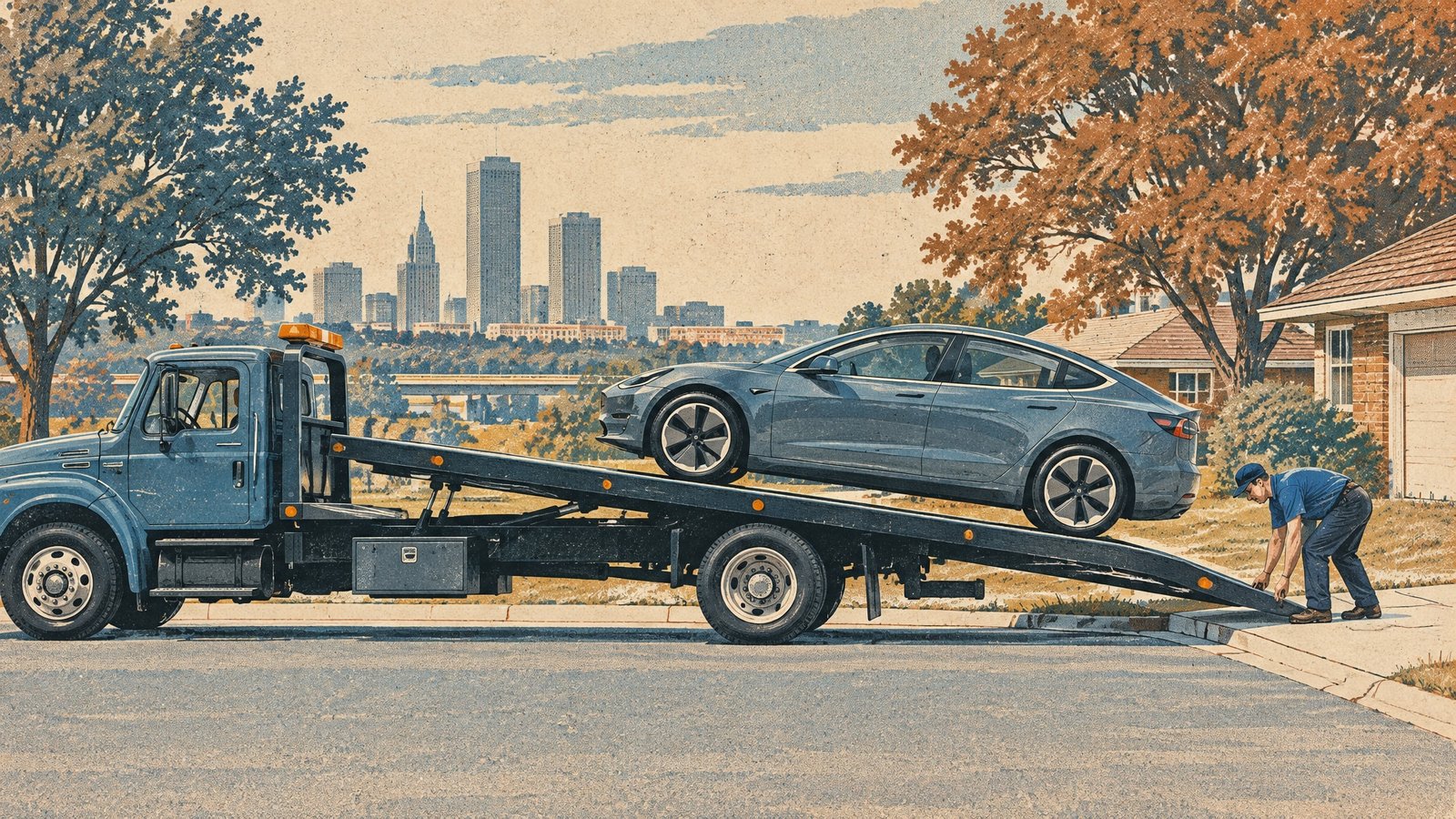
The damage usually happens at the transition, where the ramp meets the street or driveway. The bed tilts down, the front of the car points up, and a low front skirt reaches the ramp before the tires do.
Think of a car sitting at a curb cut on Riverside Drive, where the pavement dips and rises within a few feet. Or a steep driveway in Jenks, where the apron drops sharply into the street. Both are the sort of spot where a low nose can catch, and neither shows up on a phone call unless you mention it.
So you can help here. Tell the dispatcher where the car is sitting, whether the nose faces a slope, and whether you can see a lip under the front tires. A one-sentence description beats a surprise at the curb.
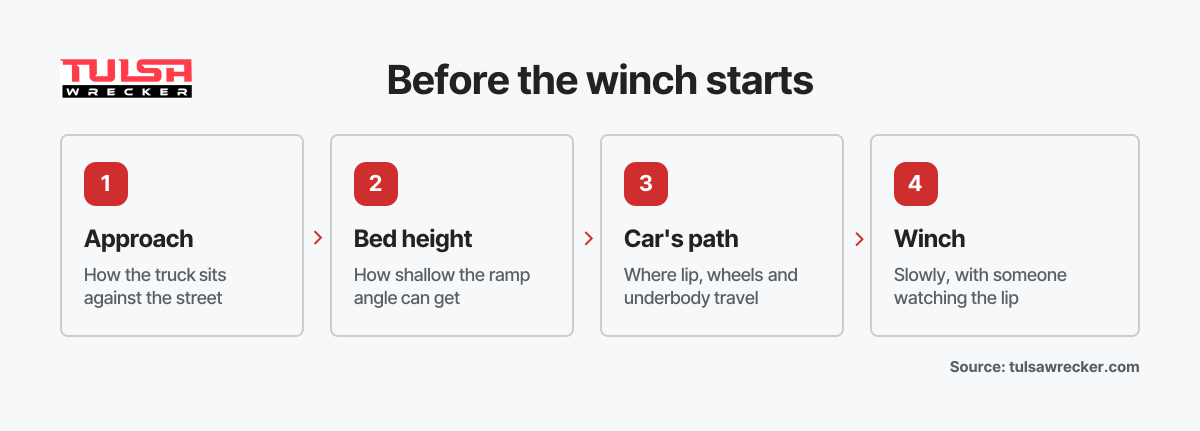
What a careful operator checks before the winch starts
Order matters, and a good operator works through it every time:
- The approach. How the truck will sit against the street, and whether the dip at the curb or driveway will tilt the ramp steeper than it needs to be.
- The bed height. How high the back of the bed sits and how shallow the angle can get.
- The car’s path. Where the front lip, wheels and underbody will travel from the pavement to the deck.
- Then the winch. Only after the first three, and slowly, with someone watching the lip.
None of this is fancy. It’s looking before pulling, and an operator who skips it is the one you end up writing about in a complaint.
A flatbed won’t fix every spot. Some cars in some driveways need a different loading position, and an honest operator will tell you so rather than force it.
Battery and drivetrain: keep the drive wheels off the road
Whatever happens with the nose, the next question is what happens to the wheels. A Tesla isn’t a car you can shove into neutral and drag a few blocks, and you should know why before you agree to a quick tow.
Why dragging a Tesla on its drive wheels is the costly mistake
When drive wheels roll on pavement, they turn the drive unit behind them. That unit isn’t set up to be spun that way while the car is off, so a long drag or a tow on the road can damage the drivetrain, and the bill comes later.
So the whole car should be off the ground before the truck pulls away. That’s another reason a flatbed is the default, and why a company that offers to “just pull it” with the drive wheels down should lose your call.
A dead pack on the roadside: what a tow can and can’t do
If the battery is flat, here’s the straight answer. A tow truck usually can’t put a meaningful charge into a Tesla on the roadside. Jump-starting works for a 12-volt battery in a regular car, but the high-voltage pack is a different animal.
The realistic fix is a flatbed ride to a charger or a service center. That’s not a defeat. It gets the car to where it can be charged or diagnosed without rolling a wheel.
Some companies carry charging gear and some don’t, and you shouldn’t assume either way. Ask directly, and if the answer is vague, plan on the tow.
Who to hire: a tow truck company checklist for Tesla owners in Tulsa
You’ll see “best tow truck company for a Tesla” in plenty of ads. We’d rather you decide for yourself, so here’s what a company should be able to answer before it earns that word from you, and what should send you elsewhere.
Questions to ask before you say yes to a Tesla tow truck in Tulsa
- What truck are you sending? You want a flatbed, named as such.
- How will a low car get loaded without touching the front lip? Listen for ramp angle, bed height and the approach, not “we’ve done it before.”
- Will the drive wheels stay off the pavement the whole trip? The only good answer is yes, because the car’s on a bed.
- Have you moved EVs before? You’re not looking for a speech, just a calm, specific answer.
- What’s the price, in writing, before you hook up? Ask for a text or an email. If you want a sense of the range first, here’s what a Tesla tow costs in Tulsa.
- Who’s behind the trucks? A name and a local number beat a call center. Tulsa Wrecker was founded by owner-operator Remi Carrillo, with local experience since 2019, and you can read about the company behind Tulsa Wrecker, powered by Neptune Towing.
If you’re in the southern part of town, this overlaps with how to choose a flatbed tow company in South Tulsa, which is a good next read.
Red flags that should send you to another company
A company that offers a hook or wheel-lift for a low Tesla and never brings up a flatbed isn’t thinking about your car. A price that changes once the truck arrives and the car is half-attached is another reason to walk away.
The third is vague answers about damage. If you ask how a low car gets loaded and hear “don’t worry about it,” worry about it.
Damage-free towing: what to check before the car is loaded
Damage-free towing comes down to care in the first five minutes, and you have a part in it. Most disputes over scrapes come down to one problem: nobody wrote down what the car looked like before it left.
Photos and notes before the car moves
Before the car goes on the bed, take a few minutes with your phone. Photograph the front lip, each wheel and as much of the underbody as you can see, in daylight or with the flashlight on.
Then ask the operator for written notes on the car’s condition at pickup. It’s a normal request, and a good operator won’t blink.
If new damage shows up at drop-off, say so before you sign anything, and photograph it where the car sits. What to do if a tow company damages your car walks through the next steps.
Tesla roadside help across Tulsa, Jenks and South Tulsa
We work Tulsa, South Tulsa, Jenks, Bixby, Broken Arrow and Glenpool. That covers a stalled car on the Creek Turnpike or a flat tire in a Broken Arrow parking lot, and the Tesla-specific details above apply to each.
Response time depends on where you are, traffic and what else is on the road, so we won’t quote you a number of minutes before we know your location. We’ll tell you what we see and keep you posted until the truck arrives.
If you’re weighing a roadside assistance app against calling a tow company directly, that article lays out the trade-offs when the car won’t move. For a Tesla that needs to ride level, see our page on flatbed towing in South Tulsa.
Call 539-292-3074 and tell us where the car is, the model year, and whether the wheels roll. We’ll say which truck it needs and quote the trip before anything is hooked up.
Frequently asked questions
Can a tow truck charge my Tesla?
Usually not in any meaningful way. A tow truck can’t put a useful charge into the high-voltage pack on the roadside, so the realistic fix is a flatbed ride to a charger or service center. Some companies carry charging gear, so ask before you call rather than assuming.
What’s the best towing company for a Tesla?
The best one is the company that sends a true flatbed, can explain how it loads a low car without touching the front lip, and keeps the drive wheels off the pavement. It should also give you a written price before hookup and have a real local owner behind the trucks.
Is it okay to tow a Tesla with a hook or wheel-lift?
We wouldn’t. A hook or wheel-lift leaves some wheels rolling, and on a low car it works right at the nose where scrapes happen. Check your owner’s manual, which generally points toward flatbed transport.
How do I know a truck can get under my low Tesla?
Ask how the operator checks the approach from the street, the bed height and the car’s path up the ramp. Tell them if the car sits at a curb cut or on a steep driveway. A good operator will have specific answers, not a shrug.
What should I do if my Tesla has new damage at drop-off?
Say so before you sign anything, and photograph the damage where the car sits. Compare it with the photos and written condition notes from loading, then follow the steps for what to do if a tow company damages your car.