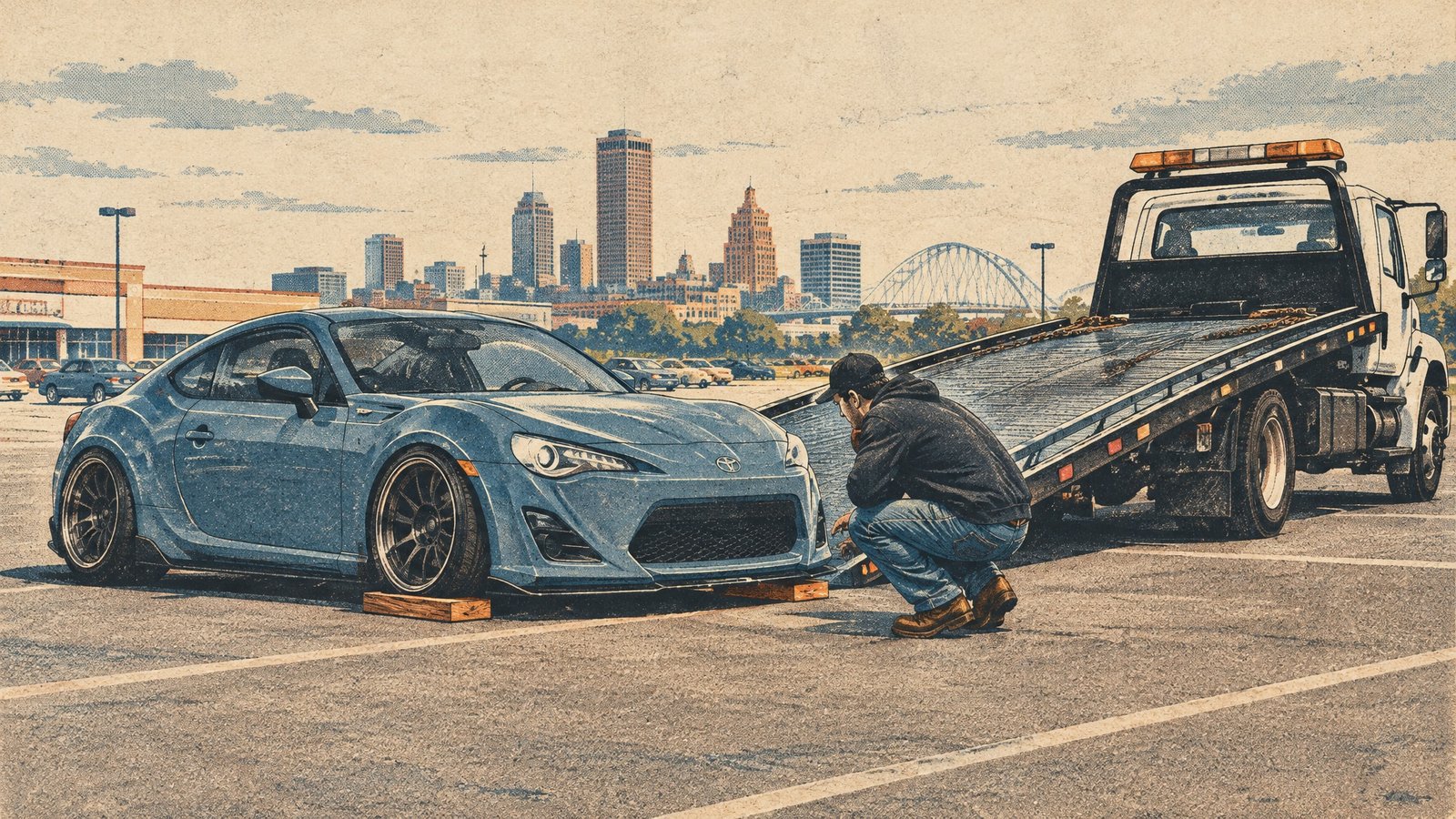
Picture a typical call. A lowered coupe won’t start in a shopping-center lot, and the owner is crouched by the front bumper, checking how much room is left under the splitter. He isn’t worried about the breakdown anymore. He’s worried about the tow.
Key takeaways
- A lowered sports car can be towed in Tulsa, and its lowest point, not its badge, decides how the loading plan is built.
- The scrape risk is highest where the ramp meets the bed, so a lower deck and a gentler, slower approach protect a front splitter or rear diffuser.
- A flatbed carries the whole car, which is why it usually beats a hook for a low sports car, especially an all-wheel-drive one.
- A wheel-lift can still be reasonable for a car with normal ride height, as long as the crew explains why they recommend it.
- Give the dispatcher the make, model, year, any aftermarket parts, the lowest point, whether the car rolls and steers, and whether it’s an EV before the truck rolls.
That worry is fair, and it’s the reason owners search for a tow truck for a low clearance sports car in Tulsa before they ever pick up the phone. At Tulsa Wrecker, we’ve been towing around Tulsa since 2019, and our founder, Remi Carrillo, still runs the work as a local owner-operator. This is how we think about getting a low car onto a flatbed without a scratch.
What makes a low clearance sports car a harder tow
Yes, a lowered sports car can be towed in Tulsa. Plenty of them are, and most come through fine when the crew plans the load before touching the winch.
The plan starts with the car’s lowest point, not its badge. A factory supercar, a tuned import and a stock-looking coupe with coilovers can all hang a different part closest to the pavement. It might be the front splitter, the rear diffuser, a side skirt or the underbody.
Whichever part sits lowest decides how the truck lines up, how the bed is set and how slowly the car climbs. We ask about it first because that one answer shapes everything after it.
Nobody has to know the technical terms to call. If you can see the part that would scrape first, tell us. If you can’t, tell us what the car is and what’s been done to it, and we’ll work it out from there.
Flatbed ramp angle and front splitters: where low cars get scraped
Most scrapes on a low car don’t happen on the highway. They happen in the first few feet of loading, when the car goes from flat ground to a slope.
The spot where the ramp meets the bed
A flatbed deck sits above the pavement, so the car has to climb. The slope is steepest where the ramp meets the bed, and that’s where a low nose gets caught. The front splitter reaches the incline before the tires do, and if the angle is too sharp, the lip drags or digs in.
The rear works the same way in reverse. A car backed onto a bed, or one that tips as it crests the top, can drop its diffuser onto the edge.
The fix is a gentler slope, and there are two ways to get one. A deck that sits lower to the ground shrinks the angle the car has to climb, and a longer approach spreads the climb over more distance. Beyond that, it comes down to a slow, steady pull so the nose never bounces as it crosses the transition.
Plenty of flatbed crews check the lowest point first and set up around it, and that’s how we work too. A careful approach doesn’t make a scrape impossible, but it takes away most of the ways one happens.
Lowered suspension and aftermarket splitters move the lowest point
A car’s published ride height only tells you so much. Once the suspension has been dropped or a bolt-on splitter has been added, the lowest point is somewhere the factory never planned for.
Aftermarket splitters often reach farther forward and sit closer to the ground than anything the maker designed. A lowered car can also squat or dive as it moves onto the bed, so the clearance you measured in the driveway isn’t the clearance on the ramp.
That’s why we want to hear about modifications even if they seem small. A car that looks stock from ten feet away may have a lip you can’t see in a photo.
Why a flatbed usually beats a hook for a low sports car
A hook or wheel-lift raises one end of the car and leaves the other wheels rolling on the road. A flatbed carries the entire car off the ground. For a low sports car, that difference matters more than most owners expect. Our longer explainer on flatbed vs. hook towing covers the basics, and here’s how it plays out on a car that sits close to the pavement.
A wheel-lift tilts the car as it raises one end, and a low front or rear can scrape the ground at that new angle. The wheels that stay down keep turning for the whole trip, and some drivetrains don’t like that. The same reasoning applies to valuable and collector cars, which is why collector cars belong on a flatbed.
A wheel-lift isn’t always wrong. For a car with normal ride height and a drivetrain that tolerates rolling wheels, a short hook tow can be a perfectly reasonable call. We aren’t against it. We just don’t think it fits a car with a splitter that clears the ground by a hand’s width.
What matters is that the crew tells you which method they recommend and why. If you hear “we’ll just hook it” with no explanation, ask for one.
When leaving drive wheels on the pavement is a bad idea
All-wheel-drive cars are the usual example. Their front and rear wheels are linked through the drivetrain, so rolling one axle while the other is lifted can strain parts that were built to turn together. Some owner’s manuals say plainly not to tow that way.
Many EVs and hybrids have their own rules about rolling wheels too. Whether a given car is fine on a hook is something you check with the manual or the maker, not something to guess at on the side of Memorial Drive.
When the manual is unclear or the drivetrain is unfamiliar, a flatbed takes the question off the table. All four wheels stay still, and nothing spins that shouldn’t.
How a damage-free flatbed load works for a sports car
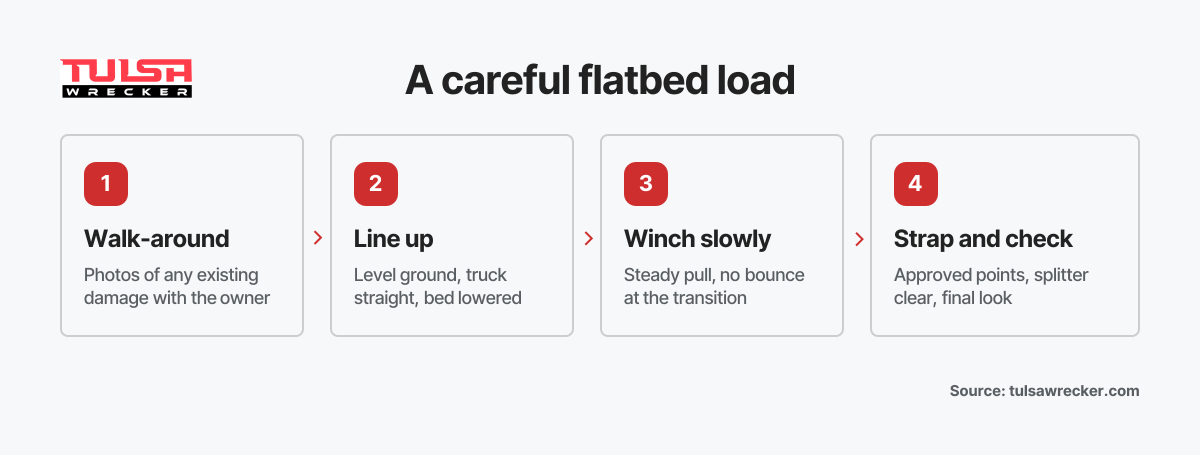
Nothing here is a promise of zero risk, because no honest tow operator can make one. What follows is what a careful crew does to keep that risk small, in the order it happens.
Positioning the truck and lowering the bed
We start by finding level ground. A truck parked on a slope changes the ramp angle before the car even moves, so we’d rather spend a minute repositioning than fight a bad setup.
Then we line the truck up straight with the car, so the tires track right up the middle of the bed. If the bed tilts, we lower it until the ramp is as flat as it can get. The winch comes next, and the pull stays slow and steady the whole way.
The moment that matters most is the transition, where the car goes from ramp to deck. We bring it through gently so the nose doesn’t bounce and the splitter has room to clear. If something looks tight, we stop and adjust rather than push through.
The walk-around, straps, and photos before the car moves
Before the car moves at all, we walk around it with you. We look at the splitter, the diffuser, the skirts and the wheels, and we take photos of any damage that’s already there. That protects you, and it protects us too.
Once the car is on the bed, we secure it with wheel straps or the manufacturer-approved tie-down points. We choose straps and attachment spots that keep the splitter clear and don’t pull on anything fragile. For an EV with a low battery floor, those approved points matter even more.
Last comes a final check. We look over the straps, the position and the clearance, and nothing rolls until we’re satisfied.
If you’re standing there during all this, speak up. You know the car better than we do, and if you’ve seen a hidden low spot or a tight tie-down point, we’d rather hear it now.
Tulsa driveways, lots, and curbs that make loading harder
The same car can load easily in one spot and cause real trouble in another. A flat, open lot gives the truck room to line up. A cramped driveway or a lot with a hard dip takes that room away.
Shopping-center lots around Utica Square are a good example. They’re usually flat, but tight rows and tight turns can limit where a flatbed can park, which is why we keep this page for flatbed help near Utica Square. Near the Jenks Riverwalk area, you’ll want to watch for curbs and slopes that the car has to cross. In South Tulsa, Bixby and Broken Arrow, steep or gravel driveways can be harder still, because the slope at the end of the drive changes the angle before the ramp comes into play.
Sports car owners tend to know their own driveways well, and that’s useful. If there’s a dip at the end of the drive that your car already scrapes on, tell us before we get there.
Picking a spot the truck can work from
If you can, meet the truck on flat, open pavement. A wide stretch of lot works better than a tight corner, and a straight run beats a bend.
If the car can’t be moved, tell us about every curb, speed bump or dip it has to cross to reach the truck. We can sometimes reposition the truck so the car crosses fewer obstacles, or approach from another side.
This isn’t a fix for every site. If the car is stuck in a spot where no flatbed can get level, we’ll tell you plainly, and we’ll work out the next-best option with you instead of forcing a load that might not go well.
What to tell the dispatcher before the tow truck arrives
The booking call is where most of the plan gets made. A few minutes of detail up front means the crew arrives with the right truck and the right straps.
The details that change the loading plan
Have these ready when you call:
- Make, model and year
- Any lowering, aftermarket splitter or diffuser
- The lowest point you can see
- Whether the car rolls and steers
- Whether it’s an EV with a low battery floor
The last two matter more than they sound. A car that rolls and steers loads one way, while a car that’s stuck in park or has locked wheels needs a different approach, often with extra gear. And since we handle Teslas and other EVs, we want to know a battery sits low under the floor, because it changes where the straps can go.
When you’ve got it all, book a flatbed in South Tulsa or call us directly, and we’ll confirm a loading plan before the truck rolls.
Questions to ask before you agree to a tow
Whoever you call, ask how the car will be secured. Ask what photos get taken and when. Ask what happens if the car gets scraped anyway. A careful operator answers all three without hesitation, and a rushed one gets vague. Our guide on how to choose a flatbed company goes further on comparing operators.
On the scrape question, here’s what should happen. The crew stops, shows you the mark and writes it down on the spot. You shouldn’t have to chase anyone for that. On your side, take photos right away from a few angles, note the time and place, and don’t sign anything that says the car is fine until you’ve checked it. Our piece on what to do if a towing company damages your car lays out the steps in full.
What low clearance towing in Tulsa costs
We won’t quote a price here, because we’d be guessing. What drives the cost is the distance, the time of day, whether a flatbed is needed and how long loading takes at the pickup spot. A car in a clean, flat lot loads faster than one stuck at the end of a steep driveway.
For a sense of the range, see what a local tow costs in Tulsa. That’s a guide, not a quote on your car.
The most accurate number comes from a call. Phone Tulsa Wrecker at 539-292-3074 with the make, model, year and lowest point, and we’ll talk through the plan and the price together. There’s no rush on your end.
Frequently asked questions
Can a tow truck tow a lowered car?
Yes, but the method matters. A flatbed with a low deck and a slow, steady winch pull is the safest way to load a lowered car. Tell the dispatcher about the lowering and any aftermarket splitter so the crew can plan around the lowest point.
What happens if my car gets scraped during loading?
A careful crew stops, shows you the mark and notes it on the spot. You should take photos from several angles right away, write down the time and place, and avoid signing off that the car is fine until you’ve looked it over.
Is a flatbed always better than a hook for a sports car?
Usually, yes, because a flatbed carries the whole car and keeps all four wheels still. A wheel-lift can be a reasonable call for a car with normal ride height and a drivetrain that tolerates rolling wheels. All-wheel-drive cars and many EVs are the ones to keep off a hook.
What do I need to tell the dispatcher about my low car?
Give the make, model and year, any lowering or aftermarket splitter or diffuser, and the lowest point you can see. Say whether the car rolls and steers, and whether it’s an EV with a low battery floor. That lets the crew arrive with the right plan.
How much does a low clearance tow cost in Tulsa?
The price depends on distance, time of day, whether a flatbed is needed and how long loading takes at the pickup spot. Call Tulsa Wrecker at 539-292-3074 with the car’s details and the crew will talk through the plan and price with you.