
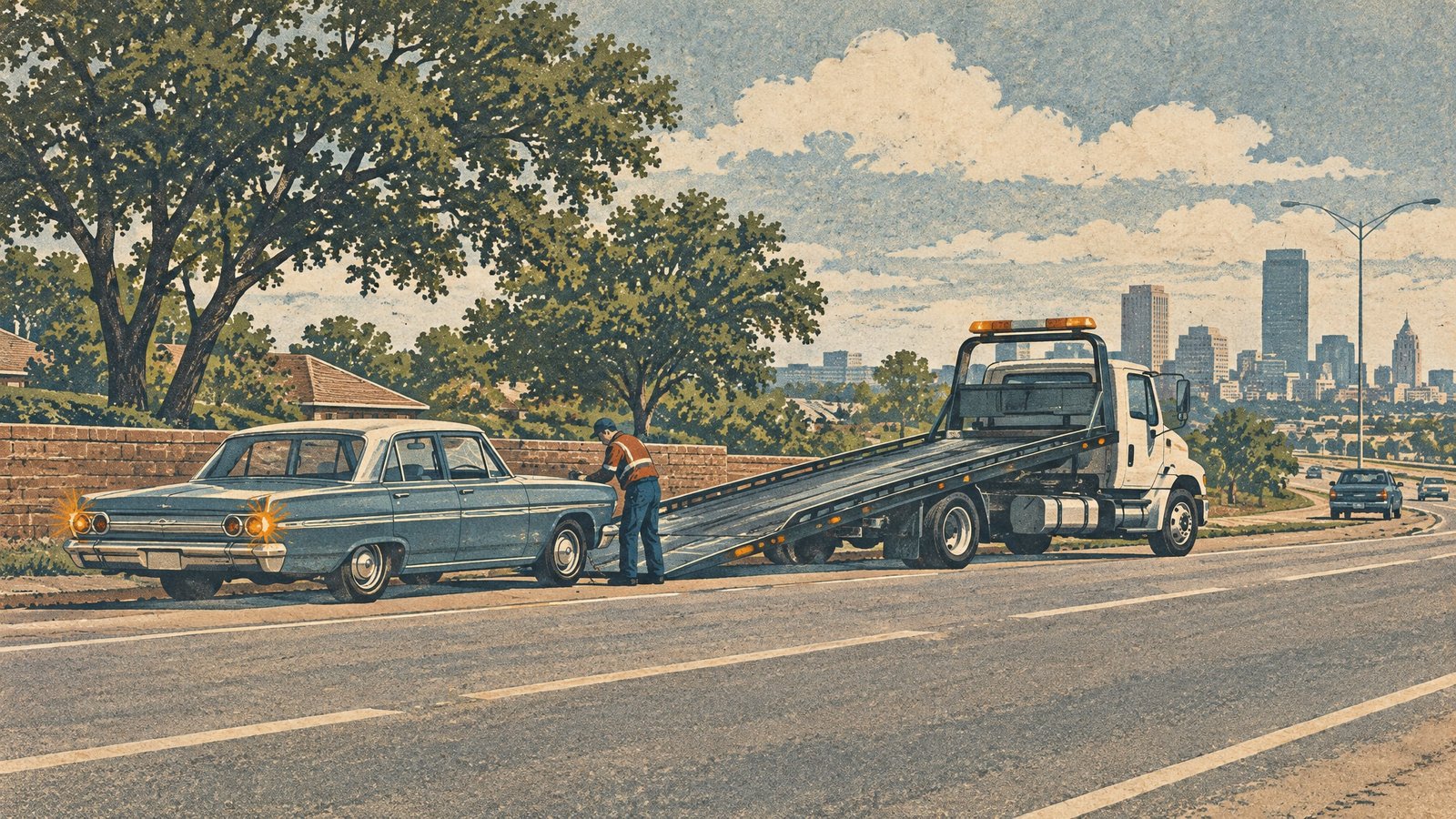
Most calls start the same way. Somebody is sitting on the shoulder near 71st and Memorial with the hazards ticking, and before they tell us what’s wrong with the car, they ask what this is going to cost.
Key takeaways
- A 10-mile tow bill has three parts: a base or hookup fee, a per-mile charge for loaded miles, and any add-ons.
- On a run this short, the base fee usually carries more of the total than the miles do, because hookup and loading take about the same time at any short distance.
- Ask whether the meter starts at the truck’s base or at your car, since that can change a short-tow bill more than the rate itself.
- A flatbed quote often runs higher than hook and chain on the same miles, but many EVs and all-wheel-drive cars can’t safely be dragged on their drive wheels.
- Get the base fee, per-mile rate, after-hours rules, winch time and any toll quoted before the truck rolls by calling 539-292-3074 with make, model, pickup spot and drop-off.
It’s a fair question. Most pricing pages online are generic, so this article breaks the cost to tow a car 10 miles in Tulsa into the parts that make up the bill. You can use it to budget before you pick up the phone.
The Short Answer: What a 10-Mile Tow Costs in Tulsa
A 10-mile tow is priced in three parts: a base or hookup fee, a per-mile charge for the loaded miles, and any add-ons. On a run this short, the base fee usually carries more of the total than the miles do.
Flatbed vs. hook and chain
| Flatbed | Hook and chain | |
|---|---|---|
| Price | Often higher | Can be lower |
| Loading | Slower, careful | Quicker hookup |
| Car strain | Car rides on deck | Bumper, drivetrain |
| EVs and AWD | Often only safe option | Often not safe |
Here is the formula in plain terms:
Total = base fee + (per-mile rate × loaded miles) + add-ons
We aren’t printing a headline price here, because a number pulled from a web page is only as good as the day it was written. Any “average tow bill” in Tulsa you read online blends flatbeds, hook-and-chain jobs, night calls and recovery work into one figure that fits none of them.
What you can do is learn the three parts, so the number you hear on the phone makes sense. If you’re also weighing a single tow against a membership, what roadside assistance runs in Tulsa covers that side of the picture.
How Tow Truck Mileage Cost Adds Up Over 10 Miles
Think of the bill as three lines on a receipt. The base fee covers getting a truck to you and hooking up. The mileage line covers the road you travel with the car on board. Add-ons are anything unusual, like winching, a tricky pickup or a toll.
You don’t need to do any math you can’t check. You just need to know which line each dollar sits on.
Why the Base Fee Carries a Short Tow
A truck still has to be dispatched, backed into place, set up and loaded whether the car goes two miles or ten. That work takes about the same time on a short run, so it doesn’t shrink just because the drive is brief.
That’s why the base fee tends to carry more of a ten-mile bill than the mileage does. Ten miles is a modest drive across town, but the setup is the same job it always is, and the setup is what the base fee pays for.
Picture a car that quits in a Bixby parking lot and needs to reach a shop off Memorial. Most of the effort happens in that lot, before the truck ever turns a wheel.
Per-Mile Towing Rate in Tulsa and Where the Meter Starts
The per-mile rate applies to loaded miles, meaning the miles your car is actually riding on the truck. Across a ten-mile haul, that line is simply the rate multiplied by the distance.
Here’s the part that trips people up. Some companies start counting at the truck’s base, so you pay for the drive out to you. Others start at the car, so you pay only for the trip from the pickup spot to the drop-off. Both approaches exist, and the difference can change the bill on a short tow more than the rate itself.
So before you agree to anything, ask where the meter starts. Then ask for both numbers, the base fee and the Tulsa towing rate per mile, and write them down.
We’re leaving out a dollar-figure worked example on purpose. A made-up one would only give you a number to cling to, and the only figures worth budgeting against are the rates quoted to you on the day you call.
Flatbed or Hook and Chain on the Same Short Haul
The method changes the price for identical miles. A flatbed carries the whole car on the deck, while a hook-and-chain truck lifts one end and drags the other on its own wheels.
Hook and chain can be a reasonable, lower-cost choice for some cars, such as an older rear-wheel-drive car with sturdy bumpers going a short way on flat roads. If a driver knows the car and the budget is tight, we won’t pretend that’s wrong.
It isn’t the right call for everything, though. Lifting by the bumper or drivetrain puts strain on parts that weren’t built for it, and for many EVs it simply isn’t safe. For the car-by-car detail, see flatbed versus hook and chain, car by car.
Why a Flatbed Quote Often Runs Higher
Damage-free flatbed towing is what Tulsa Wrecker is built around, and that focus is a big part of why a flatbed quote can run higher than hook and chain on the same miles. Three things drive it: the truck itself, the loading time, and the care it takes to bring a car up the deck without scraping a splitter or bumper.
A flatbed is a more expensive piece of equipment to run. Loading takes longer than hooking on, and a low car or a car that won’t roll takes more patience still.
You’re paying for the car to arrive the way it left. If you’d rather save a few dollars and risk a scraped bumper, that’s your decision to make, but you should make it knowing the trade.
What Pushes a 10-Mile Quote Up or Down
Four things move the number on a ten-mile tow: time of day, vehicle type, whether the car is drivable, and any winching or recovery labor. A good dispatcher names each one before the truck rolls, so none of them shows up for the first time at drop-off.
On time of day, ask whether a night or weekend call changes the base fee. We can’t tell you how every company handles it, and you shouldn’t have to guess, so just ask.
Vehicle Type: EVs, All-Wheel-Drive Cars and Lifted Trucks
Many EVs and all-wheel-drive cars can’t safely roll on their drive wheels. Dragging them can damage the drivetrain, so a flatbed is often the only safe option. We handle Teslas and other EVs on flatbeds, and EV towing costs in Tulsa goes deeper on how that affects a quote.
Lifted trucks are a different problem. Height, ground clearance and weight change how the truck gets loaded, so tell the dispatcher what you’re driving and whether it’s been modified.
Tell us if the car won’t shift out of park, has a locked wheel or sits low to the ground. Those details change the setup.
Recovery Work for a Car Stuck in Mud or a Ditch
After a hard rain, a car in a ditch off a county road near Glenpool is a different job than a car parked in a lot in Jenks. Before it can be towed, it has to be pulled out, and that’s winch time on top of the tow.
That labor should be quoted before the truck rolls. We explain how it works in winch-out service for a car stuck in mud or a ditch.
A stuck car isn’t a surprise charge if you hear about it up front, and that’s how it should go.
How Tulsa Routes Change the Mileage
The truck drives roads, so the miles that matter are road miles on the route it takes, not the straight line on a map. Ask the dispatcher which route they plan to run and how they count the distance.
Tulsa gives a driver more than one way to cover the same ten miles. A run might stay on Memorial Drive or 71st Street, or it might ride the Broken Arrow Expressway or I-44. The surface streets can be slower with more lights, while the highway can be quicker and a bit longer on the odometer.
Neither route is automatically better. What counts is that you and the driver agree on which one the quote is built on.
Turnpike Tolls on a Ten-Mile Run
A route that uses the Creek Turnpike can add a toll. On a short tow, a toll is a small line, but it’s still a line that someone pays.
Ask before the truck rolls whether a toll is passed through to you or absorbed in the rate. Any honest company will give you a straight answer, and if the answer is vague, treat that as information.
Questions to Ask Before You Agree to a Price
No-surprises pricing doesn’t take a lawyer. It takes a few questions asked in a calm voice before anybody hooks up a chain.
- What is the base fee, and what does it cover?
- What is the per-mile rate?
- Where does the meter start, at the truck’s base or at my car?
- Does a night or weekend call change the base fee?
- Will the route use a toll road, and who pays it?
- How does payment work at drop-off?
For that last one, card, cash, and app payment options lays out what to expect. The rest of the pre-call list is in questions to ask a tow company before you book.
These questions won’t guarantee the cheapest tow in town. They do make sure the price you hear is the price you pay.
What Happens After You Call for a Tulsa Tow
When you call, the dispatcher needs a handful of details. Those are the car’s make and model, the pickup spot, the drop-off, and whether the car can roll. Mention anything odd, like a low front end or an EV that won’t go into neutral.
From there the quote gets built from the base fee and the per-mile rate, plus anything the situation adds. Then the truck comes, the car gets loaded onto the flatbed and secured, and you ride to the drop-off or follow along.
Tulsa Wrecker has been towing around Tulsa since 2019. Remi Carrillo founded it as a local owner-operator company, powered by Neptune Towing, and it covers Tulsa, South Tulsa, Jenks, Bixby, Broken Arrow and Glenpool. Response times vary with where you are and how busy the roads are, and we’ll tell you what to expect when you call.
The number you can budget against comes from a call to 539-292-3074 with your car’s make, model, pickup spot and drop-off. Ask for the base fee and the per-mile rate before you agree. If you’d rather write it out, you can request a flatbed towing quote in Tulsa instead.
Frequently asked questions
Why is the base fee so much of a 10-mile tow bill?
Dispatching a truck, setting up and loading the car takes about the same time at two miles as at ten. That work is covered by the base fee. Because ten miles is a short haul, the mileage line has less room to add up.
Do I pay for the miles the truck drives to reach me?
It depends on where the company starts the meter. Some count from the truck’s base, others from your car to the drop-off. Ask before you agree, because the answer changes the total.
Is hook and chain ever a good choice for a short tow?
Yes, for some older, sturdy rear-wheel-drive cars on a short, flat run, it can be a reasonable lower-cost option. It isn’t a good fit for EVs, all-wheel-drive cars or anything with delicate bumpers or low clearance. A flatbed is the safer choice for those.
Can a toll road add to my tow bill?
It can. A route that uses the Creek Turnpike may carry a toll, so ask whether it gets passed through to you or is built into the rate. Do that before the truck rolls.
What do I need ready when I call for a price?
Have the car’s make and model, the pickup spot, the drop-off, and whether the car can roll. Call 539-292-3074 and ask for the base fee and per-mile rate before you agree.