Breaking down on Highway 75 or getting stuck in a South Tulsa parking lot is stressful enough without wondering if the tow truck itself is about to cause more damage. When you call for help, the dispatcher will likely ask if you need a flatbed or a standard wheel-lift. Knowing the difference between flatbed and hook towing can save you from expensive drivetrain repairs later. Most modern vehicles simply cannot handle being dragged with wheels on the pavement, yet plenty of drivers still request the cheaper option out of habit or bad information.
Key Takeaways
- All-wheel-drive and electric vehicles require flatbed towing to prevent regenerative motor backfeed and transfer case binding that voids warranties.
- Flatbed towing keeps all four wheels off the pavement, eliminating drivetrain stress and bumper damage during transport across Tulsa metro areas.
- Hook-and-chain methods are obsolete for passenger vehicles and reserved only for scrap removal or heavy industrial recovery jobs.
- Checking your owner’s manual before calling confirms whether your specific vehicle permits wheel-lift towing or mandates flatbed-only transport.
- Paying slightly more for flatbed service prevents thousands in transmission and body repairs caused by improper towing methods.
Local owner-operator Remi Carrillo has seen what happens when that habit catches up with people. Damage-free flatbed towing is the industry standard for protecting modern drivetrains, and improper hook towing can cause thousands of dollars in transmission repairs. This guide breaks down which towing method fits your vehicle, so you know what to ask for before the truck shows up.
Understanding the Core Difference Between Flatbed and Hook Towing
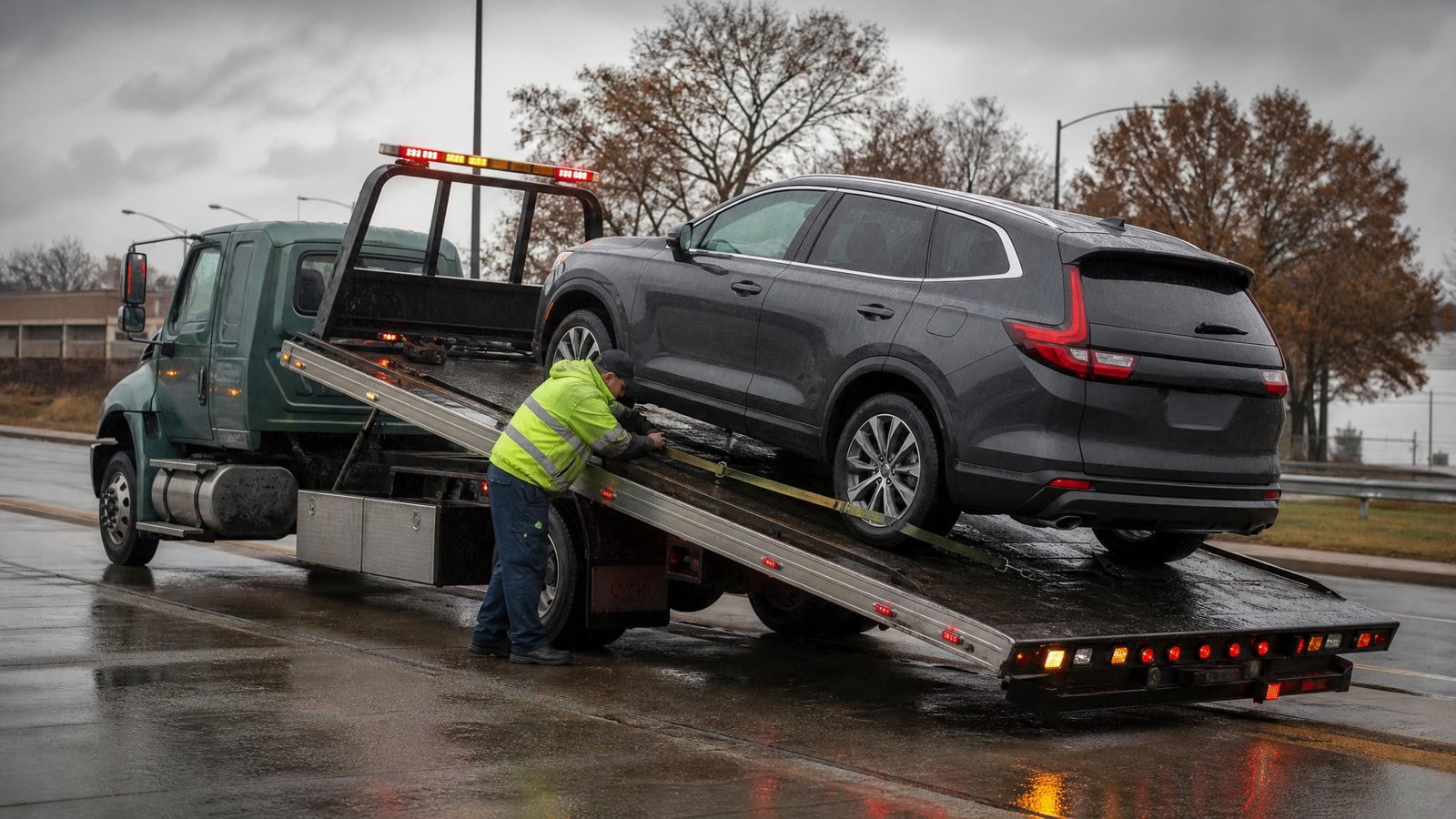
The real difference is how the vehicle’s weight gets supported during transport. That detail decides whether your car arrives safely or needs a mechanic the second it’s unloaded. Flatbed towing uses a hydraulically inclined bed that lowers to ground level, then winches the whole vehicle up until all four wheels rest on the deck. The car never touches the road during transit, so there’s no stress on axles, differentials, or steering components crossing Broken Arrow or Jenks.
Towing Method by Vehicle Type
| Vehicle Type | Flatbed Required | Wheel-Lift Safe |
|---|---|---|
| AWD / 4WD | Yes | – |
| Electric Vehicle | Yes | – |
| Low Clearance / Luxury | Yes | – |
| Automatic FWD / RWD | Recommended | Rarely |
| Manual RWD (Older) | Optional | Sometimes |
Hook-and-chain and wheel-lift methods work differently. They lift one axle and leave the other set of tires rolling on the asphalt. That was fine decades ago for rear-wheel-drive sedans, but it forces the non-lifted wheels to spin the transmission output shaft or differential without proper lubrication. You’re essentially asking your car to drive itself internally while being pulled backward, and that builds heat and friction in parts designed to move under their own power.
Modern vehicle engineering has made this distinction critical, not optional.
When to Request Flatbed Towing for Damage-Free Transport
Request a flatbed whenever your vehicle has complex drivetrain components, low ground clearance, or manufacturer rules against wheel contact. Guessing wrong here is the most common reason we get called out for preventable damage, especially when drivers assume their crossover can handle a quick wheel-lift because it looks like a regular sedan. For anything built in the last fifteen years, the safest default is keeping all four tires off the road surface.
All-Wheel Drive and Electric Vehicle Requirements
Electric vehicles and AWD crossovers, common around Bixby and Broken Arrow, need all wheels off the pavement to prevent regenerative motor backfeed and transfer case binding. In an EV, spinning wheels turn the electric motors into generators that send unregulated current back through the battery management system, which can fry expensive control modules. All-wheel-drive systems carry a similar risk, because the center differential or coupling can’t tolerate a speed difference between front and rear axles during passive rotation.
Most manufacturers now specify flatbed-only transport in the owner’s manual for AWD and EV models, and towing them any other way can void warranty claims tied to the damage. If you drive a Tesla, Rivian, Ford Mustang Mach-E, or any AWD Subaru, Audi, or Honda, insist on a flatbed no matter how short the trip. We’ve got more detail on electric vehicle towing costs and requirements, including why these rules exist and what happens when they get ignored.
Low Clearance and Luxury Vehicle Protection
Sports cars, lowered trucks, and luxury sedans with air suspension don’t load safely on a wheel-lift. The approach angle needed to lift these vehicles often exceeds what the bumper was built for, which means cracked fascias, torn chin spoilers, or crushed exhaust components before the tow even starts. Air ride systems can also collapse when the vehicle gets lifted unevenly, rupturing bags or blowing out compressors under uneven load.
Choosing a towing company for a luxury vehicle means checking they actually have equipment built for low ground clearance and sensitive bodywork. Owners who look into choosing a towing company for luxury vehicles usually realize that saving fifty dollars on a wheel-lift can cost five thousand in body shop repairs. Your car’s value is the reason to pay for equipment that treats it like cargo, not dead weight.
Hook and Chain Towing Risks for Modern Vehicles
Hook-and-chain doesn’t work safely on contemporary passenger vehicles. The engineering just doesn’t match up. The risks go past cosmetic damage, into mechanical failure that insurance may not cover if negligence gets proven.
Bumper and Frame Damage Concerns
Metal hooks and chains put enormous force onto small contact points that were never built to bear towing loads. Modern bumpers are plastic covers over energy-absorbing foam and aluminum reinforcement, designed for crash safety, not for being lifted vertically. When a chain bites into that structure, it cracks the plastic, bends the reinforcement bar, and can distort the frame rails underneath.
Even wheel-lift systems using metal arms instead of chains risk damaging alloy wheels, brake lines, and ABS sensors during hookup. The margin for error is thin on vehicles with tight wheel wells and integrated aerodynamic panels. One misaligned lift arm can scrape a rotor, pinch a fuel line, or crack a sensor housing before the operator even knows the fitment is wrong.
Why Many Shops Refuse Hook Tows
Reputable operators steer clear of hook-and-chain for passenger vehicles because the liability isn’t worth the few minutes saved. Insurance adjusters spot towing damage patterns instantly, and shops that keep causing it lose contracts and credibility around town fast.
We keep traditional hook methods for scrap removal, heavy industrial recovery, or vehicles already headed to salvage, where more damage doesn’t matter. For any drivable or repairable passenger vehicle, flatbed is the only call we make. It protects your property and our name.
Choosing Tow Method for My Car Based on Drivetrain
Your drivetrain configuration is the single biggest factor in deciding safe towing protocol, and it’s worth knowing before you even call. Front-wheel-drive, rear-wheel-drive, and all-wheel-drive systems each have their own vulnerabilities that determine whether wheels can touch pavement during transport.
FWD vs RWD vs AWD Towing Protocols
Front-wheel-drive vehicles can sometimes go with the front wheels lifted if the transmission is in neutral, though that still risks transaxle wear over longer distances. Rear-wheel-drive cars with manual transmissions tolerate rear-wheel lifting a bit better, but automatic RWD vehicles run into the same lubrication issues as FWD cars. All-wheel-drive and four-wheel-drive systems universally need flatbed transport, because no single axle can be isolated from the drivetrain without disconnecting driveshafts.
For SUV owners, we put together a dedicated comparison of SUV towing flatbed vs hook chain that covers the transfer case setups in popular models. Assuming your SUV is “just a big car” is the fastest way to burn out a transfer case or wreck a viscous coupling. Treat every SUV as flatbed-only unless your owner’s manual says otherwise.
Checking Your Owner’s Manual Before Calling
Your glovebox has the real answer on whether your vehicle allows wheel-lift towing at all. Manufacturers publish exact towing procedures, including max distance, speed limits, and prep steps like fuse removal or driveshaft disconnection. If the manual says “flatbed only,” or skips wheel-lift instructions entirely, that beats any general advice you find online.
Knowing this before you call lets dispatchers send the right truck the first time, so you’re not waiting around for an equipment swap. It also gives you the confidence to push back if an operator suggests a shortcut that doesn’t match the factory spec.
Types of Towing Methods Available in Tulsa
Tulsa Wrecker has run as a local flatbed specialist since 2019, covering South Tulsa, Jenks, Glenpool, and the surrounding area with equipment picked specifically to avoid bumper and frame damage. Our fleet sticks to light-duty flatbeds built for passenger vehicles, EVs, and motorcycles, rather than multi-purpose rigs that compromise on safety to cover more job types.
Wheel-lift trucks have their place in parking enforcement, moving vehicles short distances at low speeds on controlled surfaces. Heavy wreckers handle semi-trucks, buses, and industrial equipment too big for a flatbed. Neither one belongs in a passenger vehicle roadside call, which needs dedicated flatbed equipment and operators trained specifically in damage-free loading.
Vetting a Trustworthy Towing Company Before You Book
Asking the right questions before you book is what separates a professional operator from one cutting corners with the wrong equipment. You deserve clear answers about fleet capability, response times, and how they prevent damage, not vague reassurance. Checking takes less than two minutes and saves you a bad outcome.
Questions to Ask About Equipment and Experience
Ask the dispatcher directly whether they’re sending a flatbed, not just “a tow truck.” Confirm the driver has handled your type of vehicle before, especially if you’ve got an EV, a luxury car, or something modified with non-standard clearance. Ask about their loading process too, and whether they use soft straps instead of chains to secure the vehicle on the deck.
We put together a full list of questions to ask before hiring a tow company covering equipment, insurance, and pricing. These questions help you spot operators who care more about your vehicle’s safety than turning the job around fast. If a company hesitates to answer basic equipment questions, they probably don’t have the right truck for your car.
Verifying Local Ownership and Response Times
Local owner-operators know Tulsa traffic, construction zones, and neighborhood access in a way national dispatch centers never will. They know how to work around Mingo Road construction delays or Brookside parking constraints because they deal with it daily, not because a GPS told them. That translates to faster arrivals and safer pickups from tricky spots.
Looking into what to look for in a towing company beforehand gets you ready to judge a provider before you’re stressed out on the shoulder of a highway. Established local businesses have their reputation on the line in this community, which is accountability an anonymous call center just doesn’t have.
Making the Safe Choice for Your Vehicle and Budget
Choosing between flatbed and hook towing comes down to this: your car’s mechanical integrity is worth more than the price difference between the two. Paying a bit more upfront for proper flatbed transport beats paying for a transmission rebuild, a differential replacement, or bodywork later. Stress makes it hard to think clearly in the moment, so keep this simple rule in your back pocket: if your car has AWD, EV propulsion, low clearance, or an automatic transmission, flatbed is mandatory.
Your safety and your car’s condition matter more than shaving twenty minutes off arrival time or thirty dollars off the bill. Tulsa Wrecker runs damage-free flatbed towing built around your specific vehicle, powered by Neptune Towing (539-292-3074), with local experience since 2019. Call us when you want flatbed service that respects your car as much as you do.
Frequently Asked Questions
How much more does flatbed towing cost compared to hook-and-chain?
Flatbed towing typically costs modestly more than wheel-lift service due to specialized equipment and longer loading times. However, this premium is negligible compared to potential drivetrain or body damage repairs from improper towing methods. Always prioritize vehicle safety over minimal upfront savings.
Can my front-wheel-drive car be towed with a wheel lift?
Some front-wheel-drive vehicles with manual transmissions can tolerate short-distance wheel-lift towing with front wheels raised. Automatic FWD vehicles still risk transaxle damage because the transmission pump may not circulate fluid properly during passive rotation. Check your owner’s manual for explicit permission before accepting anything other than flatbed service.
What should I tell the dispatcher to ensure I get a flatbed?
State clearly that you require flatbed towing and specify your vehicle’s year, make, model, and drivetrain type. Mention if your car is all-wheel-drive, electric, lowered, or has air suspension to trigger appropriate equipment assignment. Ask for verbal confirmation that a flatbed truck is being dispatched rather than a generic tow unit.
Is wheel-lift towing ever safe for modern vehicles?
Wheel-lift towing is safe only for specific older rear-wheel-drive vehicles with manual transmissions and explicit manufacturer approval. Modern passenger vehicles with automatic transmissions, AWD, EV propulsion, or low clearance should never be wheel-lifted. Reputable Tulsa operators default to flatbed service for all contemporary roadside assistance calls.