
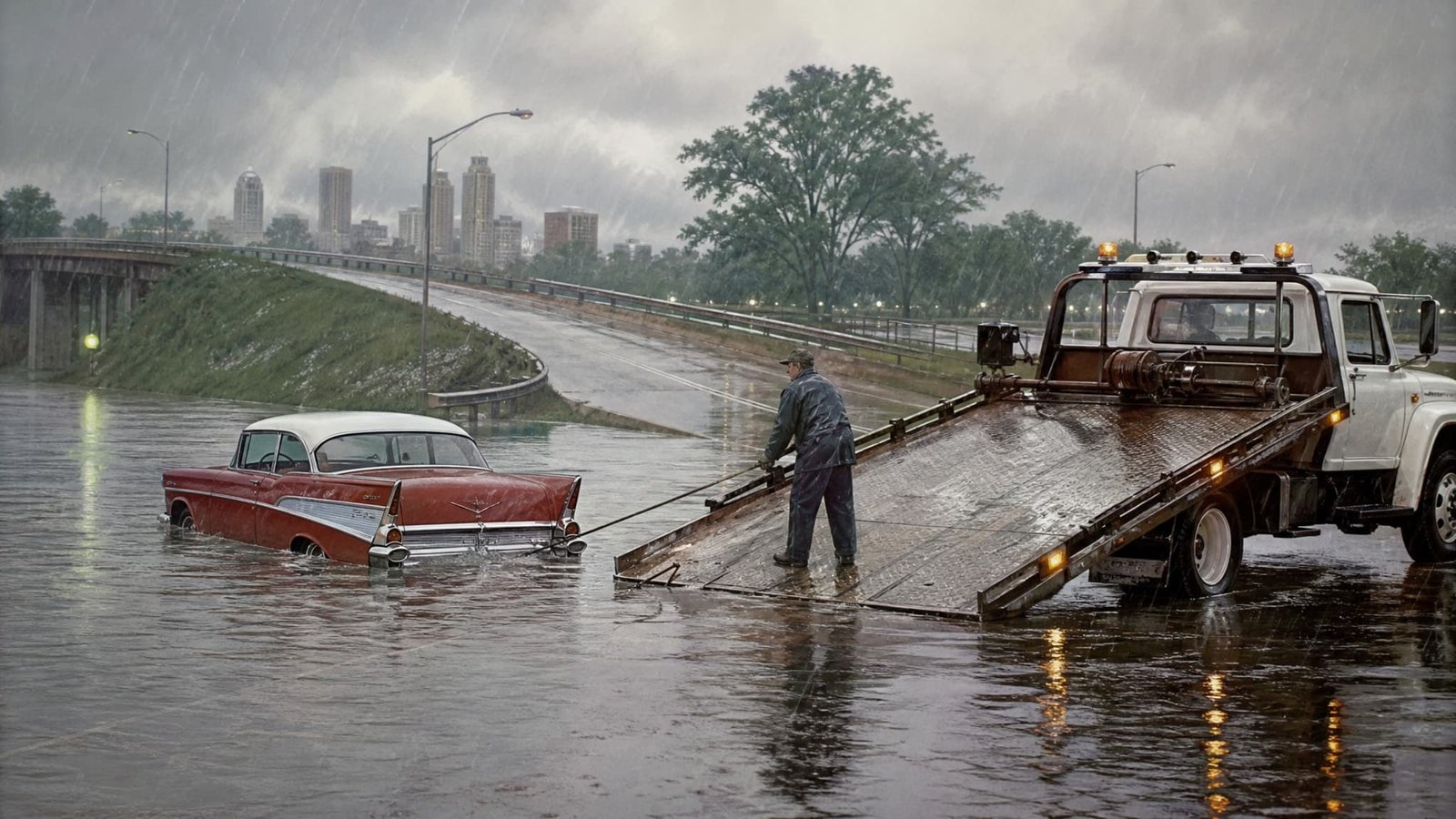
You turn the key after a heavy downpour and hear nothing but silence or a strained click. Every Tulsa driver knows that feeling. Your car won’t start after rain, and it always picks the worst moment to do it. Maybe you’re sitting in your driveway in Jenks. Maybe you’re stuck at a low-water crossing on Riverside Drive, or stranded in a Bixby parking lot while water pools around your tires. Panic is understandable, but what you do in those first few minutes decides whether this is a minor inconvenience or a wrecked engine. Understanding why Tulsa’s weather does this to cars helps you make the safer call when the skies open up.
Why Tulsa Spring Storms Cause Starting Failures
Tulsa spring storm car trouble comes from a specific mix: sudden deluges on top of lingering humidity, which stresses a car’s systems in ways steady drizzle or a dry cold snap never does. Geography plays a big part. The Arkansas River basin and the creeks that feed it create low spots where water piles up faster than storm drains can move it. Add in the intense electrical storms we get from April through June, and a vehicle is facing something well beyond wet pavement.
Flash Flooding vs. Heavy Rain: Knowing the Difference
Heavy rain soaks components gradually, but flash flooding shoves water into sealed spaces on contact. A car can survive hours of steady rain because gravity pulls water down and away from the intake. Standing water works the opposite way. It pushes upward, forcing moisture past gaskets and seals that were only ever built to shed falling rain. Tulsa Wrecker crews regularly pull vehicles out at low-water crossings on Riverside Drive and Peoria Avenue after sudden downpours, because a dip that looks gentle can turn into a trap in minutes. If your car stalled in rain tulsa near one of these corridors, water ingestion is a lot more likely than simple electrical dampness.
How Local Humidity Affects Electrical Systems
Oklahoma’s muggy air acts like an invisible conductor, bridging gaps between electrical contacts well before any puddle forms. Modern engines with exposed ignition coils misfire after heavy rain far more often than the distributor-based engines of decades past, since those high-voltage paths carry less insulation against ambient moisture. That humidity lingers in the engine bay long after the sun’s back out. A car that started fine mid-storm can fail hours later, once condensation settles on warm connectors as the temperature drops.
Common Reasons Your Car Won’t Start After Rain
Diagnosing the problem correctly saves you from expensive mistakes during an already bad day. Older cars used to suffer from soaked distributor caps. Your modern car is more likely fighting sensitive electronics and precise air-management systems that were never meant to run underwater.
Wet Ignition Coils and Spark Plugs
Moisture pooling in the spark plug wells gives voltage a direct path to ground before it ever reaches the combustion chamber. That usually shows up as a rough idle or a dead no-start, not a slow crank, and drying these parts means pulling them out, not just waiting around for evaporation. Cranking the engine over and over while the coils are wet just speeds up corrosion on the connector pins, and it can fry the module that drives them.
Flooded Air Intake and Hydrolock Risks
Water getting in through the air filter housing is the most dangerous thing that can happen after driving through standing water. Trying to restart a hydrolocked engine can bend a connecting rod instantly, so a professional check beats trial-and-error every time, liquid simply doesn’t compress the way an air-fuel mixture does. If your engine cranked normally and then seized without warning while crossing a flooded intersection, assume there’s internal damage. Leave the key alone until a mechanic has looked at the cylinders.
Battery Terminal Corrosion from Moisture
Storm runoff carries road salt and minerals that speed up corrosion on battery posts, even in the summer. You might see white or blue-green crust build up fast after a wet spell. That crust adds enough resistance to stop the starter from pulling the amperage it needs, even with a perfectly healthy battery. Cleaning the terminals is an easy fix. If corrosion has crept under the cable insulation, though, you’re looking at replacement, not cleanup.
Safety First: What to Do When Stalled in Rain
Your safety matters a lot more than getting the car running again right away. Panic leads to bad decisions, so take a breath and read the situation before you touch anything mechanical.
When to Stay Put vs. When to Exit the Vehicle
Stay inside with your seatbelt on if water is actively moving across the road or climbing up around your doors. Stepping out into moving water puts you near hidden debris, open manholes, and currents strong enough to knock an adult off their feet in surprisingly shallow water. Only leave the vehicle if water is rising inside the cabin, or if you’re stopped somewhere oncoming traffic can’t see you through the downpour.
Avoiding Water Damage While Waiting for Help
Do not try to restart a submerged engine, period. Every crank pulls more water deeper into the block. Shut off accessories, headlights included, along with the radio, to save what’s left of the battery for hazard lights and calling for help. If you think water reached the floorboards, snap a photo of the water line with your phone. Insurance adjusters will want that evidence to process a flood claim properly.
This is not a situation where persistence pays off.
Flooded Car Towing in Tulsa: Why Flatbed Is Essential
How your car gets recovered decides whether it’s repairable or a total loss after water exposure. Since 2019, Tulsa Wrecker has run flatbed-only recovery on storm-damaged vehicles, specifically to avoid the drivetrain damage that dragging causes. We’ve seen too many cars roll into shops with transmission damage that had nothing to do with the flood itself and everything to do with how they got towed afterward.
Preventing Drivetrain Damage During Recovery
All-wheel-drive and four-wheel-drive systems need every wheel turning at the same speed, or the differentials and transfer case start binding. Drag even one axle of a flooded SUV or truck and you force water-logged bearings and gears to spin dry, which turns a fixable electrical issue into a guaranteed rebuild. As we get into when covering why flatbed beats hook and chain for SUVs, lifting all four wheels removes that risk completely and keeps contaminated fluid from sloshing around during transport.
Why Hook-and-Chain Can Ruin a Wet Engine
A traditional wrecker that lifts only one axle leaves the other wheels sitting in floodwater the whole ride. That soaks brake rotors, ABS sensors, and wheel bearings in silt-filled runoff, which speeds up wear and lets contaminants into parts that are supposed to stay sealed. For flooded car towing in Tulsa, settling for anything less than full flatbed service means gambling with parts that may already be compromised.
Storm Damage Assessment Before Restarting
A quick visual check takes two minutes and can save you thousands in repairs you didn’t need to pay for. You don’t need to be a mechanic to spot the red flags that mean call someone before you turn the key.
Pop the hood and check the air filter element first. A damp or discolored filter tells you water reached the intake. Pull the dipstick and check the oil; milky or chocolate-colored oil means coolant and water are mixing inside the crankcase, and that needs service right away. Look over the fuse boxes and relay panels for water lines or residue, then check the cabin carpet for a musty smell, which usually means water got past a door seal or floor drain. If everything’s dry and no warning lights came on during the stall, you might just be dealing with moisture on an external sensor. Still, if you’re unsure, err toward caution.
Whether it’s safe to restart a car after heavy rain comes down entirely to finishing that check first. If you spot signs of water intrusion, or you’re just not sure what you’re looking at, calling for local roadside assistance options beats guessing.
Choosing Reliable Storm Response Towing in Tulsa
Not every tow company handles wet-weather calls with the same skill or care. When a storm rolls through, dispatch boards light up, and who answers your call matters more than usual.
Local Dispatch vs. National Call Centers
National networks route calls off availability algorithms, not knowledge of which streets are underwater right now. A dispatcher sitting in another state has no idea Elm Street floods before 71st Street clears, or that certain underpasses near Broken Arrow go impassable within minutes of hard rain. A local owner-operator knows these patterns because he drives them every day, and he’s got relationships with the city crews watching the drainage system.
What to Ask Before Booking Wet Weather Service
Ask whether the company runs flatbed equipment exclusively for storm calls before you say yes to a dispatch. Ask about their experience with your specific vehicle in wet conditions too, especially if you drive an EV, a hybrid, or an all-wheel-drive model that needs a different kind of handling. Our page on questions to ask before calling walks through how to vet an operator properly instead of just taking whoever answers fastest during chaos. Nail down pricing upfront, too. Storm surges sometimes bring out outfits hoping a stressed-out driver will pay whatever number they throw out.
Preventing Future Storm-Related Breakdowns
Proactive maintenance costs a fraction of what an emergency tow and repair bill runs. An afternoon spent prepping your car before storm season hits pays off every time dark clouds roll in over Green Country.
Check door and trunk seals once a year for cracks or gaps that let moisture in during wind-driven rain. Coat battery terminals and exposed electrical connectors with dielectric grease to keep corrosion out through the wet months. Swap air filters more often if you’re driving through dusty construction zones followed by rain, since dust soaks up water and holds it right against the intake. Keep the drain holes in your rocker panels and sunroof channels clear of leaves and debris, so water actually exits instead of backing up into the cabin. Small habits like these add up over a season, and they’re the difference between driving on and waiting on the shoulder for someone else.
Save Tulsa Wrecker’s number (539-292-3074) in your phone now, before you need it during the next downpour. Powered by Neptune Towing, we run damage-free flatbed recovery across Tulsa, Jenks, Bixby, Broken Arrow, Glenpool, and South Tulsa whenever storms hit.