
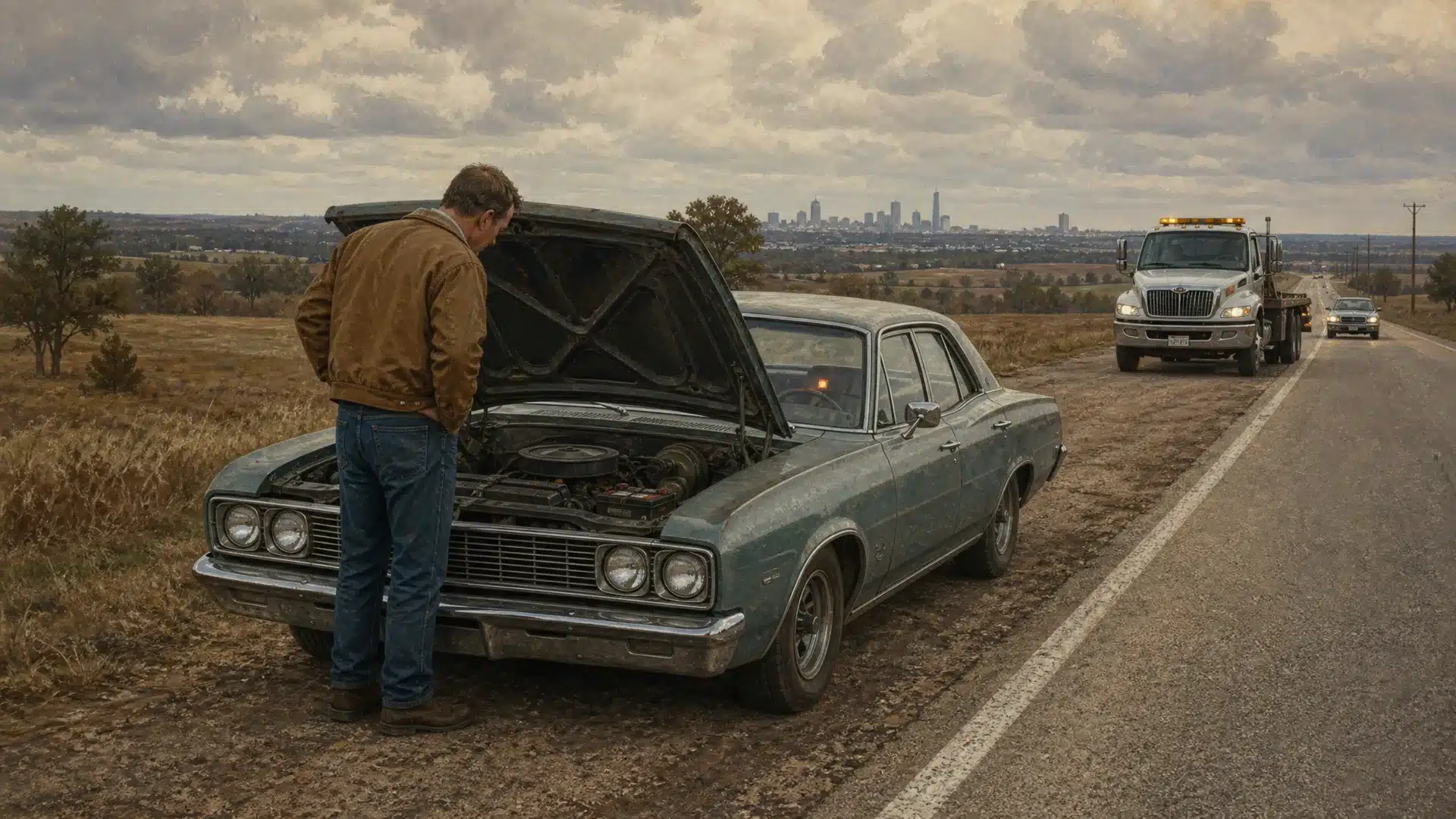
If your car won’t start in Tulsa, the first thing to do is stay calm, because the fix is usually simpler than you think. Most no-start situations come down to one of two things: a dead battery or a bad starter. Knowing which one you’re dealing with takes about 30 seconds and zero tools. This guide walks you through how to self-diagnose, what to do while you wait, and when it’s smarter to call for help than to keep guessing.
Why Your Car Won’t Start: Battery vs. Starter Problems in Tulsa
The sounds your car makes when you turn the key tell you almost everything. Don’t ignore them, they’re your quickest diagnostic tool on the side of the road.
Signs It’s a Dead Battery
Rapid clicking, a fast, machine-gun series of clicks, when you turn the key is almost always a low or dead battery. The battery has just enough power to activate the starter solenoid repeatedly, but not enough to actually spin the engine.
A single loud click followed by nothing is another common sign. That usually means the battery can’t deliver enough current to the starter solenoid, one of the most frequent patterns we see on Tulsa highway shoulders and parking lots.
A slow, labored crank, where the engine turns over but sounds like it’s dragging, also points to a weak battery. Dim dash lights and a sluggish start are other tells.
If your car won’t crank and the lights are barely on or the interior is totally dark, a dead battery is the most likely culprit. That’s also where dead car battery help in Tulsa is the fast, practical fix.
Signs It’s the Starter or Something Else
Complete silence when you turn the key, no click at all, is a different story. That more often points to a starter motor or ignition circuit issue, not the battery. If your dash lights are bright and your radio works fine but the engine won’t make any sound, suspect the starter.
The battery-or-starter question is common, and the short answer is this: noise usually means battery, silence usually means starter. There are exceptions, but that rule gets it right most of the time.
Other possibilities include a bad alternator (the battery drains because it’s not recharging while you drive), a blown fuse, or a faulty ignition switch. If you’ve already jumped the car twice and it dies again shortly after, you’re dealing with something beyond a simple dead battery.
What to Do First When Your Car Battery Is Dead in Tulsa
Before you call anyone or flag down a stranger for a jump, run through a quick mental checklist. It keeps you safer and gives you better information when you do call for help.
Safe Steps Before You Call Anyone
1. Get somewhere safe first. If you’re stuck on a busy road, prioritize your safety. Get as far off the travel lane as possible. Parking lots off 71st Street, the shoulder of I-44, and side streets near the BA Expressway are all common breakdown spots, and some of them have real traffic risk. Hazard lights on, stay in the car if you’re on a highway.
2. Check your dash lights. Turn the key to the “on” position without cranking. If nothing lights up at all, the battery is likely completely dead. If lights come on but the engine won’t turn over, note what you see, it helps whoever responds.
3. Try a jump start if help is nearby. If someone you trust has jumper cables and a working vehicle, a jump start is a reasonable first step, but only if you know the correct connection order. More on safety in a moment.
4. Call for help if you’re unsure. If you’re alone, it’s late, or you’re on a highway, there’s no shame in calling for roadside assistance across Tulsa right away. Being stuck on a dark side street is a situation where professional help is genuinely worth it.
Working through these steps calmly gives you a clear picture of what you’re dealing with.
Jump Start vs. Towing in Tulsa: Which One Do You Actually Need?
This is the real question, and the honest answer depends on why your battery died, not just that it did.
When a Jump Start Is Enough
A jump start works well when the battery is simply drained from a one-time event: you left the lights on overnight, the car sat unused for a few weeks, or the cold snapped the remaining life out of an aging battery on an early morning. If the battery is fundamentally healthy and just needs a charge, a jump will get you going and the alternator will recharge it as you drive.
In that case, the answer is clear: jump start wins. It’s faster, cheaper, and gets you back on the road without a trip to the shop.
When You Should Skip the Jump and Call a Tow Truck
A jump start is a short-term fix, not a diagnosis. Here’s when to skip it and call for a tow instead:
- The car has died multiple times in recent days. If you’ve jumped it twice already, the battery is failing or the alternator isn’t charging it. Jumping it again just delays the inevitable.
- The engine still won’t turn over after a successful jump. If you get a charge but the car still won’t crank, the problem isn’t the battery.
- The battery is old. Most car batteries last 3–5 years. If yours is past that window, a jump might not hold.
- The car dies again within a few miles. That’s a charging system problem, not a battery problem.
Knowing when to call a tow truck is about being honest with yourself. A tow to a shop now is almost always cheaper than a roadside breakdown on the highway later, especially if you’re driving on a battery that’s already failed once.
If towing turns out to be the right call, towing a non-drivable vehicle in Tulsa on a flatbed is the safest option for your car and your peace of mind.
When to Call a Professional for Roadside Battery Help in Tulsa
DIY jump starts work fine in many situations, but there are real scenarios where doing it yourself causes more damage than the original problem.
Modern vehicles, especially those with advanced electronics, start-stop systems, or hybrid components, are sensitive to jump start mistakes. Connecting cables in the wrong order, or to the wrong terminal, can blow fuses or damage the ECU. That repair costs far more than a tow. If you’re not 100% sure of the correct procedure for your specific vehicle, calling a professional is the smarter move.
If you’re driving an EV or a hybrid and the engine won’t turn over, don’t attempt a standard jump start at all. The 12V auxiliary battery in these vehicles requires a different approach, and connecting a traditional charger to the wrong point can create a serious safety hazard.
These are exactly the situations where a quick call to Tulsa Wrecker makes sense. The team handles on-site jump starts for standard vehicles and full flatbed towing for EVs, hybrids, and anything else that needs to move safely. Reach them directly at 539-292-3074 for roadside battery help in Tulsa, any time of day.
If you’re dealing with a larger vehicle, the team also handles heavy-duty jump start for diesel trucks and RVs, something most roadside services can’t do on the spot.
And if you’re already broke down on a Tulsa highway, don’t wait around hoping for a passerby. A professional response is safer and faster than managing that situation alone.
Fast Tulsa Response: What to Expect When You Call Tulsa Wrecker
Tulsa Wrecker is powered by Neptune Towing and operated by local owner Remi Carrillo, who has been responding to dead battery calls and breakdowns across the Tulsa metro since 2019. That’s years of real-world familiarity with where and why Tulsa drivers get stranded, from the parking lots near Woodland Hills Mall to the highway shoulders on I-44 and beyond.
When you call 539-292-3074, you’re reaching local dispatch, not a national call center routing your request to whoever’s available. The team covers Tulsa, South Tulsa, Broken Arrow, Jenks, Bixby, and Glenpool.
If a jump start does the job, that’s the goal. If the car needs to move, it goes on a flatbed. Damage-free towing is the standard, not an upgrade.
Whether you need a quick jump or a full tow to a shop, 24-hour towing service in Tulsa is available when you need it. Don’t sit on the side of the road longer than you have to, call 539-292-3074 and get a real local operator on the way.