If you’re sitting on the side of a Tulsa road asking yourself whether it’s safe to drive, that question alone is usually your answer. Knowing how to check if your car needs towing in Tulsa, versus nursing it to a nearby shop, is the difference between a simple service call and a repair bill that stings for months. I’ve run recoveries from Sand Springs to Broken Arrow since 2019, and the same mistakes show up over and over. This guide gives you the honest framework to make that call with confidence.
Warning Signs Your Car Needs a Tow Truck Right Now
Some situations aren’t gray areas. They’re pull-over-immediately, call-a-tow-truck moments, and treating them as anything less makes things worse.
Smoke, Steam, or Burning Smells, Don’t Risk It
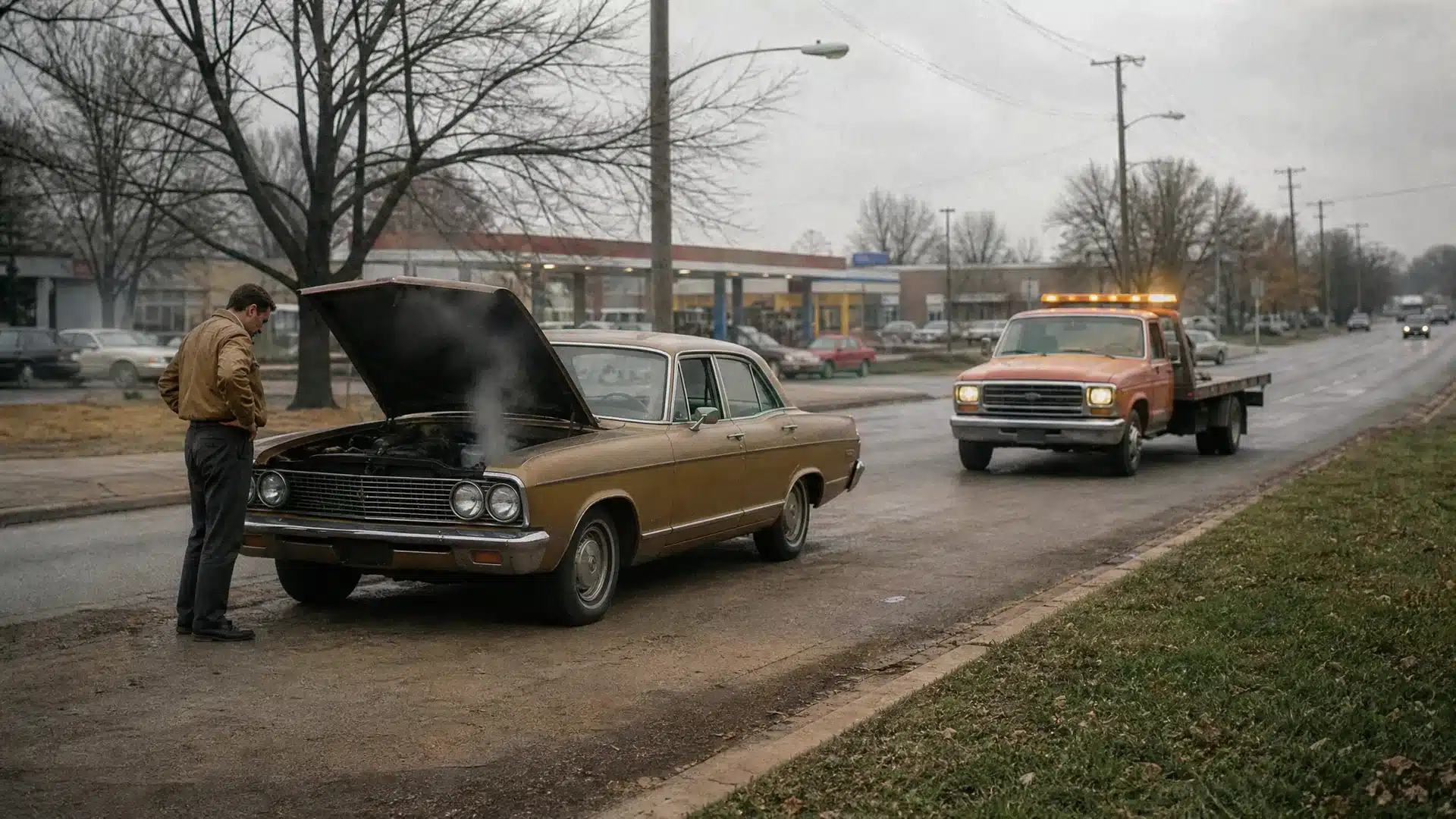
Smoke from under the hood is not a “let me see if it clears up” situation. Whether it’s white steam from a blown coolant hose or dark smoke from an overheating engine, keep driving and you risk warping cylinder heads or seizing the engine entirely. That’s a several-thousand-dollar repair that starts as a $150 tow call.
A burning smell, especially a sharp, acrid odor, can signal an electrical short, overheated brakes, or a dragging component. Each of those gets dangerous fast. Pull off safely, shut the car down, and call for a tow.
The calls that hurt the most are from drivers who smelled something wrong, figured they could make it another mile, and made it about a block before the car died completely. The tow cost stays the same. The repair bill doesn’t.
Brake Failure and Steering Problems That Make Driving Dangerous
If your brake pedal sinks close to the floor, or goes all the way to the floor, stop driving. Partial brake failure can become total brake failure with no warning. That’s not a risk worth taking on Tulsa’s busy arterials or the entry ramps on I-44.
Steering problems are equally serious. A wheel that pulls hard to one side, a steering column that feels stiff or locked, or any grinding when you turn means your vehicle isn’t behaving predictably. You can’t safely pilot a car through Midtown traffic or a 75 mph highway merge when the steering is compromised. These are immediate tow situations, every time.
When a Flat Tire, Overheating, or Transmission Noise Means Call a Tow
These are the situations Tulsa drivers second-guess most. Here’s a straight answer for each.
Can You Drive on a Flat Tire in Tulsa? Here’s the Honest Answer
No, and the Creek Turnpike is a perfect example of why. A driver who limps a car with a blown tire from the Creek Turnpike to a nearby shop risks shredding the tire completely, bending the wheel, and damaging the suspension. What started as a $200 tire replacement can turn into a $700 wheel and suspension repair by the time they pull into the parking lot.
If you have a full-size spare and the ability to safely mount it where you’re stopped, a spare swap is a legitimate DIY fix. But driving, even slowly, on a flat rim destroys metal and rubber fast. Get flat tire help in Tulsa from a professional instead of gambling on making it to a shop.
Overheating Car and Transmission Noises: Tow or Wait?
Overheating: When your temperature gauge hits the red, pull over immediately and shut the engine off. You can let it cool for 20–30 minutes in a safe spot. If the gauge climbs back into the red within a few minutes of restarting, don’t drive it. Engine overheating is one of the most common causes of severe, preventable engine damage, continuing even a short distance once you’re in the red can warp cylinder heads or seize the engine. Call a tow on a hot Oklahoma summer day; don’t push it down US-169 hoping the temperature drops.
Transmission noises: A clunk when shifting, a grinding sound in gear, or a transmission that slips and hesitates are all signs of transmission problems that require a tow in Tulsa. Driving on a failing transmission accelerates the damage significantly. If the car won’t engage a gear at all, there’s no decision to make, it’s a tow.
Vehicle Breakdown Signs Tulsa Drivers Often Ignore
Not every breakdown announces itself with smoke and drama. Some of the costliest repairs start as easy-to-ignore symptoms on the daily commute.
Watch for these before they become a bigger problem:
- Dashboard warning lights that stay on, especially the check engine, oil pressure, or battery lights. One steady light is a “get it checked” signal. Multiple lights together mean stop driving.
- Fluid puddles under the car, oil is dark brown or black, coolant is often green or orange, and transmission fluid is reddish. A fresh puddle means something is actively leaking. Transmission fluid leaks and when to stop driving depends on how fast the fluid is going, but any active leak warrants a professional look before your next trip.
- Sluggish acceleration or engine hesitation, if your car feels like it’s dragging under normal throttle on Highway 75 during the afternoon rush, that’s not a “bad gas” situation. It can point to fuel system, transmission, or sensor issues.
- Intermittent strange smells, a sulfur or “rotten egg” smell often signals a catalytic converter issue. Sweet smells can mean coolant leaking internally. Neither is safe to ignore for long.
These signs rarely mean instant danger, but they’re your window to handle the problem before the car decides to quit on I-44 during rush hour.
After a Tulsa Accident: When Your Car Needs Towing Even If It Starts
This is one of the most common misconceptions in post-accident decisions. The car starts, it drives to the shoulder, so it must be fine to take home, right? Not necessarily.
After a rear-end collision at low speed, a car may start and drive fine, but if the impact bent a control arm or shifted the subframe, the steering alignment is compromised. A vehicle like that can become unpredictable at highway speeds on US-75 or I-44. You might not notice the problem until you’re changing lanes at 65 mph.
Visible damage to wheels, tires leaning at odd angles, scraping sounds when turning, or any airbag deployment all mean the car should not be driven, even if it technically moves. After a collision, what to do after a car accident before you call a tow truck matters as much as the tow itself.
Flatbed transport is the right call for post-accident vehicles. Keeping all four wheels off the road during transport protects suspension components that are already stressed. It’s not an upsell, it’s the method that prevents additional damage between the accident site and the shop.
For safely towing a non-drivable vehicle in Tulsa, a flatbed is almost always the correct equipment choice.
DIY Roadside Fix vs. Calling a Tow Truck in Tulsa, How to Decide
Some roadside problems are genuinely manageable on your own. Others look manageable but aren’t. Here’s a practical way to sort them.
You can likely handle it yourself if:
- You have a fully inflated full-size (or temporary) spare and the flat is on a stable, level surface away from traffic
- The battery is dead and you have jumper cables and another vehicle, and the car starts and runs normally after the jump
- You ran out of fuel and can safely walk to a nearby station or have fuel delivered
Call a tow truck if:
- The spare is also flat, damaged, or you can’t safely change it at your location
- The car starts after a jump but dies again within a few minutes (battery or alternator issue that won’t self-resolve)
- Any of the warning signs above, smoke, brakes, steering, overheating, transmission, are present
Knowing when a DIY fix is actually the right call in Tulsa saves money and time. But the honest rule is this: if driving the car will make the underlying problem worse or put you at risk, the tow is the cheaper option in the long run.
How to Stay Safe on a Tulsa Road While You Wait for a Tow
Once you’ve decided to call for help, the next priority is staying safe until the truck arrives. Here’s the quick checklist:
- Get off the travel lanes immediately. If the car can move at all, pull to the right shoulder or into a parking lot. On Riverside Drive or Memorial Drive, even a shoulder stop can feel close to traffic, get as far right as possible.
- Turn on your hazard lights right away. Do this before you call anyone. It’s the single fastest thing you can do to reduce the risk of another driver hitting you.
- Stay out of the car if it’s safe to exit. If you’re on a highway shoulder, stand behind a guardrail, not beside the car. Shoulder impacts happen, and being outside the vehicle is safer than being inside it.
- Don’t stand between your car and traffic. Position yourself away from the roadway, ideally behind a barrier or up an embankment if one is available.
- Keep your phone charged and location ready. When you call, be specific, intersections, mile markers, or a nearby business name help the driver find you faster.
For more on staying safe on Tulsa roads while waiting for a tow, Oklahoma’s Move Over law also requires drivers to change lanes or slow down when passing stopped emergency and tow vehicles, knowing that helps you understand why getting fully off the road matters.
When you’re ready to call, Tulsa Wrecker’s 24-hour flatbed towing service is available around the clock. Remi Carrillo and the team have handled breakdowns and recoveries across Tulsa, Broken Arrow, Jenks, and Bixby since 2019. Call 539-292-3074, give your location and a quick description of what the car is doing, and a flatbed will be on the way. No pressure, no hard sell. Just a calm, experienced team that knows how to handle it.