Every time a tow truck pulls onto the shoulder of US-75 or I-44, the operator steps out into one of the most dangerous workspaces in Oklahoma. Traffic passes at highway speed, often just a few feet away. Amber strobes are flashing. The operator’s back is turned while they secure a vehicle. The only thing standing between them and a catastrophic strike is whether you, the approaching driver, know what to do. That’s exactly what Slow Down Move Over means, and why it matters more than most drivers realize.
Why the Slow Down Move Over Law Matters on Tulsa Roads
Tulsa’s major corridors, US-75, I-44, Highway 169, the Creek Turnpike, carry heavy daily traffic. At any hour, a breakdown or collision can put tow operators, highway patrol, and paramedics on the shoulder with nothing but cones and strobes between them and live lanes. Roadside workers across the U.S. are struck and killed by passing vehicles every year. Move over compliance is one of the most concrete safety habits any driver can build.
This isn’t a niche road rule. It’s the difference between a responder going home that night and not.
What Oklahoma’s Move Over Law Actually Requires
Oklahoma’s move over law, codified under Title 47 §11-314 of the Oklahoma Statutes, requires drivers to do one of two things when approaching a stopped vehicle with flashing lights on the roadside:
- Move over one full lane away from the stopped vehicle if it’s safe to do so.
- Reduce speed significantly below the posted limit if a lane change isn’t safely possible.
This law covers more than police cruisers. It applies to fire trucks, ambulances, highway maintenance vehicles, and tow trucks and roadside service vehicles with amber or emergency lights activated. For a full breakdown of what the move over law covers in Oklahoma, that companion article walks through the statute in plain language.
Every state in the U.S. now has some version of this law on the books. Oklahoma’s version is broader than many drivers assume.
The Real Danger at a Roadside Scene in Tulsa
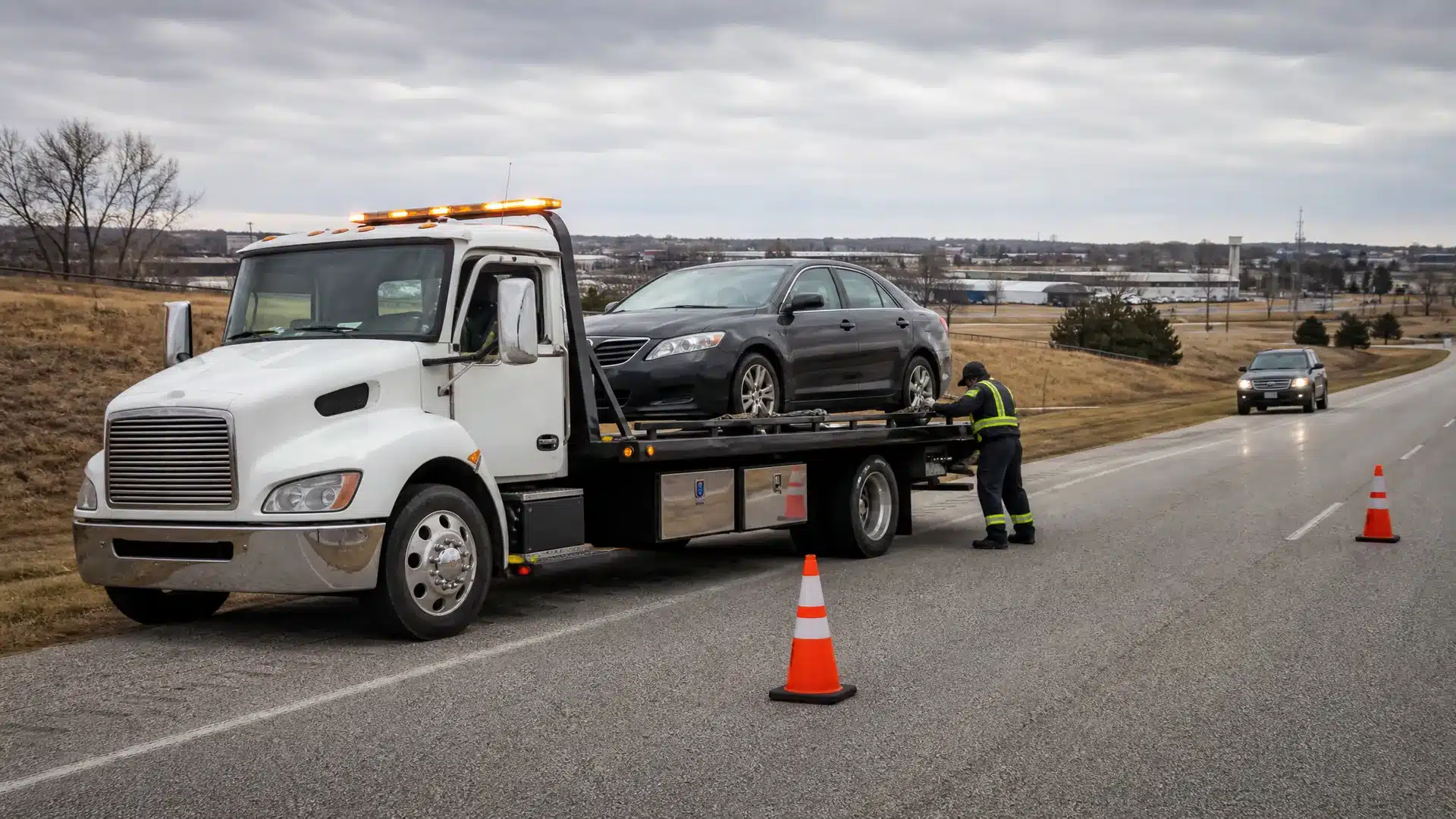
Picture this: it’s 7:45 a.m. on a Wednesday. A sedan is disabled in the right lane of southbound US-75 near 81st Street. A flatbed tow truck pulls up, lights going. The operator sets cones, positions the truck, and starts rigging the vehicle. Traffic is merging left, some of it. Other drivers are slowing to look. A few are barely moving over at all.
That operator is working in an area roughly the width of one traffic lane. On a busy urban interstate, the shoulder is often less than ten feet wide. A flatbed with its amber strobes running takes up most of that shoulder, leaving less than a car-width between the operator and passing traffic.
Tow Truck Operators Are Among the Most Vulnerable Workers on the Road
Remi Carrillo and the Tulsa Wrecker team have responded to hundreds of roadside scenes across Tulsa, South Tulsa, Broken Arrow, and the Creek Turnpike corridor since 2019. Driver inattention is consistently the biggest hazard operators face on every call.
The operator can’t watch approaching traffic while working the rigging. They’re focused on the vehicle, the chains, the angles. They’re trusting that drivers will do the right thing. When someone blows past at 65 mph with two feet of clearance, it’s not just scary, it’s a near-miss that operators deal with regularly.
Tow truck safety in Tulsa depends directly on driver behavior. That’s not an overstatement.
Common Driver Mistakes That Put Lives at Risk
These are the behaviors that make roadside scenes dangerous:
- Late merging. Drivers wait until they’re almost at the scene before changing lanes, cutting off other traffic and reducing time for the operator to react.
- Rubbernecking. Slowing down to look but not actually moving over creates a lane-change mess and unpredictable traffic patterns around the scene.
- Distracted driving. A driver on a phone doesn’t see the strobes in time to make a safe, early lane change.
- Speeding through a work zone. Some drivers treat an active tow scene like an obstacle to blow past rather than a hazard to navigate carefully.
- Re-entering the lane too early. Cutting back in before fully clearing the scene can catch an operator still working at the rear of a vehicle.
Each of these is preventable. All of them happen regularly on Tulsa highways.
How to Pass Emergency Vehicles Safely: A Practical Driver Checklist
Knowing how to pass emergency vehicles safely is a skill, and like most driving skills, it works best when it’s automatic. Here’s what a seasoned Tulsa driver does when they spot flashing lights ahead:
- Check your mirrors early. As soon as you see lights ahead, check left. Know what lane space you have before you need it.
- Signal and merge early. Don’t wait until you’re 50 yards out. Start the lane change with room to spare, it’s safer for you and less stressful for everyone behind you.
- Reduce your speed before you arrive. Drop to well below the posted limit as you approach. If you can’t safely change lanes, Oklahoma law requires a significant speed reduction.
- Put the phone down completely. This is not the moment for a glance at a message. Eyes up, hands on the wheel.
- Don’t gawk. Stay focused on driving, not on what’s happening on the shoulder.
- Don’t re-enter the right lane until you’ve fully cleared the scene. Give the operator, the cones, and the disabled vehicle room before you move back over.
These roadside safety tips aren’t complicated, but they require attention and intention. Build the habit now, before you’re suddenly on the Creek Turnpike at 70 mph with a tow scene coming up fast.
Tow Truck Safety on Tulsa Highways: What Happens on Our End
What a Tow Scene Looks Like From the Operator’s Side
When we pull up on a call on I-44 near downtown or out on the Creek Turnpike toward Broken Arrow, the first thing we do is position for safety, ours and yours. We angle the truck to give as much buffer as possible, set reflective cones behind the scene, and get the amber lights working before we step out of the cab.
Then we start working the vehicle. On a flatbed, that means releasing the bed, positioning the wheel straps or chains, and winching or driving the car up onto the deck. The whole process takes several minutes, and during every one of those minutes, we’re outside the truck, exposed.
Tulsa Wrecker uses flatbed trucks because loading the vehicle can be done with less exposure to live traffic lanes compared to a wheel-lift setup. An operator still has to work outside the cab in the open while traffic passes. How flatbed towing differs from wheel-lift at a roadside scene explains the operational differences in more detail.
What makes it manageable is drivers doing the right thing. When someone moves over early, slows down, and gives us room, we notice. It matters every single time.
Oklahoma Traffic Safety: Penalties and What’s at Stake
Violating Oklahoma’s move over law requirements and penalties carries real consequences. A first offense can result in a fine, and if the violation causes injury or property damage, drivers can face reckless driving charges, a much more serious criminal matter.
Beyond fines, the stakes are human. Hitting a roadside worker or a stranded motorist changes lives permanently. No distraction, no hurry, no lapse in attention is worth that outcome.
Move over enforcement has increased in recent years as awareness campaigns have grown. State troopers actively enforce the law on US-75, I-44, and Highway 169, corridors where tow scenes and emergency stops are frequent.
Keep it simple: move over, slow down, pay attention.
If You’re the One Stranded: How to Stay Safe Until Help Arrives
If your car breaks down or you’re in a collision on a Tulsa highway, your first moves matter. Here’s what to do:
- Pull as far right as possible. Get fully onto the shoulder, ideally past the white fog line. More distance from traffic is always better.
- Turn on your hazard lights immediately. Do it before you even stop completely. It signals other drivers while you’re still moving.
- Stay behind the guardrail if one is present. If you exit the vehicle, get behind any physical barrier between you and traffic. Never stand in a travel lane or directly beside your car.
- Call for help right away. The longer you’re sitting on the shoulder, the more exposure you have. Get a professional tow dispatched fast.
For a full guide on what to do when your car breaks down on a Tulsa highway, that article covers the scenario step by step. If you were just in a collision, check out the steps to take after a car accident before the tow arrives.
If you need Tulsa roadside assistance when you’re stranded, Tulsa Wrecker dispatches fast with local knowledge of Tulsa’s roads and traffic patterns. We know the Creek Turnpike interchange at rush hour. We know the tight shoulders on US-75 through midtown. That local experience means we position and respond smarter.
Save this number before you need it: 539-292-3074. If you’re already stranded and need emergency towing in Tulsa right now, we’re ready.
Slow Down Move Over isn’t just a law, it’s the reason operators like Remi get to come home after every shift. Do your part on Tulsa roads, and we’ll do ours.