Breaking down on the Mingo Valley Expressway or getting stuck in a muddy lot off Riverside Drive is stressful enough without wondering if the tow truck can even handle your rig. Standard roadside assistance often doesn’t have the equipment or the experience to move a lifted truck safely. Force a hookup that doesn’t fit, and that’s how expensive modifications get destroyed. What you need is a tow truck for lifted trucks in Tulsa that understands clearance angles, drivetrain protection, and the geometry of an oversized build.
Key Takeaways
- Lifted trucks with 6-inch or greater suspension lifts exceed the safe loading angle of standard wheel-lift wreckers, making flatbed towing mandatory to prevent bumper and drivetrain damage.
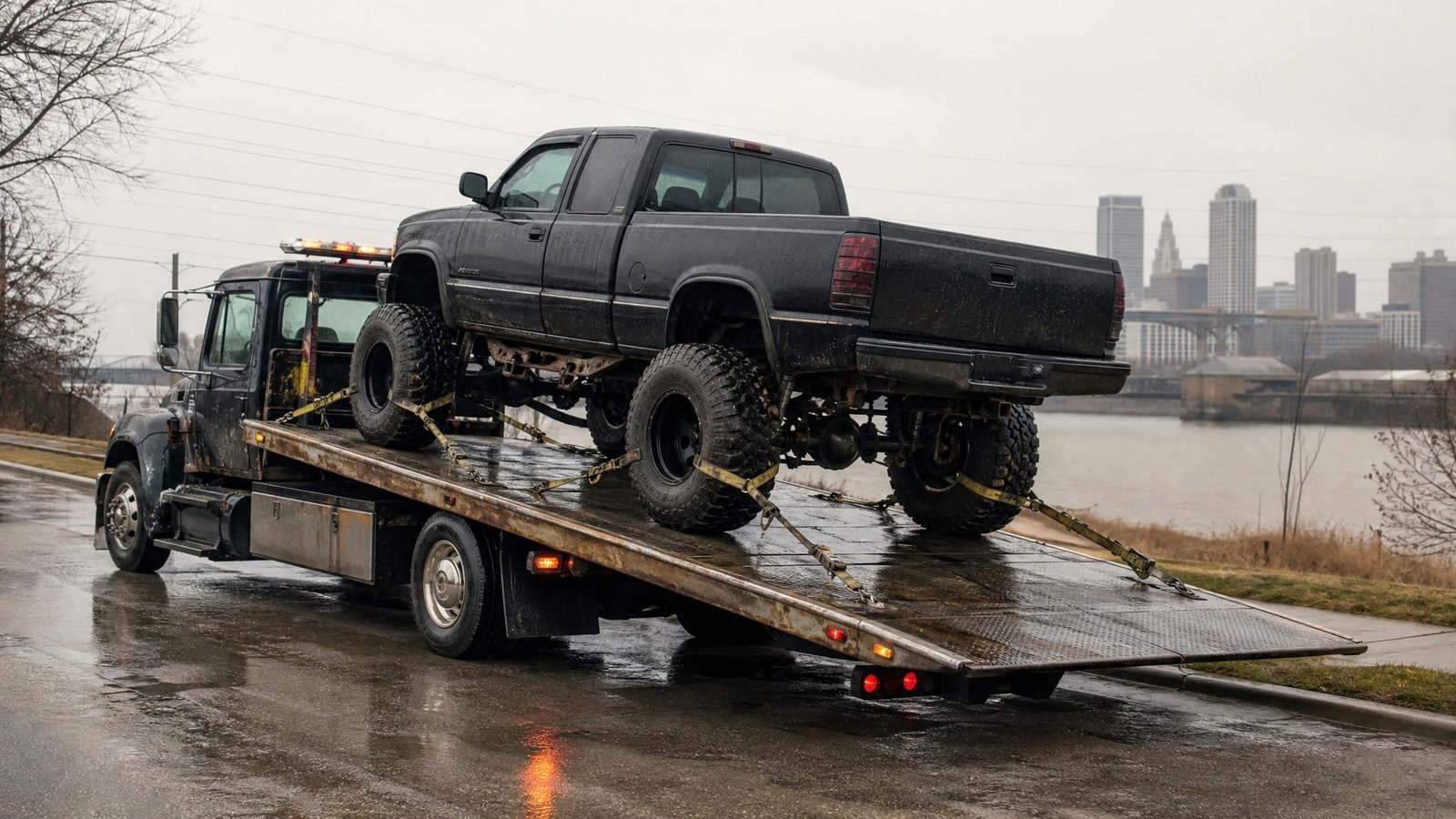
- Flatbed towing fully supports all four wheels of a lifted 4×4, eliminating stress on transfer cases, CV joints, and aftermarket suspension components during transport.
- Oversized tires 37 inches and above require custom strap placement to avoid crushing bodywork or snapping axle shafts during transit.
- Tulsa Wrecker’s EV-capable flatbeds safely tow lifted electric trucks without risking battery pack or high-voltage system damage from regenerative braking activation.
- Communicating exact lift height, tire size, and modification details to the dispatcher before booking ensures the correct equipment arrives ready to handle your specific build.
Tulsa Wrecker has run damage-free flatbed towing for lifted and oversized trucks across Tulsa and the surrounding area since 2019, under owner-operator Remi Carrillo. A 6-inch lift kit changes every calculation about approach angles and securement points, and we treat your modified investment with the respect it demands. This isn’t just about moving metal from point A to point B. It’s about making sure your suspension, tires, and bodywork arrive in the same condition they left the breakdown site.
Why Standard Tow Trucks Can’t Handle Lifted Rigs Safely
Most general towing fleets are built around stock passenger vehicles, so their wheel-lifts and hook-and-chain setups physically can’t accommodate the geometry of a modified pickup. Lifted trucks with 6-inch or greater suspension lifts often exceed the safe loading angle of a standard wheel-lift wrecker, which risks bumper and drivetrain contact during hookup. Force a connection built for a factory-height sedan, and your aftermarket front end takes the impact before the wheels ever leave the pavement.
Towing Method Comparison for Lifted Trucks
| Method | Drivetrain Safety | Clearance Risk |
|---|---|---|
| Flatbed Towing | All wheels supported | Level loading surface |
| Wheel-Lift | Transfer case damage risk | Exceeds safe angle on 6+ inch |
| Hook-and-Chain | CV joint stress | Bumper and skid plate contact |
Ground Clearance and Approach Angle Risks
The steep ramp angle needed to load a lifted truck onto a standard wrecker creates an immediate collision point between the deck and your front bumper or skid plates. Even if the truck clears the initial climb, the transition from incline to flat deck can scrape exhaust components or crush differential housings that sit lower than expected once the suspension articulates. Our guide on flatbed versus hook towing differences gets into why only a fully level loading surface removes these contact risks.
A wheel-lift simply can’t tilt far enough to match a high-clearance vehicle without creating a dangerous pivot point. The result is often cosmetic damage to custom bodywork, or structural stress on mounting brackets that were never built to carry the truck’s weight at that angle.
Drivetrain Damage from Improper Hook-Ups
Dragging a four-wheel-drive lifted truck with any wheels on the ground risks transfer case and transmission failure, because modified driveline angles prevent proper neutral positioning. Flatbed towing is the only method that fully supports all four wheels of a lifted 4×4, so it takes the stress off transfer cases, CV joints, and aftermarket suspension components during transport. A driveshaft spinning without engine lubrication will overheat and seize its bearings within miles. What started as a simple breakdown turns into a five-figure repair bill.
That risk holds even if the driver thinks they’ve disconnected everything necessary, since aftermarket lockers and limited-slip differentials don’t behave like stock units. A modified drivetrain needs complete isolation from road friction to survive a tow. No amount of careful driving by the tow operator substitutes for getting every tire off the asphalt.
Flatbed Towing Specialists: Protecting Your Modified Investment
Your truck represents thousands of dollars in parts and labor. Handing it to a generic service that treats every vehicle the same ignores the reality of your build. We use techniques built for lifted vehicle flatbed towing that account for oversized tires, extended brake lines, and custom steering linkages. You deserve a team that looks at your specific modifications before a strap or winch cable ever touches the truck.
Winch Loading Techniques for High-Clearance Vehicles
Loading a tall truck calls for low-angle winching that keeps tension steady and keeps the chassis from slamming against the deck during the final transition. We position our flatbeds to create the shallowest approach possible, sometimes using auxiliary ramps or ground-level positioning so the winch line pulls horizontally instead of yanking upward. That controlled ascent protects delicate air suspension bags and keeps shock absorbers from topping out violently under load.
Generic operators often rush this part, cranking the winch at full speed, which introduces bounce and lateral shift that can misalign the vehicle on the bed. Our patience during loading translates straight into safety during transit, because a truck that settles correctly stays secured without constant re-tightening.
Securing Oversized Tires and Suspension Components
Oversized tires (37-inch and above) and extended fender flares require custom strap placement to avoid crushing bodywork or snapping axle shafts in transit. Standard ratchet straps placed over massive rubber can deform sidewalls or crack plastic flare attachments. Improper anchoring to suspension arms can bend control rods under highway vibration. We find the manufacturer-approved tie-down points on your frame or axles that spread holding force without stressing aftermarket additions.
Our guide on SUV towing flatbed advantages covers why high-center-of-gravity vehicles demand this extra attention. Every strap we run gets checked for clearance against fuel lines, wiring harnesses, and hydraulic hoses that may have been rerouted during your lift install.
Local Challenges for Big Truck Tow Services in Tulsa
Towing a wide, tall truck through Tulsa isn’t just about equipment. It’s about knowing which routes can actually fit your dimensions without causing a second accident. Narrow historic streets, active construction zones in Jenks and Bixby, and tight downtown parking structures all throw obstacles that dispatch software rarely accounts for. Local owner-operator experience since 2019 means faster, safer recovery for 4×4 towing in Tulsa, without guessing at routes or finding out about a clearance problem mid-transport.
Navigating Tight Spots on Riverside Drive and South Tulsa
South Tulsa corridors like Riverside Drive and Brookside have older infrastructure, with tighter turning radii and lower overhead clearances than you’ll find on the modern highways. A lifted truck on a flatbed adds real height and width, so it takes an operator who knows exactly which intersections allow safe passage and which call for a different route. We handle these constraints daily, steering around low bridges and narrow alleyways that could trap your vehicle or damage property.
You shouldn’t have to direct your tow operator away from hazards they should already know about. Knowing Green Country well enough to move your truck efficiently, even when the direct route won’t work for an oversized load, is the job.
Recovery from Dirt Roads and Construction Zones
Lifted trucks frequently end up disabled in unpaved lots, trailheads, or unfinished subdivisions, where mud and uneven terrain complicate the extraction. Standard wreckers often lack the traction or ground clearance to even reach these spots, leaving you stranded until someone shows up with the right equipment. We carry the gear to get into rough terrain safely, and we stabilize the flatbed before any winch operation starts, to keep it from tipping or sliding.
Construction zones around Broken Arrow and Glenpool add another layer, with lane widths and temporary barriers that shift week to week. Finding a flatbed that fits oversized vehicles in that kind of moving target takes real local knowledge, not just a GPS coordinate.
EV and Tesla Capable Towing for Modern Lifted Builds
Lifted electric trucks like the Rivian R1T and Ford F-150 Lightning bring towing requirements a lot of traditional companies still haven’t caught up with. These vehicles combine serious weight from the battery pack with high-voltage systems that can be damaged by improper grounding or by triggering regenerative braking during a move. Tulsa Wrecker’s fleet includes EV-capable flatbeds built to tow lifted electric trucks without risking the battery pack or the high-voltage system.
Flatbed transport isn’t optional for these platforms. Dragging any wheel can generate uncontrolled electrical current that fries inverters or permanently degrades battery cells. You need an operator who understands isolation procedures and uses non-conductive securing equipment, for the vehicle’s sake and their own. If pricing is on your mind, our EV towing cost expectations page lays out what to expect for this kind of specialized work.
We stay current on manufacturer towing protocols for each major EV platform, so your electric drivetrain gets the same damage-free treatment a combustion build would. That matters because mistakes with high-voltage systems aren’t just expensive. They can be dangerous.
What to Ask Before Booking a Tow for Your Lifted Truck
Not every dispatcher knows the difference between a 2-inch leveling kit and a full 8-inch suspension lift, and a vague description is how the wrong equipment shows up at your location. Tell them your truck’s exact specs upfront, so the right flatbed arrives ready to work. Honest service means confirming capability before dispatch, not finding out it’s a mismatch after the truck has already arrived and you’re still stranded.
Verifying Flatbed Capacity and Winch Ratings
Ask directly whether the assigned truck has enough winch capacity and deck length for your vehicle’s weight and wheelbase. Lifted trucks often exceed standard ratings. A winch rated for a stock Silverado may stall out pulling a fully built 3500 dually with steel bumpers and armor. Confirming these specs takes thirty seconds and saves you hours waiting on a second, more capable unit to get redirected to your location.
Don’t accept “we can probably handle it” as an answer. Ask for confirmation that the equipment matches your documented weight and dimensions. Hope isn’t a towing strategy.
Confirming Experience with Aftermarket Modifications
Ask whether the operator has recent experience with vehicles matching your modification level, tire size and lift type included. Our questions to vet your tow provider list covers the bases worth hitting before you commit. A company that hesitates or deflects when you ask about lifted truck experience probably doesn’t have much of it.
Tell the dispatcher about anything non-standard, like long-travel suspension, welded bumpers, or a relocated fuel tank, since any of it can affect hook-up points. Giving them that up front means the operator shows up prepared instead of improvising on the side of the road.
Fast Response for Lifted Truck Emergencies Across Green Country
Specialized equipment shouldn’t mean waiting longer when you’re stuck on I-44 or broken down in a Glenpool parking lot at midnight. Powered by Neptune Towing, our local setup lets us dispatch the right flatbed fast across Tulsa, Broken Arrow, Jenks, and the surrounding towns. Book a flatbed tow online or call us directly at 539-292-3074 for help built around your vehicle’s needs.
We keep capable trucks spread across Green Country instead of parked at one central yard, which cuts travel time for oversized recoveries. Whether you’re commuting through South Tulsa or out on the trails past the city limits, our response times hold up against general-purpose services that don’t have your truck’s specific capabilities to begin with.
Damage-Free Guarantee: What Sets Local Operators Apart
National towing apps connect you with whoever happens to be nearby, whether or not they’ve ever touched a lifted truck or understand what your build is worth. Tulsa Wrecker works differently. Remi Carrillo and his team take personal accountability for every job and treat your vehicle like it’s their own modified build. That owner-operated setup closes the gap between corporate promises and what actually happens in the field, the gap that trips up franchise operations.
Damage-free towing isn’t a marketing line for us. It’s the reputation we’ve built serving Tulsa’s truck community year after year. Choose a local specialist who lives here and gets what your rig means to you, and it shows in every strap placement, every loading decision made slow and deliberate instead of rushed.
Frequently Asked Questions
How much does it cost to tow a lifted truck in Tulsa compared to a standard vehicle?
Lifted truck towing typically costs more than standard passenger vehicle towing due to specialized equipment requirements, longer loading times, and additional securement precautions. The exact price depends on your truck’s weight, tire size, recovery location, and distance traveled. Call 539-292-3074 for an honest quote based on your specific build rather than a generic rate.
Can my lifted electric truck be towed without damaging the battery or motors?
Yes, but only via flatbed towing with proper high-voltage isolation procedures to prevent regenerative braking from generating destructive current during movement. Tulsa Wrecker carries EV-capable equipment specifically designed for lifted electric platforms like the Rivian R1T and F-150 Lightning. Never allow a lifted EV to be towed with wheels on the ground, as this will permanently damage the drivetrain.
What information should I give the dispatcher to ensure the right tow truck arrives?
Provide your exact lift height, tire diameter, approximate vehicle weight, and any non-standard modifications like welded bumpers, relocated fuel tanks, or long-travel suspension. Mention whether your truck is two-wheel or four-wheel drive and specify if it’s electric or hybrid. This detail allows dispatch to assign a flatbed with adequate winch capacity and deck dimensions for your build.
Does a specialized flatbed for lifted trucks take longer to arrive than a regular tow truck?
No, Tulsa Wrecker maintains capable flatbeds positioned throughout Green Country for rapid response to lifted truck emergencies across Tulsa, Broken Arrow, Jenks, and surrounding areas. Our local infrastructure powered by Neptune Towing enables competitive dispatch times despite the specialized equipment requirement. Calling directly at 539-292-3074 often yields faster assignment than third-party apps that filter through incompatible providers first.