A car accident hits you all at once, the impact, the noise, the sudden stillness. Your hands might be shaking. Your mind is racing. And right in that moment, the decisions you make matter more than you probably realize. Knowing what to do after car accident towing situations arise, and before the tow truck even gets called, can protect you, your passengers, and your vehicle claim. This guide walks you through every step, from the first 60 seconds to the moment your car rolls onto a flatbed.
The First 60 Seconds at an Accident Scene
Stay Calm and Check for Injuries
Shock is real. It changes how you process information, and it’s completely normal. Take a breath. Your first job is simple: check yourself, then your passengers, for injuries.
If anyone is hurt, even if you’re not sure, don’t move them unless the vehicle is on fire or in immediate danger. Moving an injured person the wrong way can make things worse.
Turn the engine off. Put the car in park. Activate your hazard lights immediately. These steps take seconds and start protecting everyone at the scene.
Get to Safety, Don’t Stand in Traffic
Once you’ve confirmed your immediate situation, get out of the vehicle only if it’s safe, and when you do, get completely away from active travel lanes.
On corridors like US-75 and I-44 through Tulsa, secondary collisions at accident scenes are a serious risk. A passing driver may not see stopped vehicles until they’re almost on top of them, especially in low light or heavy rain. Drivers or bystanders standing near traffic lanes, rather than behind a guardrail or barrier, are in real danger from vehicles that haven’t slowed down. Secondary crashes involving people already at an accident scene are a major contributor to highway fatalities.
Move to the shoulder edge, past the guardrail if possible, and stay there until it’s safe to approach your vehicle.
Accident Scene Safety: What to Do Before Anything Else
Set Up Your Hazard Signals
Your hazard lights are already on. Now, if you have flares or reflective triangles in your vehicle, deploy them. Place them 100–200 feet behind the scene to warn approaching traffic, especially on a curve or hill where sight lines are short.
Stay behind barriers when setting them out. No documentation photo is worth stepping into a live lane.
Oklahoma’s Move Over Law and Why It Matters Here
Oklahoma law requires drivers approaching an accident, emergency vehicle, or tow truck on the roadside to move one lane over, or slow down significantly if a lane change isn’t possible. Understanding Oklahoma’s Move Over Law matters whether you’re the driver stuck on the side of the road or the one passing by.
If you’re at the scene and traffic isn’t slowing, stay well back from the road edge. Don’t assume passing drivers see you.
Talking to the Other Driver and Calling 911
Once the immediate scene is as safe as you can make it, approach the other driver calmly. Keep it civil. You’re gathering information, not starting an argument.
What to exchange:
- Full name and contact number
- Driver’s license number
- Insurance company and policy number
- License plate number
- Vehicle make, model, and color
What not to say: Don’t apologize, don’t admit fault, and don’t speculate about what happened. Something like “I didn’t see you” sounds sympathetic, but it can be used against you later. Stick to the facts, names, numbers, information.
When to call 911: Call immediately if anyone is injured, if a vehicle is blocking a travel lane, if the other driver is uncooperative or appears impaired, or if you feel unsafe. In Oklahoma, a police report matters for insurance purposes even in minor collisions. Don’t assume the other driver will report it, call it in yourself.
If you’re on the side of a busy Tulsa highway and feel unsafe waiting, stay on the phone with 911 dispatch. They can help manage traffic and get help to you faster.
Documenting the Damage, Your Accident Checklist
Good documentation is what protects your insurance claim later. Don’t skip this step because you’re shaken up, it takes five minutes and saves you a lot of headache.
Photos and Notes to Take at the Scene
Walk around both vehicles and photograph:
- All four corners of your vehicle
- All four corners of the other vehicle
- Both license plates (close-up, readable)
- The point of impact on each vehicle
- Skid marks, debris, or fluid on the road
- Nearby signs, signals, and intersection markers
- Road and weather conditions, wet pavement, sun glare, construction
Note the cross streets, the time, and the direction both vehicles were traveling. If there are witnesses, get their contact information too.
What to Tell Your Insurance Company
Call your insurer as soon as you’re safely out of the scene. Give them the factual sequence of events: where you were, what direction, what happened. Don’t editorialize. Share the photos and the other driver’s information.
If a police report was filed, ask for the report number, your insurer will want it. Be straightforward and stick to what you observed. Your insurer’s job is to figure out liability; your job is to give them accurate information.
When and How to Call a Tow Truck After an Accident
Signs Your Car Isn’t Drivable
Here’s something experienced tow operators will tell you: a car that looks drivable after a collision often isn’t. The damage that matters most is sometimes what you can’t see from the outside.
Don’t drive the vehicle if you notice any of the following:
- Fluid leaking under the hood or underneath the car
- Deployed airbags (the car’s safety systems are compromised)
- A wheel that pulls hard or vibrates when you try to move
- Visible frame damage, a bent body panel near the wheel wells, or a door that won’t close right
- A warning light you haven’t seen before
Driving a structurally compromised vehicle to the shop can cause additional damage, or lead to another crash. When in doubt, have it towed. See more detail on towing a non-drivable vehicle safely if you’re unsure what to look for.
How Accident Towing Works in Tulsa
Don’t just wait for whoever shows up first. After an accident, your vehicle is at its most vulnerable, and how it gets towed matters.
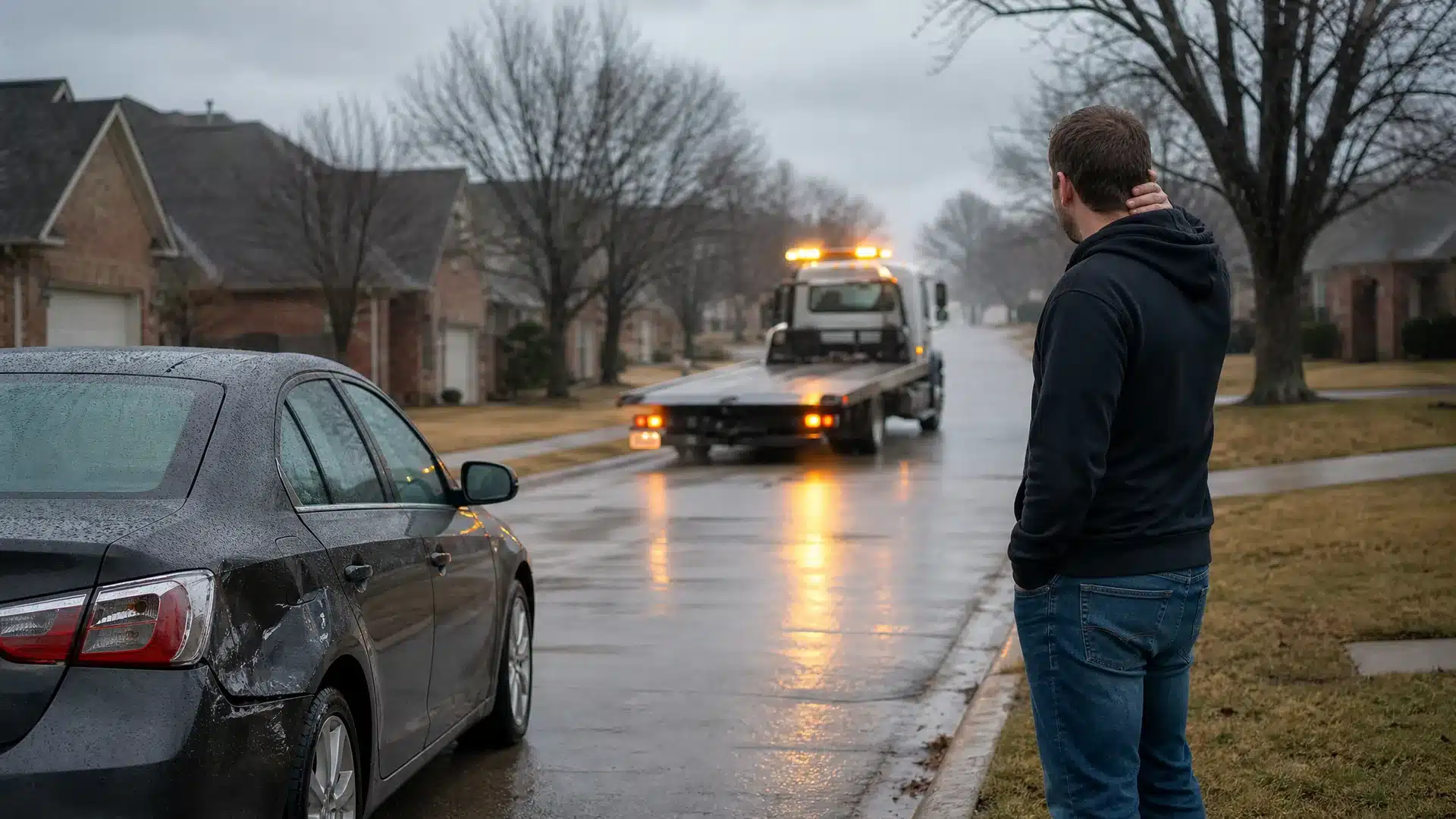
For car accident towing in Tulsa, flatbed towing is the right call. A flatbed keeps all four wheels completely off the ground, which is critical when there’s frame damage, a bent axle, or a compromised drivetrain. Wheel-lift or dolly towing in those situations can stress and grind components that are already damaged, turning a manageable repair into a much bigger bill. Read more about how flatbed towing works and why it’s the standard for post-accident recovery.
The difference between flatbed vs. wheel-lift towing isn’t just equipment preference, it’s about protecting what’s left of your car after a collision.
Tulsa Wrecker, powered by Neptune Towing, has been responding to accident calls across Tulsa, Jenks, Broken Arrow, and Bixby since 2019. Owner-operator Remi Carrillo handles many of these calls personally. You’re getting someone with real, hands-on experience, not a dispatcher routing a random driver. Call 539-292-3074 to reach the team directly.
Getting Your Vehicle Towed Safely: What to Expect
When the tow truck arrives, the operator will assess the vehicle before touching it, looking at the damage, the position, and the best way to load it without making anything worse.
On a flatbed, your car gets winched or driven onto the bed, then secured with straps at multiple points. The operator will confirm where you want the vehicle taken: a body shop, a dealership, your mechanic, or wherever makes sense for your situation.
A good tow operator doesn’t rush you. They communicate what they’re doing, answer your questions, and handle a stressed driver with patience. That’s not a small thing when you’ve just been in a crash.
Tulsa Wrecker’s damage-free towing approach means the vehicle that arrives at the shop looks exactly like the vehicle that left the accident scene, no new scrapes, no dragging, no sloppy tie-downs. If you’re dealing with breaking down on a Tulsa highway or recovering from a collision, that attention to detail is what separates a good tow from a stressful one.
If you’ve been in an accident and need emergency towing in Tulsa, call 539-292-3074. Tulsa Wrecker is local, experienced, and ready, whether you’re stuck on I-44, on 71st Street, or anywhere in between. Stay safe, stay off the road edge, and let us handle the rest.