If you just Googled tesla towing tulsa from the side of the Creek Turnpike or South Peoria, here’s what you need to know right now: your Tesla cannot be towed like a regular car. The wrong tow truck, or an inexperienced driver, can cause serious, expensive damage in the time it takes to hook up the cables. More Teslas and EVs are on Tulsa roads in 2026 than ever before, and most traditional tow operators in the area haven’t updated their training or equipment to keep up. Tulsa Wrecker has. Here’s what makes EV towing different, and what to do while you wait for help.
Why Tesla Towing in Tulsa Is Different From Towing a Regular Car
A gas-powered car has a transmission you can put in neutral. The engine disconnects from the wheels, and a wheel-lift or dolly can drag it down the road without grinding anything important. A Tesla doesn’t work that way.
The drivetrain and regen braking problem
Tesla’s electric motors are permanently connected to the wheels, there’s no neutral gear in the traditional sense. When those wheels spin, the motors spin with them. That means rolling a Tesla on two wheels, or dragging it on a dolly, forces the motors to turn whether the car is powered or not. Regenerative braking makes it worse: the system is designed to recapture energy during deceleration, but during a disabled tow it can create unpredictable resistance and voltage feedback the car wasn’t built to handle.
What happens when a Tesla gets towed the wrong way
The risks aren’t theoretical. Towing a Tesla with a wheel-lift or dolly can damage the inverter, stress the battery management system, and in worse cases cause the electric motor itself to overheat or fail. Drivetrain and inverter repairs run into the thousands. An inexperienced driver may also drag a Model 3 or Model Y across asphalt with the parking pawl engaged, a locked position that’s not designed for forced rolling, which can crack internal drivetrain components. None of that shows up until you’re already at the dealership getting the bad news.
Proper Lifting Points and Why Getting Them Wrong Is Expensive
Getting a Tesla onto a flatbed isn’t just about finding a spot to hook. Tesla’s official owner documentation specifies exact jack pad locations for each model, and it warns clearly that improper lifting can damage the high-voltage battery enclosure and vehicle frame.
Where to correctly position a Tesla on a flatbed
The lift points vary by model. On the Model 3 and Model Y, Tesla specifies four small jack pad locations on the rocker panel area, marked with notches the driver needs to know to look for. The Model S and Model X have their own designated positions that differ from the smaller models. Using a generic hook-up spot, the kind that works fine on a Chevy or Ford, risks putting load directly on unintended frame sections or battery housing. A tow operator who hasn’t done this before will often eyeball it and guess. That guess can bend frame rails or crack battery enclosure components.
The battery pack sits low, chassis damage is a real risk
The Model 3 sits about 5.5 inches off the ground at its lowest point. That’s low. When a standard rollback loads a Tesla at too steep an angle, something that happens when the bed isn’t dropped far enough, the underside scrapes the ramp. The battery pack’s aluminum underbody shield runs almost the full length of the vehicle. Scraping or cracking that shield is a costly repair, and it leaves the battery pack exposed to road debris afterward. A good EV tow operator drops the bed fully, loads slowly, and keeps the angle shallow.
Flatbed Towing Is the Only Safe Option for Electric Vehicles
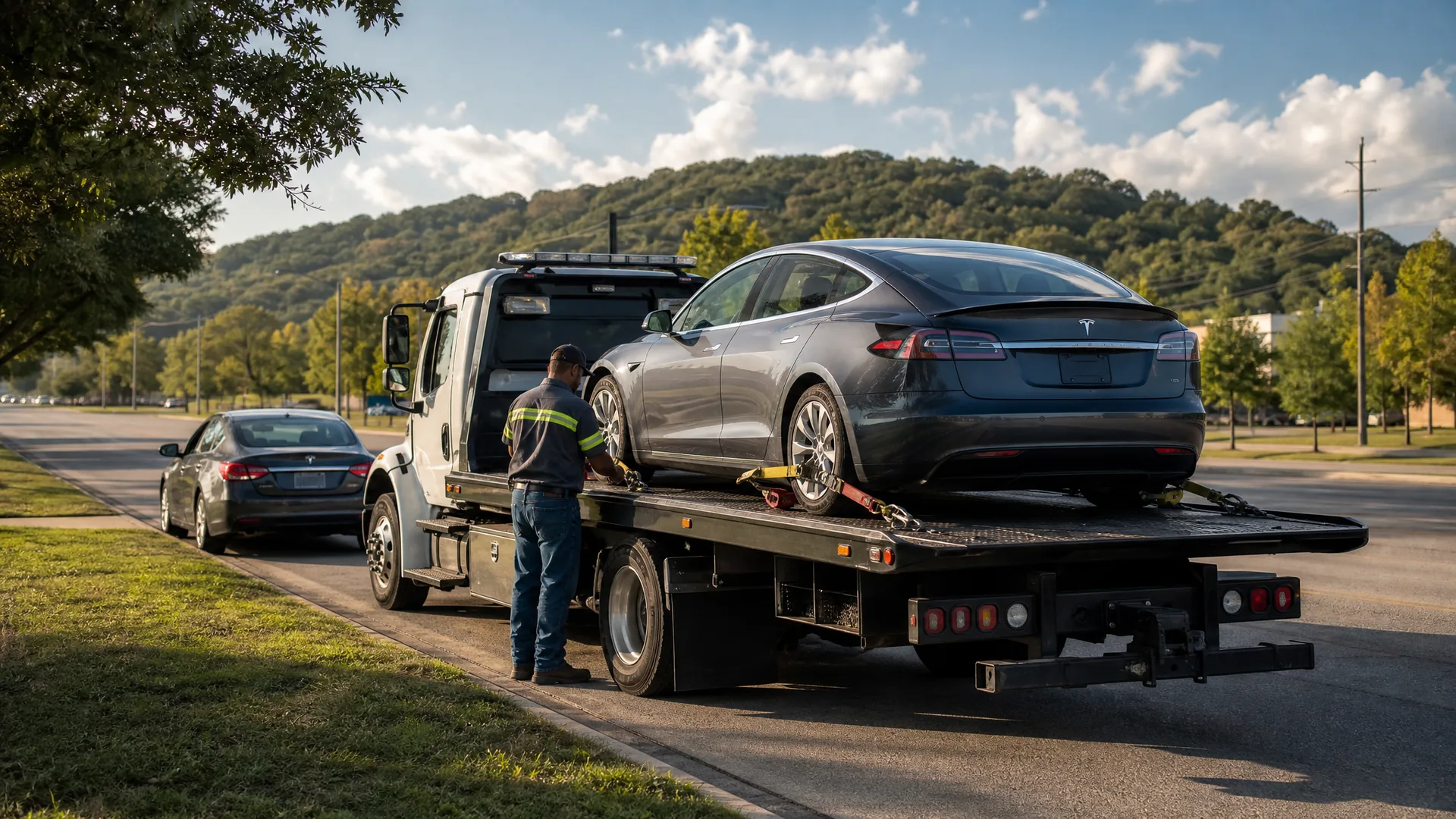
This one isn’t a matter of preference, it’s what Tesla specifies and what every informed EV towing specialist will tell you. Why flatbed towing is safer than wheel-lift for most vehicles comes down to one basic principle: all four wheels need to stay off the ground. When they do, the motors can’t spin, regen braking can’t engage, and no unwanted back-voltage gets fed into the battery management system. Wheel-lift and tow dolly setups leave two wheels on the road, and for an EV, those spinning wheels mean spinning motors acting as generators, pushing voltage into a system that wasn’t designed to receive it during a disabled tow. Flatbed is the only safe call. To understand how flatbed towing works in Tulsa and what to expect during the process, that link covers the full picture.
Tesla Breakdown Assistance in Tulsa: What to Do While You Wait
Sitting on the side of Highway 169 or Peoria Ave in a dead Tesla is stressful. Here’s how to make the wait safer and set your car up for the tow. If you need guidance on what to do when your car breaks down on a Tulsa highway, that page covers the general safety steps, turn on hazards, stay in the car if traffic is close, get to the shoulder.
How to safely put your Tesla in Transport Mode
Transport Mode prevents the parking pawl from locking the wheels, which lets the car roll freely onto a flatbed without forcing internal drivetrain components. Activate it through the Tesla touchscreen: go to Service > Towing (the exact path varies slightly by software version), then enable Transport Mode. You can also do it through the Tesla app if the car still has enough battery to respond. Tell the tow operator it’s enabled before they start loading, a good driver will ask.
If the car is completely dead and the touchscreen won’t respond, let the tow operator know. Loading a Tesla without Transport Mode isn’t impossible on a flatbed, but it requires extra care and a very low loading angle to avoid forcing the drivetrain. For situations where the vehicle simply won’t move at all, see our guide on towing a non-drivable vehicle safely in Tulsa.
Can you charge your Tesla while being towed?
No, and this is a question we hear often. A Tesla cannot charge through wheel movement during a flatbed tow because all four wheels are off the ground and the drivetrain isn’t engaged in a way the BMS can use. Even during a wheel-lift tow (which you should avoid for other reasons), the back-EMF generated by the spinning motor is not the same as useful charging current. Your car won’t gain range on the way to the shop. The practical takeaway: if you have any remaining charge, use it to get to a safer pull-off spot. After delivery, the nearest Tesla Supercharger locations in the Tulsa area, along 71st Street, near Woodland Hills, and off the BA Expressway, are good next stops if the car can charge normally.
Battery Damage Prevention: What a Good EV Towing Company Does Differently
When you’re calling for local roadside assistance in Tulsa and you drive a Tesla or another EV, the right questions to ask are simple: Do you use a flatbed only? Do you know the lift points for my model? Do you know what Transport Mode is?
A trained EV tow operator won’t run chains across the battery tunnel. They won’t hook straps anywhere near the undercarriage battery housing. They load at a shallow angle, move slowly, and use the correct jack pad positions. They verify Transport Mode before the wheels leave the ground.
Tulsa Wrecker’s owner-operator, Remi Carrillo, has been running Tulsa’s damage-free towing company since 2019, powered by Neptune Towing. Every Tesla and EV tow we do is flatbed-only, no exceptions. We know the lift points by model, we ask about Transport Mode on the phone before we arrive, and we load slowly. Your battery pack is the most expensive single component in your car. We treat it that way.
Call Tulsa Wrecker for EV-Safe Towing Across Tulsa and Surrounding Areas
Tulsa Wrecker serves Tulsa, South Tulsa, Broken Arrow, Jenks, Bixby, and Glenpool. We’ve handled Tesla and EV tows across all of them. If your Tesla is down right now, call us at 539-292-3074, we know what we’re doing, and your car is in good hands.