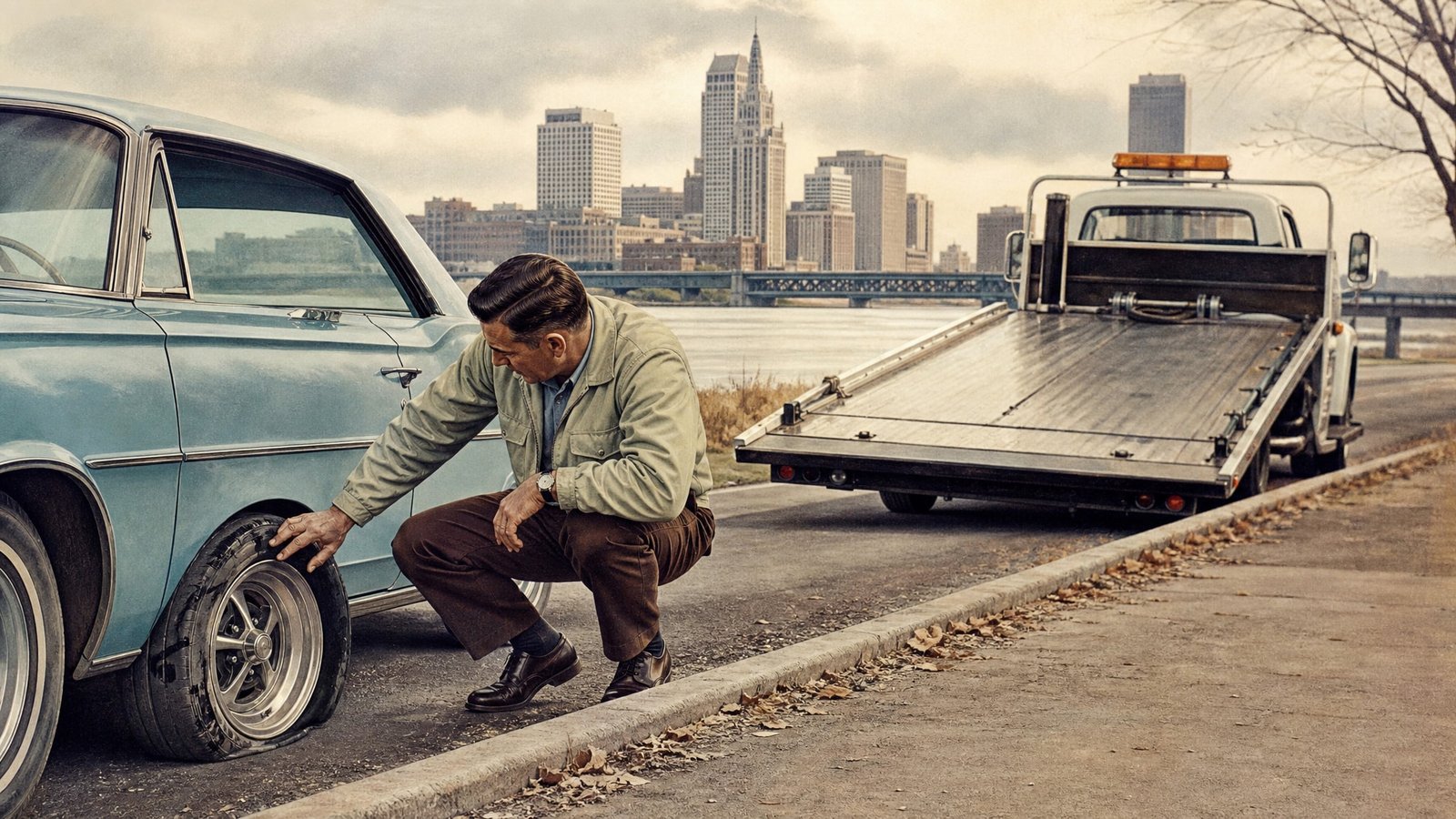
Hitting a curb on Riverside Drive or merging onto Highway 75 happens faster than you can react. That thud usually leaves you wondering if your car is still safe to drive.
Key Takeaways
- Driving on a tire with sidewall bulges or exposed cords risks sudden blowout at highway speeds and requires immediate towing rather than continued travel.
- Modern aluminum alloy wheels often crack internally upon hard curb impact even without visible exterior bending, necessitating professional inspection before driving.
- Flatbed towing prevents secondary damage to drivetrains and EV battery trays by eliminating rotational stress during transport.
- Local owner-operator services typically respond faster than national apps because drivers understand Tulsa-specific geography and current traffic patterns.
That moment of uncertainty is where most secondary accidents happen. Drivers either panic-stop in live traffic or limp home on compromised suspension components that fail miles later. You need a calm, systematic way to check the damage before you turn the key again.
This guide walks you through the diagnostic steps we actually use when we get a call from someone who just struck a curb in Tulsa. We look for specific failure points in tires, wheels, and steering geometry, the kind of thing that separates a minor alignment fix from a tow-required breakdown. Not every impact needs a wrecker, but misjudging the severity can turn a repair bill into a total loss, or put you at risk on the Creek Turnpike.
Immediate Safety Check: Assessing Drivability on Tulsa Roads
Your first priority after hitting a curb is getting out of active traffic lanes without causing another collision. Resist the urge to brake hard or inspect damage while still moving. Find a shoulder, parking lot, or side street where you can check the vehicle without blocking commuters during rush hour on South Tulsa corridors like Memorial Drive or 71st Street.
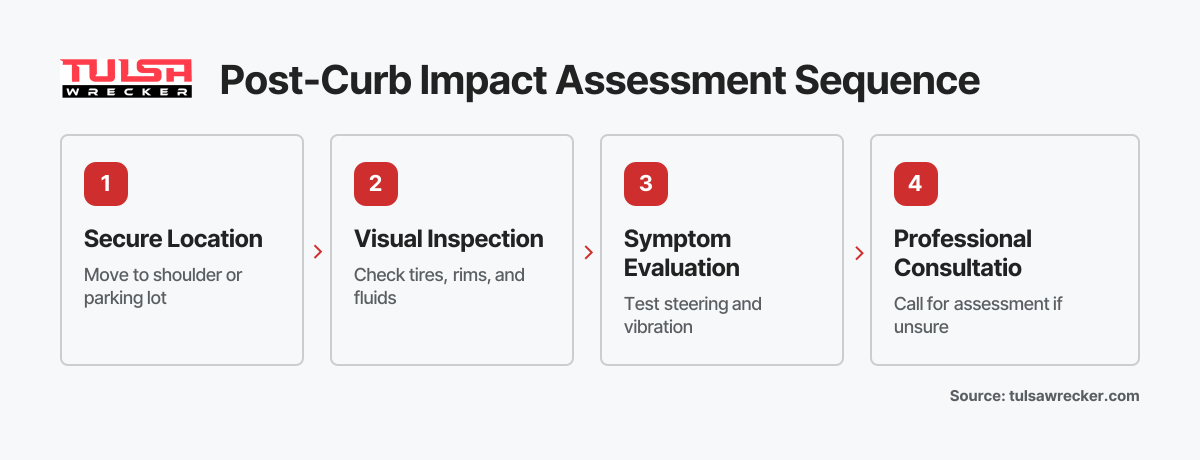
Don’t inspect the car while standing in an active travel lane or on a narrow highway shoulder, where passing trucks create real wind shear. Your safety matters more than saving a few minutes, so take the extra effort to reach a secure spot before checking for curb-related tire damage or bent rims.
Once stopped, turn on your hazard lights and walk around the vehicle. Check for fluid leaks, hanging plastic, or obvious tire deformation before you even think about driving to a shop. If you see oil, coolant, or transmission fluid pooling under the car, the impact likely cracked a housing or ruptured a line, and that will drain critical fluids within minutes of restarting the engine.
Spotting Hit Curb Tire Damage and Bent Rims
Modern aluminum alloy wheels often crack internally on a hard curb impact even without any visible exterior bending. A professional inspection matters here because these lightweight wheels are built for performance and fuel efficiency, not ductility. They tend to fracture along the inner barrel or spoke roots, where stress concentrates during lateral impacts against concrete curbs.
Check the sidewall carefully for bubbles, bulges, or separated rubber. Those indicate broken internal cords, and that kind of structural failure can rupture suddenly under load. Driving on a tire with a sidewall bulge or exposed cords risks a sudden blowout at highway speeds, especially on corridors like Highway 75 or the Creek Turnpike, where you have no room to recover from a catastrophic tire failure.
Run your hand along the rim edge to feel for sharp bends, cracks, or missing chunks that might not be visible standing up. Pay special attention to the area directly opposite the valve stem, where impact forces often transfer. Even minor rim deformation breaks the seal between tire and wheel. That causes slow air loss, the kind that strands you hours later once the pressure drops below a safe level.
If the tire looks intact but you suspect hidden damage, mark the spot with chalk or tape and have someone with proper equipment inspect it. Don’t guess based on appearance alone. A visual check catches the obvious stuff, but it won’t reveal internal ply separation or hairline fractures that compromise the wheel’s ability to handle braking and cornering loads.
Car Pulling After Hitting Curb: Alignment vs Suspension Failure
A car pulling to one side after hitting a curb could mean anything from a simple toe adjustment to a collapsed control arm bushing. Telling the two apart determines whether you can safely reach a mechanic on your own. A minor alignment shift usually causes a steady, predictable drift you can correct with light steering input, which means cautious travel to a nearby shop at reduced speed is fine.
Severe suspension damage looks different. Think violent shaking, clunking noises, or a steering wheel that feels disconnected from the road even though it appears centered. When the steering response goes vague or delayed, components like tie rods, ball joints, or strut mounts have likely taken damage, and that makes the car unpredictable in an emergency maneuver.
Vibration through the wheel at specific speeds usually points to a bent rim or a shifted tire belt rather than alignment. Either way, it needs attention before it gets worse. Ignoring these symptoms because the car “still drives fine” invites a component failure at the worst possible moment, the kind that turns a controlled tow into an uncontrolled roadside breakdown.
Straight tracking doesn’t equal safe operation. Some suspension failures only show up under hard braking or an evasive steering input. The absence of obvious pulling doesn’t guarantee structural integrity, which is why a professional look still matters even when the car seems fine at low speeds.
Should I Drive After Hitting Curb or Call for Help?
The decision to drive or call for a tow comes down to three things: tire integrity, steering response, and fluid containment. If any one of these shows compromise, driving further risks a catastrophic failure that endangers you, other drivers, and your repair bill.
A fluid leak means a broken mechanical connection that will worsen with every mile, potentially seizing brakes or locking a differential once levels drop too low. Steering play or unusual noises suggest damaged linkages that could separate completely during normal driving, leaving you unable to avoid an obstacle or hold your lane.
Tire damage is the most immediate threat, because a sidewall failure happens without warning and leaves you zero recovery time at speed. If you see bubbles, exposed cord, or real tread separation, that tire has already failed structurally. It only looks functional because it hasn’t hit its breaking point yet.
When in doubt, calling for a professional assessment costs far less than replacing a destroyed transmission or dealing with injuries from a high-speed blowout. That said, this doesn’t replace a certified mechanic’s hands-on diagnosis. It just keeps well-intentioned drivers from making expensive mistakes based on incomplete information.
For situations where the tire simply lost air without structural damage, you might only need flat tire help in Tulsa rather than a full tow. Confirming that distinction takes an honest look, not a hopeful guess.
Why Flatbed Towing Prevents Further Damage
Flatbed towing lifts all four wheels off the pavement, which eliminates rotational stress on a damaged drivetrain and prevents transmission wind-up or bearing wear during transport. Hook-and-chain methods drag compromised suspension components across asphalt, grinding bent parts against each other and turning repairable damage into a replacement-only situation.
This matters most for vehicles with suspected axle or differential damage from a severe curb strike, where even a short drag can destroy seals and contaminate lubricants. Why flatbed beats hook and chain for SUVs gets into why modern towing standards favor full support over partial lifting.
Neptune Towing powers Tulsa Wrecker with equipment built to handle Tesla and other EVs safely after a curb impact that might affect battery trays or low-slung components. EVs carry a unique vulnerability since their battery packs sit inches off the ground, and traditional towing methods can wreck thousands of dollars in sensitive electronics if used on them.
Damage-free transport isn’t marketing language. It reflects a mechanical reality: improper towing turns a minor incident into a major claim. EV towing considerations covers why the right equipment pays for itself by preserving warranty coverage and avoiding secondary damage during recovery.
Local Roadside Assistance vs National Apps in Tulsa
National dispatch apps route your request through a call center that has no idea about Tulsa’s geography, construction zones, or neighborhood access. You might wait forty minutes for a driver who doesn’t know certain Jenks subdivisions restrict commercial vehicle entry, or that Broken Arrow detours shift weekly during ongoing road work.
A local owner-operator answers the phone directly and gives you an accurate ETA based on real-time traffic, school dismissal times, and alternate routes the navigation apps haven’t caught up on yet. Talking to someone who actually lives here means getting an honest read on whether your situation truly needs a tow or if something simpler will do.
Response time matters a lot when you’re stuck on a busy corridor where an idling car becomes a hazard for everyone around you. Local operators typically get there faster because they’re already positioned around the metro. National networks add dispatch layers that slow communication down and make it harder to hold anyone accountable when the estimate turns out wrong.
Tulsa Wrecker has provided damage-free flatbed towing and honest roadside assessments across Tulsa, Jenks, and Broken Arrow since 2019, under local owner-operator Remi Carrillo. That kind of longevity comes from relationships built on being straight with people, not from algorithmic matching. It’s why customers trust that whoever picks up the phone actually knows their vehicle and their location.
Before you commit to any service, questions to ask before hiring a tow company is worth a read. Knowing what to ask separates an experienced operator from an outfit looking to cash in on a stressful moment.
Who to Call for Professional Curb Impact Assessment
When you call for help after a curb strike, describe the impact speed, angle, and whatever symptoms you’re seeing, not just “I hit something.” Details like “struck a six-inch curb at twenty mph while turning right” or “steering wheel vibrates above thirty mph” let us give you an accurate read on whether you need an immediate tow or can safely wait for mobile service.
Give your exact location using cross streets, landmarks, or mile markers instead of something vague that slows the response down during peak traffic. An operator who knows Tulsa’s layout can get to you fast with precise coordinates, especially in spots where GPS signals bounce off buildings or new developments haven’t made it into the mapping databases yet.
Ask directly about pricing before you authorize service, so you don’t get hit with a surprise fee on top of an already stressful day. Real towing costs in Tulsa lays out actual numbers so you’re deciding based on facts, not anxiety.
A phone assessment can’t replace a physical inspection, but an experienced operator can spot the red flags that call for an immediate tow versus the ones that allow temporary mobility. That’s what good, consistent guidance looks like: it puts your safety and your vehicle ahead of squeezing more revenue out of the call.
Frequently Asked Questions
How can I tell if my tire is unsafe to drive on after hitting a curb?
Look for sidewall bubbles, bulges, exposed cords, or tread separation that indicate broken internal structure. Any visible deformation means the tire has already failed and could blow out without warning at speed. Even if the tire holds air, structural damage makes it unsafe for highway driving.
What are the signs of a bent rim versus simple alignment issues?
Bent rims typically cause vibration through the steering wheel at specific speeds and may show visible deformation along the lip or barrel. Alignment issues cause steady pulling to one side without vibration and respond predictably to steering correction. Both require professional inspection since hidden cracks can exist without obvious bending.
When is it necessary to call a tow truck instead of driving to a mechanic?
Call for towing if you see fluid leaks, experience steering play or unresponsiveness, or find tire damage like sidewall bulges. These conditions indicate structural failures that worsen with distance and risk catastrophic breakdown. Minor alignment drift without other symptoms may allow cautious driving to a nearby shop.
Does hitting a curb always require professional roadside assistance?
Not every curb impact demands towing, but all warrant professional assessment to rule out hidden damage. Light contact at low speeds might only need alignment correction, while harder impacts can crack wheels internally or damage suspension components invisibly. Erring toward inspection prevents costly secondary failures from undetected problems.