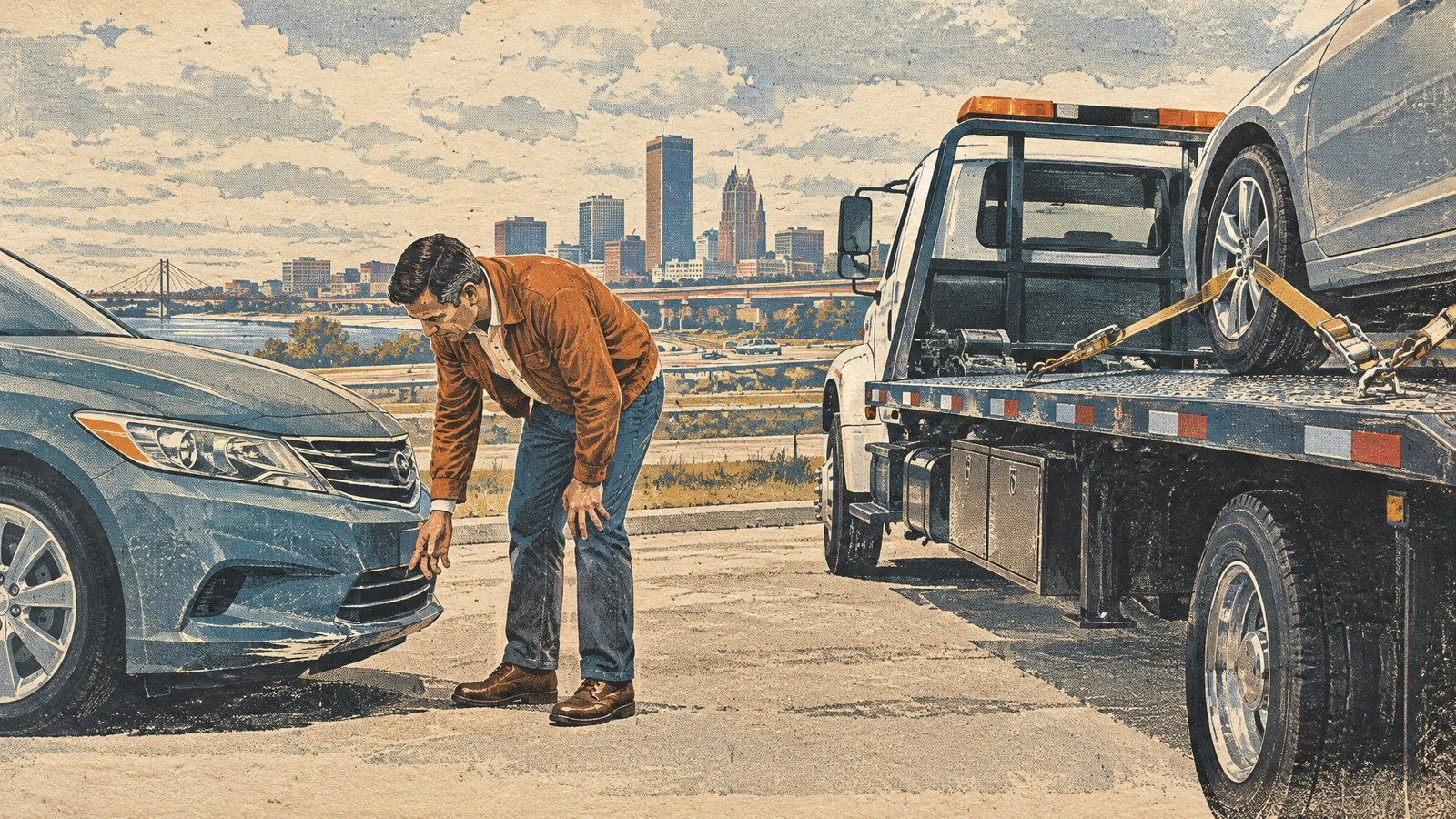
Most tow jobs go the way they should. The car goes up, the car comes down, and nobody thinks about it again. But once in a while a driver steps out at the drop-off and sees a fresh scrape on the bumper or a cracked splitter that wasn’t there at pickup.
Key takeaways
- Tell the operator about visible damage and ask for it on the ticket before the truck leaves the scene.
- Photos from every side, a wide shot showing the truck’s name or unit number, and a drop-off walk-around are what tie damage to the tow.
- Paying the tow bill doesn’t by itself end a damage claim, but a signed release of all claims can.
- Send the tow company a written notice with photos and the ticket, and tell your own insurer promptly, because it can pay first and pursue the company later.
- A flatbed carries the whole car and avoids dragging or lifting wheels, but it can still scrape or crack parts if it’s loaded or strapped badly.
If a towing company damages your car, the next hour matters more than most people realize. We’ve been towing around Tulsa since 2019, and the drivers who come out of these situations best all did the same few things in the same order. Here’s that order, plus how a damage claim usually plays out and why the way a car is loaded decides so much.
Get Safe and Speak Up Before the Truck Pulls Away
Safety comes before any paperwork. If your car is broken down on a busy stretch like the Broken Arrow Expressway, get yourself and your passengers well clear of the lanes, behind the guardrail if there is one, with your hazard lights on. Our list of what to do while you wait for a tow truck covers that part in more detail.
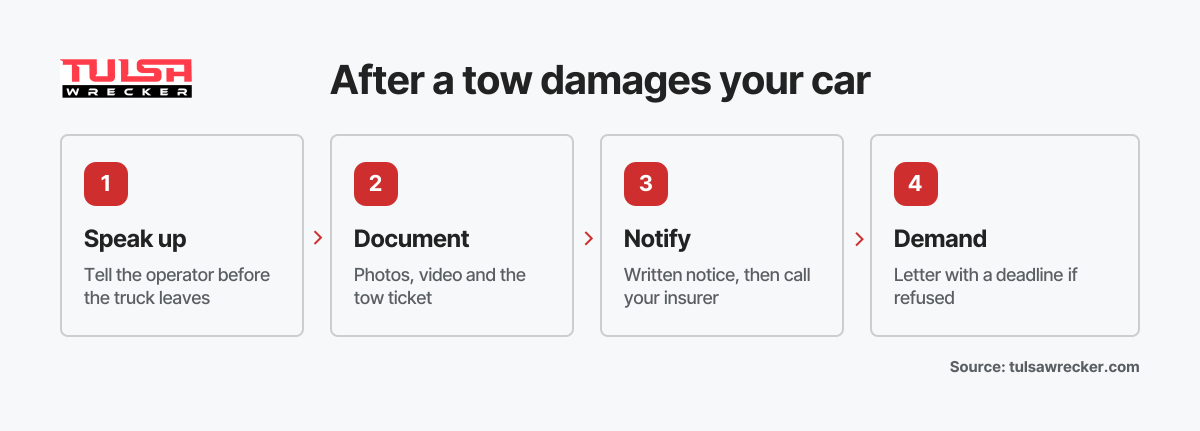
Once the truck is loaded, or while it’s being loaded, take a look at your car. If you spot a scratch, a dent, a cracked piece of trim or a hanging bumper, say so right then, calmly, before the driver climbs back into the cab.
You don’t need to argue or accuse anyone. Point to the spot, ask the operator to look at it with you, and ask him to write it on the ticket. Most professionals will do that without fuss, because a note made on the spot protects them too.
Take a quick photo of the spot before the truck leaves, even if it’s just one frame on your phone, because proof made at the scene beats a recollection later. And if the truck has already pulled away, don’t write the claim off. You can still document everything at the other end, which is the next step.
Document the Damage Right Away
This is the part of a towing damage claim that wins or loses it. A car scratched by a tow truck is only as provable as the pictures and paperwork you gather before the car leaves your sight, so spend ten minutes here even if you’re tired and cold and just want to go home.
Photos and Video That Show When the Damage Happened
You’re trying to show a before and an after, with the tow in the middle. Work through it like this:
- Walk all the way around the car and shoot every side, plus the roof, the wheels and the underside of the front and rear bumpers if you can see them.
- Take close-ups of each scratch, crack or dent, with something like a coin or your hand beside it for scale.
- Take one wide shot with the truck’s company name or unit number visible, and the street or lot in the frame.
- Record a slow, 30-second video walk-around, talking out loud about what you see. Your phone stamps the date and time, which helps.
Do the same walk-around at drop-off, from the same angles, before the driver leaves. If you have older photos of the car, such as a listing, a recent trip or a dealership shot, pull them up too. Clean older photos make a “that was already there” argument much harder.
Think about the account that circulates online of a front strap letting go during loading and the car dropping hard. When something like that happens, the damage often isn’t a surprise to anyone, and a wide shot with the truck in it ties the damage to the moment.
Reading the Tow Ticket Before You Sign
The ticket is the other half of your evidence, so read it before you sign, even on a cold night. Check these lines one at a time:
- Legal company name. It should match the truck and be a real business you can send a letter to, not just a nickname.
- Driver name. You’ll want it later if there’s a dispute.
- Vehicle description. Make, model, color and plate should all be right.
- Notes on existing damage. If it’s blank and your car has a ding, ask for it to be written in. If it’s blank and your car was clean, leave it blank and say so.
- Release language. Look for wording that says you accept the car “as is,” or release the company from all claims. That’s the line that can cost you later.
If you see release language you’re not comfortable with, ask the driver to explain it. If it’s going to stay, write “damage noted, not released” next to your signature and keep a photo of the signed page.
How to File a Towing Damage Claim
Two parties need to hear from you: the tow company and your insurer. The order matters less than doing both quickly, and doing the first in writing.
Notify the Tow Company in Writing, Then Call Your Insurer
A phone call is easy to forget or deny, while an email or a letter is a record. Keep your notice short and factual:
- Date, time and place of the tow, and the driver and unit number if you have them.
- A plain description of the damage, with your photos attached.
- A copy of the ticket.
- A request for the company’s insurance carrier and policy details.
Send it by email and keep the sent copy. Certified mail adds a receipt if you want one.
Then call your own insurer. You may be wondering whether your policy covers this at all. Depending on your coverage, collision or comprehensive may respond to damage during a tow, and some policies include rental reimbursement while the car is in the shop. Read your declarations page or ask the agent directly, because the answer depends on what you bought.
Even if you plan to go after the tow company, tell your insurer promptly. An insurer can pay for the repair first and then pursue the tow company for its money, a process called subrogation. That can spare you a long fight, though your deductible may come into play.
Coverage gaps cause real pain. One consumer thread describes a car picked up by an insurer-assigned tow company when the owner had no rental coverage, and the damage turned into days without a car. If you have no rental coverage, ask your insurer or the tow company early about how you’ll get around while repairs happen.
What about the tow bill? You’ll generally need to pay for the tow itself to get the car released, and paying doesn’t by itself end a damage claim. The danger is what you sign alongside the payment. Pay, get a receipt that shows the amount, and don’t sign a form that releases all claims. If a release is unavoidable, write that the damage is disputed next to your signature and keep a copy.
Tow Company Liability in Oklahoma: Who Usually Pays
A company that takes your car on its truck is generally expected to take reasonable care of it. So if the driver, the equipment or the loading method caused the damage, the company is usually the party that pays for the repair.
That covers the obvious cases, like a strap that slips, a lift that bites into a bumper, or a car dragged over a curb on the way up the deck. It doesn’t require the driver to have meant any harm. Careless work is enough.
This is practical guidance, not legal advice. Oklahoma law and the facts of your situation decide each case, so if the numbers are large, a short call with a local attorney is worth it.
When Pre-Existing Damage or Fine Print Changes the Answer
Three things can change the answer.
Pre-existing damage. If the scratch was already on the car, the company isn’t on the hook for it. That’s why your before photos and the damage notes on the ticket matter so much.
A release form. A signed waiver of claims can give the company a strong defense, even if the damage was real. This is the reason for reading that last line before you sign.
A weak spot on the car. A bumper cover held on by a few cracked clips, a loose undertray or a lowered car with a fragile front lip may fail under normal handling. A company may argue that the part was already compromised. You can usually counter that with clean photos and a repair estimate that describes the damage as fresh.
If none of these apply and your evidence is solid, you’re in decent shape.
When the Tow Company Won’t Pay: Your Next Steps
Sometimes the company ignores your email or denies the claim outright. You still have options, and you can use them in a sensible order. If you’ve been wondering how to sue a towing company, this is the path, and it usually starts with a letter, not a courtroom.
Writing a Demand Letter With a Clear Deadline
A demand letter is a formal version of your first notice, with a deadline. Write it like this:
- Describe what happened and when, in a few plain sentences.
- List the damage and attach your photos and the tow ticket.
- Attach a written repair estimate, and the amount you’re asking for.
- Set a response deadline, such as 14 days from the date of the letter.
- State that you’ll pursue small claims court if you don’t hear back.
Keep it polite and factual. Send it by email and by certified mail, and keep copies of everything, including the receipts for the estimate and any rental costs. A good letter often settles the matter, because it shows the company you’re organized and the claim is real.
Small Claims Court or a Lawyer: How to Decide
Small claims court is built for people who represent themselves. The filing is simple, the process is faster than regular civil court, and a clear set of photos, a ticket and an estimate is exactly what a small claims judge wants to see. For a typical bumper, panel or trim repair, that’s usually the right move once the demand letter has gone unanswered. Check the Oklahoma court’s current rules on the dollar limit before you file.
A lawyer is worth a consultation in a few situations:
- The repair is costly, or the car may be a total loss.
- Someone was hurt during the tow.
- The company clearly disputes that it caused the damage, and you expect a real fight.
You can also file a complaint with the Oklahoma Attorney General’s consumer protection office. That won’t repair your car, but it puts the problem on record, and it can sit alongside small claims.
Flatbed vs. Hook Towing: Where the Damage Risk Comes From
Most damage doesn’t come from bad luck. It comes from how the car is lifted and carried, and that’s mostly decided by the equipment on the truck. We’re a flatbed outfit, so take our view with that in mind, but here’s the honest explanation.
Where Hook and Wheel-Lift Towing Puts the Stress
With a hook or wheel-lift truck, two wheels come off the ground and the other two stay rolling. The lifted end carries the load through the wheels, the bumper area and the suspension, and a tight angle or a low front end can crunch plastic you’d never expect to be involved.
All-wheel-drive cars add another problem. Because the drivetrain links all four wheels, dragging two while lifting two can strain parts that were never meant to turn that way. We go further into it in why flatbeds beat hooks on AWD cars. Many EVs raise similar concerns, which is why a flatbed is the usual choice for a Tesla or other EV.
For the full comparison, see flatbed vs. hook: which one your car needs.
What a Flatbed Still Can’t Guarantee
A flatbed carries the whole car off the pavement, so the wheels, bumpers and drivetrain aren’t being dragged or lifted on their own. The risk shifts to how the car is loaded and secured.
It isn’t a magic fix. A flatbed can still scrape a low front lip on the ramp, or crack a part if the straps land on the wrong points. A hurried or careless operator can do real damage on a flatbed too.
Damage-free towing is mostly a matter of habits: choosing the right angle on the deck, using the right tie-down points, and checking the car before and after. That’s the core of what Tulsa Wrecker does, from everyday cars to Teslas and other EVs.
How to Avoid Tow Truck Damage Next Time
You can lower your risk before the truck even arrives, with three questions. Ask whether the company tows on a flatbed. Ask how it secures a car. Ask whether the driver notes existing damage before loading. A good company answers all three without hesitation, and a vague answer tells you something too. We’ve put together questions to ask a tow company before you book if you want the longer list, and how to choose a flatbed tow company if you’re comparing operators.
If you’re in Tulsa, South Tulsa, Jenks, Bixby, Broken Arrow or Glenpool and want a flatbed that keeps the whole car off the pavement, call Tulsa Wrecker at 539-292-3074 or look at flatbed towing in South Tulsa.
Frequently asked questions
How do you sue a towing company?
Start with a written demand letter that describes the damage, attaches your photos, the tow ticket and a repair estimate, and sets a response deadline. If the company still refuses, small claims court is built for people who represent themselves. Check the court’s current dollar limit and filing rules before you file.
Do I have to pay the tow bill before I can dispute the damage?
Generally you’ll need to pay for the tow itself to get the car released, and paying doesn’t by itself end a damage claim. Get a receipt, and don’t sign a form that releases all claims. If a release is unavoidable, write that the damage is disputed next to your signature.
Should I call my insurer or the tow company first?
Contact both quickly. Send the tow company a written notice with photos and the ticket, and call your insurer the same day. Your insurer may pay for the repair first and then pursue the tow company, which can save you a long dispute.
Does a flatbed guarantee my car won’t be damaged?
No. A flatbed carries the whole car instead of lifting two wheels, which lowers the risk for bumpers, suspension and AWD drivetrains. But a low car can still scrape on the ramp, and straps in the wrong spots can crack parts, so the operator’s loading care still matters.