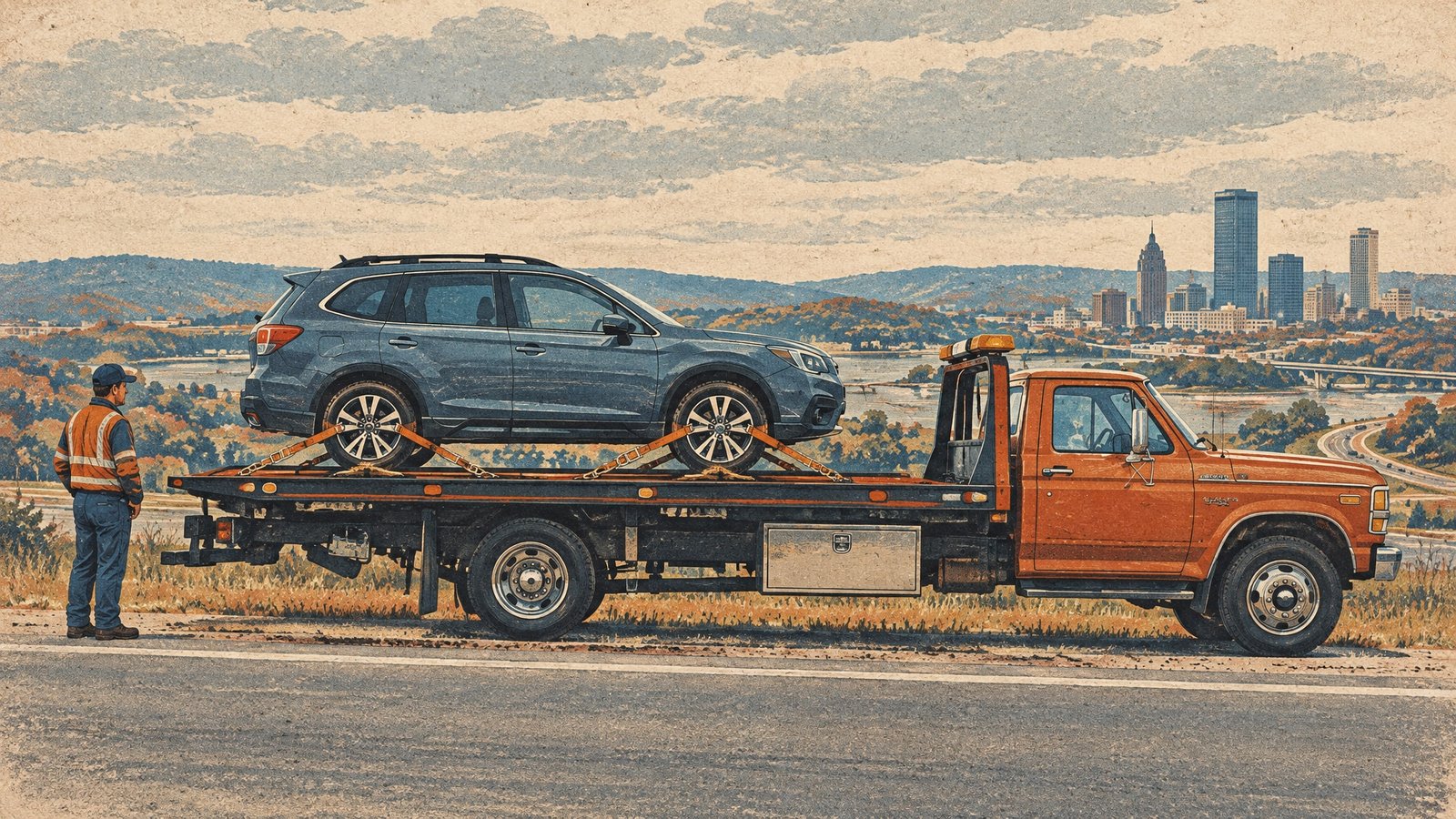
The call usually goes the same way. A Subaru is stopped on the shoulder of I-44, the driver is a little rattled, and the first thing out of their mouth is “just hook it up, it’s only a few miles.” We get the thinking. Short trip, short tow, how much harm could it do?
Key takeaways
- On an AWD car, the wheels left on the pavement keep turning the driveshafts, differentials, and transfer case or center coupling, even though the truck does the moving.
- Neutral and a tow dolly don’t reliably protect an AWD car, because the rolling wheels are still tied to the driveline.
- A flatbed lifts all four wheels off the road, so no wheel turns the driveline, and in practice it is the tow an AWD car needs.
- For most Subaru owners the safe answer is a flatbed, and a flatbed is also the simplest answer for a part-time 4WD 4Runner.
- Flatbed pricing depends on distance and the vehicle, so ask for the total before the car is loaded.
More than you’d expect, if the car is all-wheel drive. Here is why, and what we do instead.
What AWD Means When Your Car Gets Towed
On a front-wheel-drive car, the engine sends power to two wheels and the other two just roll along. AWD is different. It links all four wheels through the driveline, so the front and rear axles are tied together by driveshafts, differentials, and a transfer case or center coupling.
That connection is great on a wet Tulsa morning. It is a problem on a tow hook.
A wheel left on the pavement can still spin parts of the drivetrain that the tow truck isn’t moving. The truck lifts one end, the other end rolls, and everything wired to those rolling wheels turns with them, with the engine off and nothing doing its normal job.
Why Hook Towing Can Damage an AWD Drivetrain
Hook towing is the wheel-lift or hook-and-chain setup. The truck grabs two wheels, lifts that end off the ground, and drags the car with the other two wheels still rolling. It works fine for plenty of cars, and it’s quick. It just isn’t built with AWD in mind.
If you want the broader comparison, we cover flatbed vs. hook towing for your car separately. This piece stays on the drivetrain.
What Two Wheels on the Pavement Do to the Driveline
Picture the car on a hook with its front wheels in the air. The rear wheels are still touching the road, so they turn. They spin the rear axle, which turns the rear differential and the driveshaft. That driveshaft runs forward to the transfer case or center coupling, which is designed to let the front and rear axles work together under power.
Now the car is being pulled with no engine power at all. The raised pair isn’t turning the way the rolling pair is, and the center coupling ends up taking the strain between the two. Depending on the car, the gears and fluid in the transmission and differentials also turn without the lubrication they get when the engine runs.
The damage doesn’t announce itself. You won’t hear a bang on the Broken Arrow Expressway. A car can come off a hook looking fine and then show a whine, a shudder in tight turns, or a warning light weeks later, and by then nobody connects it to the tow.
Distance matters, but a short tow isn’t automatically a safe one. Even a few miles on a hook can add awd towing damage, because the wear starts the moment those wheels turn while the rest of the car sits still. That is why we don’t treat “it’s only five minutes” as a reason to skip the flatbed.
Why Neutral and Tow Dollies Don’t Protect an AWD Car
Shifting to neutral feels like the obvious fix. It is not one on most AWD cars. Neutral disconnects the engine from the transmission, but on many AWD systems the center coupling and the driveshafts still tie the axles together, so the rolling wheels keep turning parts you meant to rest. Neutral also doesn’t guarantee the transmission is lubricated while it’s being dragged.
A tow dolly sounds like a middle road, since it cradles two wheels instead of lifting the whole car. The catch is that the other two wheels are still on the road. On an AWD car, that is the same problem with different hardware.
On some front-wheel-drive cars, a dolly can work. Put the front, driven wheels on the dolly, and the rear wheels just roll on their own with nothing connected to them. Even then, the owner’s manual has the final word, and we’d still rather see most cars ride a flatbed.
Your car isn’t one of those FWD cases if it’s AWD. Neutral and a dolly won’t do the job for you.
Why an AWD Car Needs a Flatbed Tow Truck
A flatbed lifts the whole car. Nothing touches the road, so no wheel is turning the driveline while the rest of the car sits still. That is the plainest reason a damage-free tow leans on a flatbed, and it’s why we run flatbeds for this kind of job.
We should be straight about one thing. A flatbed is the tow an AWD car needs in practice, not an absolute law of physics. Some models have their own manufacturer rules, and a few allow certain methods. If your manual says something specific, we go by it.
All Four Wheels Off the Pavement
With all four wheels off the ground, the driveshafts, differentials, and transfer case sit still. The car is cargo. It rides the way a piece of equipment rides, and the only thing moving is the truck.
That also helps with low-slung bumpers and splitters, since the bed tilts to a shallow angle. We cover the same reasoning for bigger vehicles in why flatbed beats hook and chain for SUVs.
What a Flatbed Job Looks Like on an All-Wheel Drive Car
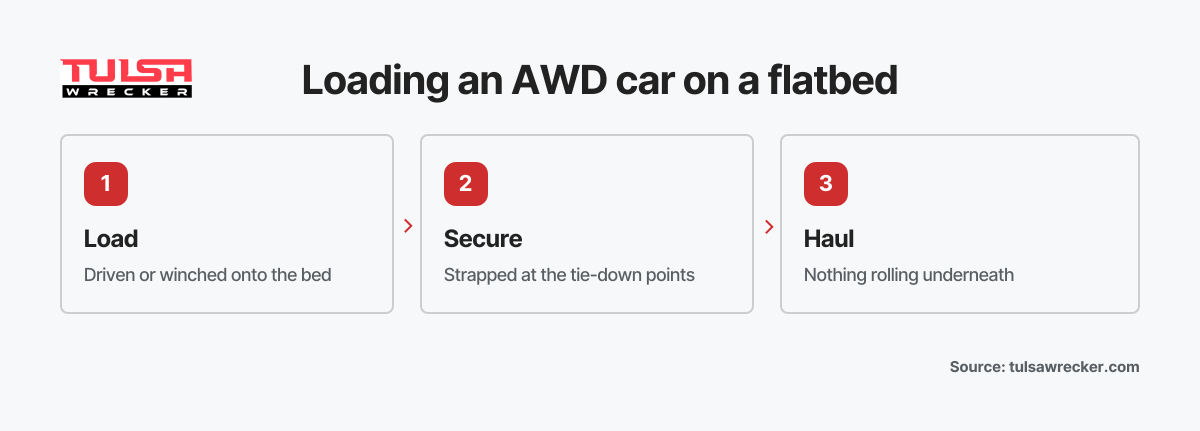
An all wheel drive tow truck job is straightforward to watch. Here is how it goes:
- The operator tilts the bed and lines up with the car.
- The car is driven or winched onto the bed, depending on whether it runs and rolls.
- The operator secures it at the tie-down points, with straps that don’t pull on the suspension or body panels.
- The bed levels out and the car is hauled with nothing rolling underneath.
You’ll notice there’s no hook on a wheel and no chain on a bumper. If the car won’t start, the winch does the pulling slowly and in a straight line. Tell dispatch if the car won’t shift out of park, so the right gear shows up.
Four-Wheel Drive and AWD Towing Around Tulsa
Tulsa is a good place to learn how much these cars matter. I-44 gets slick fast in an ice storm, the Creek Turnpike has long stretches with nowhere to pull over, and the Broken Arrow Expressway is not a place you want to wait around. Plenty of drivers here pick AWD and four-wheel drive for exactly those days.
AWD Wagons and Crossovers Around Tulsa
From the driver’s seat of a tow truck, Subarus are everywhere. So are the crossovers that do the same job. That’s an operator’s observation, not a count, but we load them often enough that the question comes up constantly.
So, can you tow a Subaru on two wheels? For most Subaru owners, the safe answer is no. Use a flatbed. The owner’s manual sets the model-specific rule, and when it says all four wheels must stay off the pavement, that’s what it means.
These cars also end up stuck more than broken. If yours is sitting in mud or against a ditch edge after a storm, winch-out help for a car stuck in mud or a ditch comes first, and the flatbed haul comes after.
Part-Time 4WD Trucks and SUVs in Tulsa
A 4Runner works differently from a Subaru. Part-time four-wheel drive sends power to the front axle only when you engage it with a lever or switch. Full-time AWD is always connected and manages power on its own. Because of that, towing rules for part-time systems can look different, sometimes with a transfer-case neutral step in the manual.
That sounds like a loophole. It usually isn’t worth the trouble. A flatbed is still the simplest answer for a 4Runner, because you skip the shifting, the guessing, and the second-guessing about what the transfer case is doing.
Know Your Drivetrain Before You Call
You don’t need to be a mechanic to figure out what you drive. Look for an AWD or 4WD badge on the tailgate. Check the dash and console for a drive-mode switch, a 4H/4L selector, or a lock button. A car with none of those and no badge is most likely front-wheel drive, though the manual confirms it.
Check the Owner’s Manual First
Open the towing section of the owner’s manual. That’s where the manufacturer states which wheels must stay off the pavement for your exact model, and it beats any guess from a stranger on the internet, us included.
If the manual is missing, or the wording is unclear, say so when you book. We’ll treat the car as AWD and send a flatbed.
What a Flatbed Tow for an AWD Car Costs in Tulsa
Flatbed jobs can be priced differently from hook jobs, since the truck and the work are different. The total depends mainly on distance and the vehicle, so a short run across Jenks costs something different from a haul out to Glenpool or the far side of Broken Arrow.
We keep the numbers out of this page on purpose, because they shift with each job. For context, read what a local tow costs in Tulsa. Dual-motor EV owners can check Tesla towing costs in Tulsa.
Ask for the total before the car is loaded. A straight number up front is how an honest tow works, and you shouldn’t have to hunt for it afterward.
Booking the Right Tow Truck for an AWD Car in Tulsa
Finding a tow truck for an AWD car in Tulsa comes down to one question: can the company send a flatbed? Keep questions to ask a tow company before you call handy if you’re comparing. Tulsa Wrecker is a local owner-operator business, founded by Remi Carrillo, powered by Neptune Towing, and we’ve been towing around here since 2019.
We cover Tulsa, South Tulsa, Jenks, Bixby, Broken Arrow, and Glenpool, and we handle Tesla and EV towing too. A dual-motor EV is AWD, so flag it when you call.
What to Tell Dispatch When You Call
Keep it simple. Give us the year, make, and model, and tell us whether it’s AWD or four-wheel drive. Say where the car is, and mention any visible damage or a car that won’t shift out of park.
Take a breath first. You’re not behind on anything, and a calm call gets a better result.
Call 539-292-3074, or book a tow truck online in Tulsa if you’d rather type than talk. Local response is quick, and a person who knows these roads will pick up.
Frequently asked questions
Can you use a tow dolly on a front wheel drive car?
Often, yes. If the front, driven wheels sit on the dolly, the rear wheels just roll with nothing connected to them. The owner’s manual has the final word for your model, and a flatbed is still the gentler option.
Can you tow a Subaru on two wheels?
For most Subaru owners, the safe answer is no. The wheels on the pavement keep turning an AWD driveline that is meant to work together under power. Read the towing section of your manual, and use a flatbed.
Can I tow an AWD car in neutral?
Not reliably. On many AWD systems the driveshafts and center coupling still connect the axles in neutral, so the rolling wheels keep turning drivetrain parts. Neutral also doesn’t guarantee the transmission stays lubricated while it’s dragged.
Is a 4Runner towed differently from a Subaru?
Part-time four-wheel drive works differently from full-time AWD, and the manual may describe a transfer-case neutral step. A flatbed skips all of that, which is why we call it the simplest answer for a 4Runner.
How do I find out what a flatbed tow will cost?
Price depends mostly on distance and the vehicle. Call or book online, give us the details, and ask for the total before the car is loaded.