If you own a classic, you don’t call a tow company the way everybody else does. A commuter with a flat just wants to get moving. You’re picturing the nose of a low car scraping a ramp, a fender with original paint, and a piece of chrome you can’t buy new anymore.
Key takeaways
- A flatbed keeps all four wheels off the pavement, so old tires and automatic drivetrains don’t roll on the road during a classic car tow.
- A tilt-deck flatbed lowers the bed so a low car loads at a gentler angle, and you should flag spoilers, air dams, and valances at booking.
- Straps go on frame or suspension tie-down points and over the wheels, never on bumpers, painted panels, or chrome.
- A non-running classic with a locked steering column or no power assist needs a planned winch load, so tell dispatch before the truck leaves.
- Before booking, ask whether it’s a true flatbed, how they load a low car, whether cargo insurance covers your car, and for a quote that names every extra charge.
Those worries are fair, and they’re the right ones to bring to the phone. Add the fact that plenty of classics won’t start, won’t roll easily, or have a steering column that’s locked up, and you can see why this isn’t a standard tow. Here’s how we handle it at Tulsa Wrecker, and what to ask any company before you hand over your keys.
What Makes a Classic Car Different on the Tow Truck
Here’s how a typical call goes. A man’s ’67 Chevelle dies in the parking lot after a Midtown car show. The fuel pump quit, the car sat low and quiet, and he’s standing there with a trunk full of folding chairs and a stomach full of dread.
He isn’t asking how fast we can get there. He’s asking whether anything is going to touch his paint.
That’s the difference. When people search for a vintage car tow in Tulsa, they’re usually comparing trust, not just response times. A late-model sedan can take a bump or a scuff and go on being a sedan. A numbers-matching coupe with 50-year-old paint cannot.
Three things set a classic apart on the truck:
- Clearance. Many are built low, with front ends that sit inches off the ground.
- Original finish. Factory paint, chrome, and glass are hard or impossible to replace.
- Rare parts. Trim, emblems, grilles, and wheels may not be made anymore.
On top of that, a good share of classics don’t run. So the crew has to plan for a car that won’t help with its own loading, and you can make that job far easier by telling us what you know about the car when you call.
Why a Flatbed Is the Right Tow for a Classic Car
A flatbed keeps all four wheels off the pavement, so nothing rolls on old tires and nothing turns inside the drivetrain while the truck is moving.
That’s the whole argument, and it’s a simple one. A hook or wheel-lift tow raises one end of the car. The other pair of wheels rolls along the road for the entire trip, and on a classic that means aged rubber, possibly with dry rot you can’t see, is taking miles it didn’t sign up for. On some automatic transmissions, a drive axle that spins while the engine is off is a real problem too.
We go deeper on why flatbeds beat hooks for drivetrain protection, and if you’re weighing the two methods, there’s a plain comparison of flatbed or hook towing, and how to tell which your car needs. For a classic, though, we don’t treat it as a close call.
Non-Running Classics and the Winch
A non-running car changes the job. It usually has no power steering and no brake assist once the engine is off, and some have a steering column that’s locked. You can’t just point the wheels where you want them.
So the car gets winched onto the deck slowly and in a straight line, with someone watching the wheels the whole way up. That’s how classic car flatbed towing works when the engine won’t turn over. The crew needs to know about a locked column or a seized brake before they plan the winch and decide where the car sits on the bed, because those details change the plan.
Tell dispatch if the car is in neutral, if the brakes drag, or if you’re not sure. “I don’t know” is a perfectly good answer, and we’d rather hear it than find out at the curb.
Low Clearance: Getting a Low Classic Onto the Bed Without Scraping
A low clearance tow truck in Tulsa has one main job with a car like yours: get it from the street to the deck without the front or rear touching anything it shouldn’t. The nose and tail are the parts most likely to meet a ramp lip, and a few extra inches of angle can be the difference between a clean load and a gouge you’ll see every time you walk past the car.
It’s not only the truck’s ramp, either. Steep driveway dips, a curb cut at a strip-center lot, or the lip of a garage floor can catch a low car before it ever reaches the bed. The crew looks at the pickup spot first and plans from there.
Tilt Decks and Ramp Angle
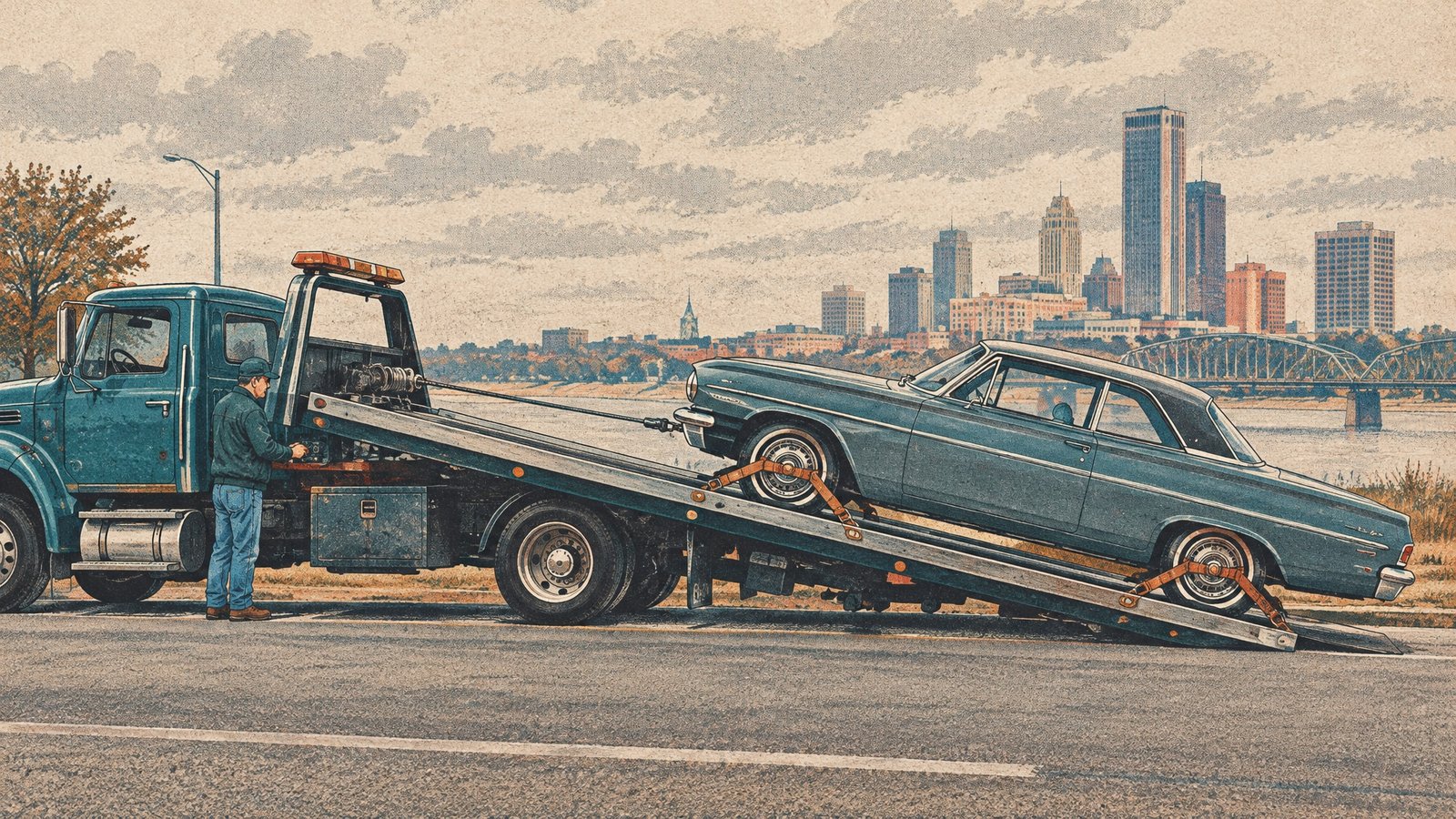
Here’s the plain version of how a tilt-deck flatbed works. The whole bed tilts and slides back until its rear edge sits close to the pavement. That lowers the starting point, so the ramp runs at a gentler slope and the car rolls on more like a wheelchair ramp than a ski jump.
A shallower angle matters because the middle of a long, low car can also drag at the point where the ramp meets the bed. The gentler the slope, the less the underside has to hunt for a place to catch. Sometimes the crew will add wood blocks or ramp extenders to ease that transition further.
Mention a low car at booking and we plan the angle before we leave the yard, not after we show up. That’s one phone call that saves you a repair bill.
Front Spoilers, Valances, and Long Overhangs
Some parts hang lower or stick out farther than the rest of the car. Those are the ones we ask you to point out when you call:
- Air dams and chin spoilers
- Thin lower valances, especially fiberglass or older plastic
- Long nose overhangs that stick out well past the front wheels
- Aftermarket body kits and side skirts
Many of these pieces are thin, brittle with age, or both. A scrape that wouldn’t matter on a pickup can crack a valance in two. If you’ve lowered the car, added a spoiler, or just know the front end sits close to the ground, say so. You’re not being fussy. You’re giving the crew information that decides how the car goes on.
Original Paint and Rare Parts: Where Hooks and Chains Cause Trouble
Original paint, bumpers, and rare trim are what drivers fear losing, so the answer here is method. Straps go on frame or suspension tie-down points, with wheel straps over the tires. Nothing gets hooked to a bumper, a painted panel, or chrome.
Damage-free towing is how we work and what we aim for on every job. It’s a method and a goal, not a magic promise, and no honest operator can make an absolute guarantee about a 60-year-old car with a thin paint layer and brittle parts. What you can expect is that we handle it with care and a sound process.
Tie-Down Points, Straps, and Paint
Chains and hooks are the old way, and they’re hard on classics. A hook on a bumper can crease it. A chain across a thin body edge can scuff the paint or dent the metal beneath it. Even a clean-looking spot can leave a mark you only notice later in the sun.
Soft straps at designated tie-down points and over the wheels do the opposite. They hold the car steady without biting into the finish. The car’s weight sits on the frame or suspension, where it’s meant to sit.
Not every classic has obvious tie-down points. Some older frames, unibody cars, and restored suspensions need a closer look. If you know where a shop or a restorer attaches straps on your car, tell us.
Wheels, Trim, and Parts You Can’t Easily Replace
Original wheels and old tires are some of the most exposed pieces in a bad tow. So are emblems, grilles, side trim, and anything chrome. A strap that slips across a wheel face, or a tow that puts rolling load on an aged tire, can do real harm.
Here’s the part owners know too well. One snapped tab on a piece of trim can turn into months of searching swap meets and forums for a part that isn’t made anymore. Replacement can cost far more than the tow ever did, and some pieces simply can’t be found.
A flatbed isn’t magic, either. It won’t save a loose bumper or a rusted tab that was already ready to let go. That’s why photos before loading matter, and we cover them below.
Finding a Tulsa Tow Truck You Can Trust With a Classic Car
Trust is the real question when you’re looking for a tow truck for a classic car in Tulsa. You’re not shopping on price alone, and you shouldn’t be. You want someone who understands what’s on the back of the truck, and who’ll tell you plainly how they’ll do the job.
If you’re comparing options, our guide on how to choose a flatbed tow company walks through the basics. Its South Tulsa focus still applies across the metro.
Questions to Ask Before You Say Yes
Any reputable collector car towing service should answer these without hesitation:
- Whether the truck is a true flatbed, not a hook or wheel-lift
- How they load a low car, and what they do about ramp angle
- Whether their insurance covers your car while it’s on the truck
- Whether the person who answers the phone is the one who shows up
Listen to how they answer, not just what they say. A clear answer on cargo coverage sounds specific and doesn’t dodge. If you get vague talk, ask again or move on to the next call.
We’re owner-operated by Remi Carrillo and have been towing around Tulsa since 2019, so the person on the phone knows the work. That’s the standard we try to meet, and it’s fair to hold any company to it.
Honest Pricing and Cargo Insurance
A fair quote tells you what’s included and spells out any extra charge up front. If a winch-out, a tricky pickup spot, or a long wait will cost more, you should hear that before the truck rolls, not on the receipt.
We don’t quote figures here because the distance, the pickup spot, and the car all change the number. For a starting point, read up on what a local tow costs before you book.
On insurance, ask directly whether cargo coverage applies to your car while it’s loaded. Get the answer clearly, and ask for it in writing if it matters to you. Your own policy may have something to say too, so it’s worth a quick call to your agent.
Before the Truck Arrives: Photos, Loose Parts, and Keys
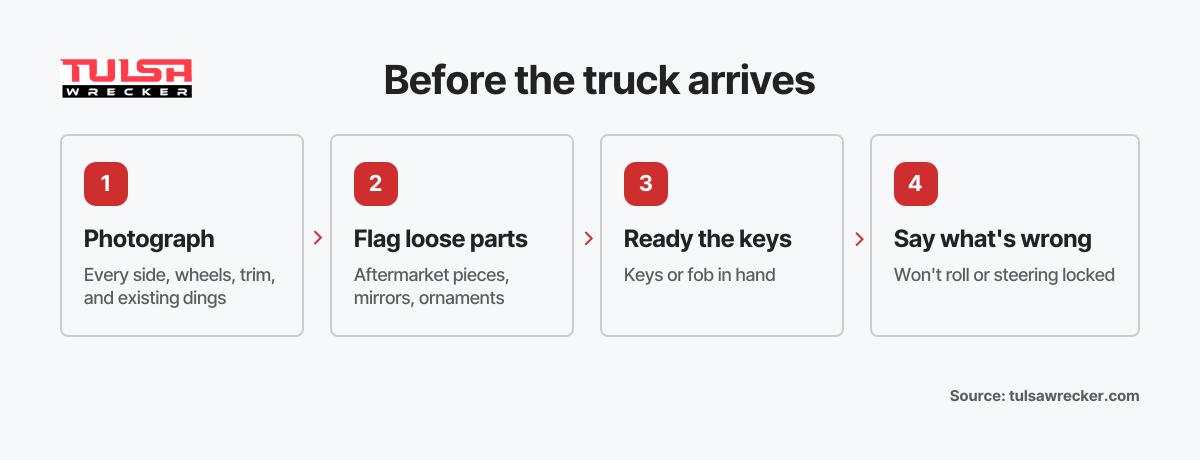
A few minutes of prep protects you and the crew, because a record of how the car looked beforehand settles most questions later. Walk around the car and photograph every side, plus the roof, the wheels, and any trim you worry about. Note the dings and chips that are already there.
Then look for anything loose. Aftermarket spoilers, a hood ornament that wobbles, a mirror held on by habit, or a trunk lid that doesn’t latch well should all be mentioned to the driver on arrival. Pull out anything valuable from the car, too.
Have the keys or fob ready. If the car won’t roll, or the steering is locked, say so when you book, not when the truck is already parked in front of it.
Please don’t push a non-running classic off the road to get it out of the way. Pushing strains a car that may have no power assist, risks a locked wheel, and can put you in traffic. If you’re stuck on the roadside, we’ve put together what to do while you wait for the truck.
Where We Tow Classic and Antique Cars Around Tulsa
We cover Tulsa, South Tulsa, Jenks, Bixby, Broken Arrow, and Glenpool. That includes pickups out of Midtown garages, show parking lots, and driveways off the Broken Arrow Expressway, as well as moves from a South Tulsa home to a restorer’s shop in Jenks or Bixby.
If you’re looking for antique car transport in Tulsa, it works the same way. We load the car on a flatbed, strap it properly, and take it where it needs to go around the metro.
When you’re ready, call 539-292-3074 or book a tow truck online. Have the year, make, and model, the pickup spot, and whether the car runs. That’s all we need to plan the job, and there’s no rush to decide before you’ve asked what you want to ask.
Frequently asked questions
Can a classic car be towed with a hook or wheel-lift?
It’s not what we’d recommend. A hook or wheel-lift raises one end, so the other wheels roll on the pavement the whole way, which is hard on old tires and some automatic drivetrains. A flatbed avoids that by carrying the whole car on the deck.
What should I tell dispatch about a low classic car?
Mention any air dam, chin spoiler, thin lower valance, or long nose overhang, plus whether the car has been lowered. Also say what the pickup spot looks like, such as a steep driveway or curb cut. That lets the crew plan the loading angle before they arrive.
What if my classic won’t start or the steering is locked?
Tell us when you book. A non-running classic usually has no power steering or brake assist, so the crew winches it onto the deck slowly and in a straight line. Knowing about a locked column ahead of time helps them plan where the car sits on the bed.
Should I photograph my car before it’s loaded?
Yes. Take photos of every side, the roof, the wheels, and any trim you worry about, and note existing dings. That gives you and the driver the same record of the car’s condition.
Which areas do you cover for classic and antique car tows?
We serve Tulsa, South Tulsa, Jenks, Bixby, Broken Arrow, and Glenpool. Call 539-292-3074 or book online with the year, make, model, pickup spot, and whether the car runs.