Your car just stopped. Maybe it quit at a light on Memorial Drive, maybe the Broken Arrow Expressway took a tire, maybe a fender-bender left it unable to steer. Either way, you’re about to make one phone call, and that call decides who shows up.
Key takeaways
- A Tulsa caller reaches a national app, a dispatch center, or a local owner-operator, and which one answers decides who shows up and who is accountable.
- Before you book, confirm four things: the company name, a Tulsa callback number, whether a flatbed or a hook is coming, and whether the quote covers the hookup and the drive.
- A flatbed carries the whole vehicle off the pavement, so it’s the damage-free choice for most calls, especially lifted trucks, low cars, AWD vehicles, and EVs.
- Distance, vehicle type, the truck the job needs, and extra work like a winch-out set the bill, and the quote should come before the hookup.
- A useful first call gives an exact location, the year, make, and model, and whether the car rolls and steers, while you stay out of live traffic.
If you need to hire a tow truck driver in Tulsa, the short answer is a local owner-operator who names the truck, gives you the price before the hookup, and stands behind the work afterward. This guide covers private calls, the ones you place yourself for a breakdown, a flat, a dead battery, or a car that won’t move. Here’s how to sort the good call from the guess.
What you’re really hiring when you call a tow truck driver in Tulsa
You’re hiring three things at once: a truck, a person at the wheel, and someone who answers if the job goes sideways. Which kind of company picks up your call decides all three.
Most Tulsa callers end up with one of three options:
- A national towing app. You tap a button, a stranger gets the job from a queue, and the company you’re dealing with is a screen. Convenient, but nobody local owns the outcome. Here’s a closer look at a local tow truck versus a national towing app.
- A dispatch center. A call-taker sends whichever contractor is free. The truck may be good. You just won’t know whose it is until it pulls up.
- A local owner-operator. The person behind the business does the work and answers for it. You know whose name is on the door.
None of these is automatically wrong, and a good driver can turn up through any of them. But when something is dented, late, or priced differently than you were told, the chain of who to call gets shorter the closer you are to the owner.
When to hire a private tow truck driver instead of calling a friend
Hire a private tow truck driver any time the car can’t roll and steer safely on its own, because a friend with a strap and a pickup is built for a short pull in a parking lot, not for a highway shoulder. Everyone has a buddy who says he can handle it, and for a dead car in your own driveway he might.
The trouble starts with an all-wheel-drive car, a low bumper, a transmission that won’t shift, or an EV. A bad pull can cost more than the tow you tried to avoid. If you’re still weighing it, here’s a plain breakdown of whether a friend or a tow truck is the right call.
What owner-operator towing in Tulsa means when you call
Owner-operator towing means the person who built the business is also the person accountable for the work, so a problem goes to one place instead of bouncing between a call center and a contractor. It’s a simple idea that gets lost in a lot of marketing.
Who answers for the job
Tulsa Wrecker was founded by Remi Carrillo, a local owner-operator, and it’s powered by Neptune Towing. We’ve been towing around Tulsa since 2019, and the business is built on damage-free flatbed work, careful handling, and straight answers about price.
Think of it like a plumber who owns the shop versus one sent by a franchise hotline. Both can fix the leak. Only one has his own reputation riding on how your kitchen floor looks afterward.
An independent tow operator also has no incentive to rush you into a hookup before you understand the quote. That matters most when you’re stressed on the side of a road.
An owner-operator isn’t the right fit for everything, though. If your car is covered by a roadside plan that only pays a specific network, call that plan first and ask what it covers.
Local roads and the corridors you already drive
Local knowledge saves time, and you can hear it in the first minute of a call. Say “westbound I-44 near the Arkansas River” and a local driver can picture the shoulder, the exits, and where it’s safe to load.
Our daily work runs along the same corridors you drive: I-44 across town, the Broken Arrow Expressway between Tulsa and Broken Arrow, and Memorial Drive as it runs down through South Tulsa. Each has its own trouble spots, from tight shoulders to busy on-ramps. A driver who knows them picks the safest place to load before the truck even stops.
How to hire a local tow truck driver in Tulsa you can trust
A local tow driver you can trust gives you four things before you agree to anything: the company name, a Tulsa callback number, the type of truck, and what the quote includes. If a caller can’t get those in a two-minute conversation, keep dialing.
Questions to ask before you book
You don’t need a long list in a stressful moment. Ask four things, and listen to how easily they’re answered.
What’s the company’s name? A real business says it without hesitating. Can I have a Tulsa number to call back? That lets you reach the same people if the truck is running late. Which truck is coming, a flatbed or a hook? Then, does the quote cover both the hookup and the drive?
Answers should be short and specific. If you’ve got a few more minutes in a parking lot, the fuller list of questions to ask a tow company before you call is worth skimming.
Signs a quote needs a second look
Most red flags are quiet ones, and none of them requires you to assume the worst about anyone. They just mean you should pause and ask another question.
- No company name when they answer the phone.
- A vague total, like “it depends, we’ll see when we get there.”
- A quote they won’t state until after the truck is hooked up.
- Hook-and-chain offered for a car that really needs a flatbed.
Any one of these is enough to say, politely, that you’ll call somebody else. Calm and clear works fine.
Flatbed or hook: how to match the truck to your vehicle
For most calls, a flatbed is the damage-free choice, because it carries the whole vehicle up off the pavement. Nothing drags, nothing hangs from the bumper, and the wheels aren’t turning while the car moves down the road.
A hook-and-chain truck lifts one end and pulls the other on its own wheels. It has its place for some older cars and some short moves, but it’s a poor fit for lifted trucks, low-clearance cars, and all-wheel-drive vehicles. Lift a lowered sports coupe by its front and you can scrape the bumper. Tow an AWD car with two wheels rolling and you risk stressing the drivetrain.
A flatbed isn’t a cure-all, and it won’t fix a problem the car already had. It just keeps the tow from adding a new one. If your car needs a specific setup, flatbed versus hook towing goes deeper on matching the truck to the vehicle.
Tesla and other EV owners need a plan before the hookup
Tell the dispatcher it’s an EV in your first sentence, because the truck, the loading method, and the tie-down points all depend on it. Teslas and other EVs shouldn’t simply be dragged on their drive wheels, which is one more reason a flatbed is the usual answer.
Tesla and EV capable towing is a core part of what we do. Before the truck arrives, check your owner’s manual for the car’s tow or transport mode. Have the model and year ready. If the car won’t unlock or shift, say so on the call so the driver can plan the load. For a look at pricing, see what Tesla towing costs in Tulsa.
Where we tow: Tulsa, South Tulsa, Jenks, Bixby, Broken Arrow, and Glenpool
Our primary coverage is Tulsa, South Tulsa, Jenks, Bixby, Broken Arrow, and Glenpool, and we serve the surrounding areas as well. If you’re a bit outside that list, call and ask.
Here’s how the map breaks down in practice. In Tulsa proper, I-44 and Memorial Drive carry most of the breakdowns we see. South Tulsa, Jenks, and Bixby are connected by the same stretches you use for work and school runs. Broken Arrow calls often start on the Broken Arrow Expressway. Glenpool sits farther down US-75.
We don’t promise minute-level arrival times for any of these towns, because traffic, weather, and the job in front of us all move the number. What you get is an honest window when you call.
Honest pricing: what sets the bill and how you pay
The bill comes from the job, not from how upset you sound on the phone, and the quote should come before the hookup. A tow driver who can’t tell you what the number covers before the truck is hooked up isn’t ready to do the job yet.
What changes the final bill
Four things drive the price, and you can ask about each one:
- Distance. A short move across Jenks costs less than a tow from Broken Arrow to South Tulsa.
- Vehicle type. Larger or heavier vehicles, and EVs that need special handling, take more care and more equipment.
- The truck the job needs. Flatbed or hook, depending on what your vehicle can safely handle.
- Extra work. A winch-out from a ditch or a muddy lot adds time on top of the tow itself.
A quote is only as firm as the description you give. If the car turns out to be stuck deeper than you said, or the job changes on site, the number can change too, and a good driver tells you before doing anything extra.
We’re not going to hand you a dollar figure in an article, because the honest number depends on your exact situation. Call, describe the car, and ask. For payment, see cards, cash, and apps.
How Tulsa tow truck dispatch works, from your first call to the hookup
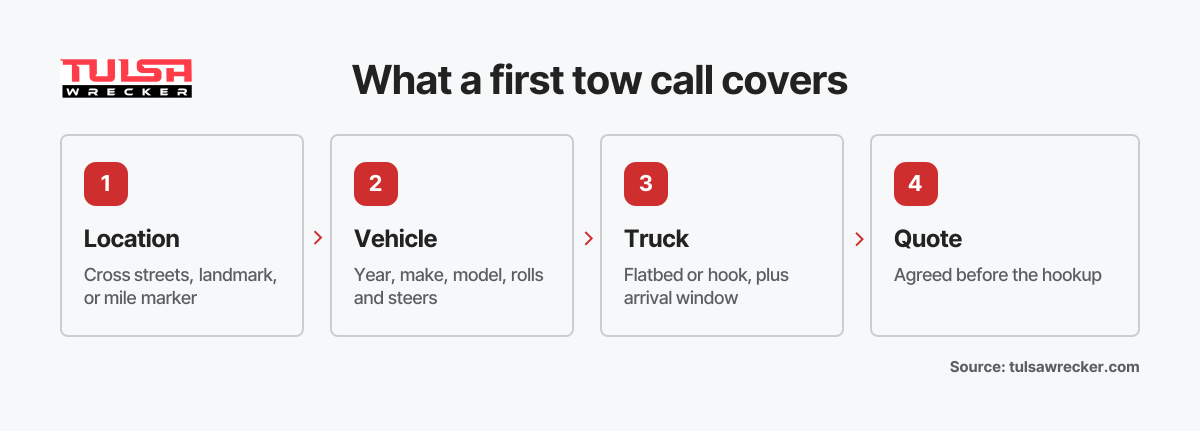
Tulsa tow truck dispatch is a short conversation in a set order: where you are, what you’re driving, whether it rolls, which truck is coming, and roughly when. The speed shows up in how few steps it takes, not in a countdown.
What to have ready when you call
Start with a precise location. Cross streets work, so does a landmark, and on a highway a mile marker is best. “Somewhere on 44” doesn’t help anyone, but “eastbound I-44, just past the Peoria exit” does.
Next, give the year, make, and model, and say whether the car rolls and steers. A car with a locked wheel needs different handling than one that just won’t start.
Then the dispatcher confirms which truck is coming, flatbed or hook, and gives you a rough arrival window. That’s also the moment to ask for the quote and the company name if they haven’t offered them.
Staying safe while you wait for the truck
Your first job is to get out of live traffic. If you can drive the car to a lot, a side street, or a wide shoulder, do it slowly with your hazard lights on.
If the shoulder isn’t safe, the answer changes. On a busy stretch of I-44 or the Broken Arrow Expressway, the usual choice is whether to wait inside or step out. When you’re stuck close to the lanes, stay buckled in with the hazards flashing. Only get out when you can stand well off the road, behind a barrier or far up the slope. There’s more in what to do while you wait for the truck.
We offer 24-hour emergency towing, so a dead car at 2 a.m. gets the same answer as one at noon.
When you’re ready, call 539-292-3074 or book a tow truck online in Tulsa, and we’ll take it from there.
Frequently asked questions
Can I get a price before the truck is hooked up?
Yes, and you should insist on it. A quote should cover the hookup and the drive, and it should come before the driver connects to your car. If the job changes on site, such as a winch-out, a good driver tells you before doing extra work.
Do I need a flatbed for my car?
For most calls, yes. A flatbed carries the whole vehicle off the pavement, which makes it the damage-free choice. It matters most for lifted trucks, low-clearance cars, all-wheel-drive vehicles, and EVs.
What should I tell the dispatcher if I drive a Tesla?
Say it’s an EV in your first sentence and give the model and year. Mention whether the car will unlock or shift. That lets the driver plan the truck and the loading method before arriving.
Which areas do you cover?
Primary coverage is Tulsa, South Tulsa, Jenks, Bixby, Broken Arrow, and Glenpool, and surrounding areas are served as well. If you’re a little outside those towns, call 539-292-3074 and ask.
Is it safer to wait inside my car or outside it?
Get out of live traffic first, using your hazard lights. If the shoulder isn’t safe, stay buckled in with the hazards on. Only step out when you can stand well off the lanes, such as behind a barrier.